The Battle of An Loc by James Wilbanks

Here is a review I wrote on the book “The Battle of An Loc” by James Wilbanks for the Military History Book Club. A must have book for anyone with an interest in Viet-Nam. This is a very good read. The Battle of An Loc was a major battle of the Vietnam War that lasted from April 13 to July 20, 1972. It culminated in a decisive victory for South Vietnam’s Army of the Republic of Vietnam (ARVN). The struggle for An Loc was one of the most important battles of the war. It saw the introduction of conventional warfare and tanks by the North Vietnamese Army (NVA). The ARVN forces halted the NVA advance towards Saigon. It delayed the war’s end by three years.

The author, James Wilbanks, was present and wounded at An Loc. This is not only his account, but gives insights from the North Vietnamese and US Advisor’s after action reports plus other communist documents. The role of the unending US air support, the bravery of the US air crews, and the orchestration by the Forward Air Controllers to the battle’s victory for the ARVN and US Advisor’s is covered in warranted great detail. The inability of the NVA to have armor and infantry work together in more conventional warfare is clearly brought to light and documented. Wilbanks gives insights into Richard Nixon’s Vietnamization’s perceived success by the politicians and its ultimate failures. This is a must have read and must have addition to the library for anyone with interest in the war in Viet-Nam.

Read and reviewed by Jimmie Aaron Kepler.

Dan O’Brien’s latest project: Mobsters, Monsters & Nazis

1

Well, the time has come to announce Dan O’Brien’s latest project: Mobsters, Monsters & Nazis: a collaboration between Dan O’Brien and Steve Ferchaud, who illustrated Conspirators of the Lost Sock Army and the Loose Change Collection Agency. What I am revealing today is the sketches for some of the interior illustrations (which will be black and white) of the first issue. It will be released as six issues (eBooks) starting on Halloween. It is influenced by film noir, pulp comics, and an abiding love of Lovecraft. It is now available for pre-order and Dan will be promoting it heavily starting in the month of October. He would love to hear what you think of it so far! Visit him at: http://thedanobrienproject.blogspot.com/ or on Twitter, @AuthorDanOBrien.


2 3
4 5
6 7
8 9
10 11
12 13

We Were Soldiers Once and Young by General Harold G. Moore and Joseph L. Galloway

There is a movie based on this book. I read the book first and was surprised when I saw the movie. They had left out the second battle. It was a battle that was just as bloody as the first, but without LTC Moore commanding. General Moore and Joseph Galloway have written a fine book. It should be must reading for every military officer and politician. I found this book to be consuming my attention. It was very hard to put down. The narrative of the training, deployment, battle, wives back at Fort Benning, battle, deaths and death notifications by cab drivers, and the stupidity of the leadership that lead to the second battles terrible losses.

We Were Soldiers Once and Young is terrific book! I was in junior high school when the battle of Ia-Drang took place. I remember it vividly. My dad had returned months earlier from his first duty in Viet-Nam. I was living in a military family. I watched soldiers march to and from training daily from my school’s playground. I can still vividly recall the CBS evening news story with Walter Cronkite discussing the impact of all the deaths on Fort Benning and Columbus, Georgia. I wish I had read this before I served as a US Army Infantry platoon leader. Buy it, read it, and keep it in your library.

Read and reviewed by Jimmie Aaron Kepler.

How the North Won: A Military History of the Civil War by Herman Hattaway and Archer Jones

How the North Won: A Military History of the Civil War by Herman Hattaway and Archer Jones is a scholarly look at the Civil War. Hattaway and Jones have produced a great book on Civil War logistics, planning, and administration. They authors seem to focus more on the logistics and strategy side over the tactical side.

The book was very good, but at times, it was a dry recitation of chronology, dull facts, and statistics. I had to force my way to complete the book, and it took two attempts to get it read. Most copies of the book will collect dust on some university library bookshelf. It is too deep and too dry for most readers. Better to borrow this book from your library than spend your money purchasing the book.

Read by Jimmie Aaron Kepler.

A Soldier Reports by William Westmoreland

The book is the memoir of one of America’s most controversial military leaders. I found it refreshing to read of his background and upbringing. He briefly covers his days as a cadet at West Point where he graduated in 1936, the horse dawn artillery days, and his role in World War II where he fought with distinction in North Africa and Europe with the Ninth Division. We see his fast rise to a Brigadier General before thirty years of age and later (1952–53) in role in the Korean War. He served as superintendent of West Point (1960–64), attained (1964) the rank of general and commanded (1964–68) U.S. military forces in Vietnam. He then assumed the position of army chief of staff, which he held until his retirement in 1972.
I was saddened as I read Westmoreland’s comments on one of the early killed in action lists that crossed his desk. It included 2LT John J. Pershing III, grandson of World War I supreme commanding general “Blackjack” Pershing. The book looks at the Viet-Nam war from Westmoreland’s point of view. It explains his decision making process. It is more than an after action report. It is worth reading if you are a political or military history junkie. His relationship with Lyndon Johnson and Robert McNamara are not covered in the detail I would have liked. This is the story of a decent man, giving his best to his country in difficult times.
Read and reviewed by Jimmie Aaron Kepler.

A Life in a Year: The American Infantryman in Vietnam, 1965-1972 by James R. Ebert

Includes spoilers:

Wisconsin high school teacher James R. Ebert does a masterful job as he combines interviews and printed primary sources in this remarkable telling of the infantryman’s experience during the Vietnam War. Ebert tells the story of the US Army and a few US Marine infantrymen during the Vietnam War. He takes their story from induction into the service through basic and advanced individual training, arrival in Vietnam, their first combat experiences, the first killed in action they experience, in some cases the soldier’s death, and the freedom birds that take them back to the world. Ebert points out while infantryman accounted for less than 10% of the American troops in Vietnam, the infantry suffered more than 80% of the losses.

Ebert uses an interesting technique starting every chapter with a letter by Leonard Dutcher to his parents. Dutcher just wanted to do his part for God and country and go home at the end of his 12-month tour (13 for Marines). Spoiler alert! In the last chapter, we find out that Dutcher was killed. It caught me off guard and really added to the impact of the book. Ebert takes many of the soldiers and Marines experiences word for word from the individual himself through interviews or letters. It is a collective look at similarities of the many infantry soldiers and Marines in the war. It is a very personal account from many points of view.

This is an important book in Vietnam War literature. This is what the grunts really went through. I was left with somewhat of feeling of guilt from reading the book. Why? I graduated high school in 1971. Some of my high classmates went to Vietnam and fought. Everett Maxwell was killed in action. I went to college and was ultimately commissioned a second lieutenant in the infantry, went through airborne school and served three years active duty. My becoming an officer deferred my entry on active duty from 1971 to 1975. This is the reason for my reflective thoughts.

Read and reviewed by Jimmie Aaron Kepler

Twice Armed: An American Soldier’s Battle For Hearts & Minds In Iraq by Lt. Col. R. Alan King

While serving as a senior civil-military adviser in Baghdad, U.S. Army Lt. Col. R. Alan King disarmed several potentially dangerous situations with a weapon few members of the Coalition Provisional Authority possessed: quotations from the Qur’ran.

Twice Armed: An American Soldier’s Battle for Hearts and Minds in Iraq begins as the first American forces in Iraq in April 2003. King’s civil affairs unit acted as liaison between the military, civil authorities, and the local population. It was a job with extraordinary challenges – in the early days of the occupation, various Iraqi exiles returned to Baghdad to declare themselves mayor or sheriff, and tempers flared during the endless summer power outages. But King found success through bringing faith to the battlefield. He estimates that he met with over 3,000 sheiks, praying with them and asking for their help to rebuild Iraq. And those relationships earned him a reputation for fairness and respect for Islam that led several people on the “most-wanted” list to seek him out and surrender to him personally; he even met with Muhammad Saeed al-Sahaf, a.k.a. “Baghdad Bob”, the former Iraqi Minister of Information.

But King also writes with pain at the memory of close friends who were killed in combat, both from his battalion and the Iraqis who worked with them, and he reflects with frustration on dealings with military bureaucracy and critical blunders that cost him some of that hard-earned trust.

R. Alan King was awarded two Bronze Stars for Valor, two Bronze Stars for achievement, and the Combat Action Badge. He is now an active reserve member of the U.S. Army, and returned from his most recent service in Iraq in October 2007. He has appeared on NBC, CNN, Fox News, and other networks as a military commentator.

Twice Armed won the 2008 Colby Award, which recognizes a first work of fiction or non-fiction that has made a significant contribution to the public’s understanding of intelligence operations, military history or international affairs. Named for the late Ambassador and former CIA Director William E. Colby, the Colby Award has been presented annually by the William E. Colby Military Writers’ Symposium at Norwich University, the nation’s oldest private military college, since 1999.

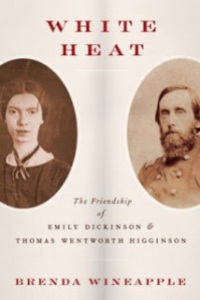
Book Review – White Heat: The Friendship of Emily Dickinson and Thomas Wentworth Higginson

White HeatHe had seen men enslaved, and seen death in battle on a terrible scale. So when a young, unknown poet named Emily Dickinson wrote to ask whether he thought her verse was “alive”, Thomas Wentworth Higginson – a critic for The Atlantic Monthly and a decorated Union veteran – knew he was seeing poetry that lived and breathed like nothing he had seen before.

Higginson was immediately awed by Emily Dickinson, and went on to become her editor, mentor, and one of the reclusive poet’s closest confidantes. The two met only twice, but exchanged hundreds of deeply personal letters over the next twenty-five years; they commented on each other’s work, mulled over writers they admired, and dazzled each other with nimble turns of phrase. After she died, he shepherded the first collected edition of her poetry into publication, and was a tireless champion of her work in his influential Recent Poems column for The Nation.

Later generations of literary scholars have dismissed Higginson as a dull, ordinary mind, blaming him for the decision to strip some of the distinctive, unusual structure from Dickinson’s poems for publication. However, Brenda Wineapple offers a portrait of Higginson that is far beyond ordinary. He was a widely respected writer, a fervent abolitionist, and a secret accomplice to John Brown’s raid on Harpers Ferry; wounded in the first year of the Civil War, he returned to service as colonel of the first federally-authorized regiment of former slaves. White Heat reveals a rich, remarkable friendship between the citizen soldier and the poet, a correspondence from which Dickinson drew tremendous passion and inspiration – and which she credited, more than once, with saving her life.

Brenda Wineapple is the author and editor of five books, including the award-winning Hawthorne: A Life and Sister Brother: Gertrude and Leo Stein. Her essays, articles, and reviews have appeared in The American Scholar, The New York Times Book Review, Parnassus, Poetry, and The Nation. She teaches in the MFA programs at Columbia University and The New School in New York.

On Their Own: Women Journalists and the American Experience in Vietnam by Joyce Hoffmann

For female reporters who wanted to cover the long, brutal war in Vietnam, the challenge began before they even left home, when – in the words of one former Saigon bureau chief – they had to “fight like hell to get the assignment.”

On Their Own: Women Journalists and the American Experience in Vietnam focuses on a few of the approximately 70 women who worked as journalists during the Vietnam War, spanning from its earliest days as a “not-so-secret war” in the late 1950s to the fall of Saigon nearly two decades later. Each traveled a different path to get the assignment, and each arrived at different conclusions about what they saw. Dickey Chapelle, a grizzled anti-Communist hawk, lived at the front lines with the Marines for more than four years; she would become the first American woman to be killed while covering a war. Gloria Emerson, on the other hand, the first woman to report from Vietnam in 1956, would later earn some of President Nixon’s angriest epithets on the White House tapes for her award-winning work about the war’s effect on South Vietnamese civilians. And for Laura Palmer, among the last reporters to leave Saigon in 1975, the faces below her departing helicopter were “sacred, because it was beyond words; you stand in the mystery, you stand with humility, and you stand with awe.”

Researched and written over the course of ten years, On Their Own is the story of a fundamental shift in journalism, the point at which the “boy’s club” of war reporting in World War II and Korea gave way to the modern press corps of Iraq and Afghanistan, and a more vivid perspective on the causes and casualties of war. At the outset, they had to fight for the assignment; after they got it, the women profiled in On Their Own produced work that led one critic to suggest, in 1986, that Vietnam had been the first war recorded better by women than by men.

Joyce Hoffmann has written for the Washington Post, Chicago Tribune, the Philadelphia Inquirer, and several other publications over the course of her twenty-five year career. She is currently a professor of journalism at Old Dominion University and public editor of the Virginian-Pilot.

http://www.pritzkermilitarylibrary.org/events/2008-10-30-joyce-hoffmann.jsp

General Albert C. Wedemeyer: America’s Unsung Strategist in World War II by John McLaughlin

General Albert C. Wedemeyer: America’s Unsung Strategist in World War II by John McLaughlin. Be there no doubt, the author is a fan of General Albert C. Wedemeyer. The book is a statement of admiration for the general. This is not bad. I am very knowledgeable in military history as a historian by education and a former US Army officer. This book made me aware of a large gap in my knowledge. Yes, I had heard of General Wedemeyer. I was aware of his leadership in China. No, I had no idea he was the architect and strategist of the “Victory Program” which conceived the plans for US mobilization and included the D-Day invasion.

In the late 1930s he was an exchange student at the German Kriegsakademia, the Nazis’ equivalent of Fort Leavenworth’s Command and General Staff School. Because of this,he recognized the revolutionary tactics of Blitzkrieg once they were unleashed, and he knew how to respond.

The book is researched with the skill of a scholar and told in a straight forward way that is very engaging. We learn of a man who held key roles of strategizing on both the European and Asian fronts.

General Wedemeyer was an amazing intellect, one of the brightest minds the US has ever had. Dr. John McLaughlin did a great job of giving us the facts, telling the story, and leaving a tribute to General Albert C. Wedemeyer who was America’s Unsung Strategist in World War II. The book is very good. It has lessons for military leaders, politicians, and strategic strategist.