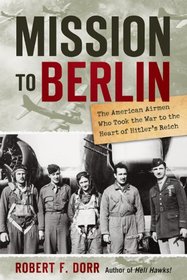
Mission to Berlin: The American Airmen Who Struck the Heart of Hitler’s Reich

Robert F. Dorr’s “Mission to Berlin” documents the mission that took place on February 3, 1945 to bomb Berlin, the capital of Nazi Germany.  The author does a very skilful job of telling the stories of the men who flew on it. He shares the incredible story of American fearlessness in the last months of World War II. The size of the air battle challenges our belief as in excess of 1,000 bombers and multiple-hundreds of fighter aircraft originating from Allied bases journey to the heart of Nazi Germany. You also get a good overview and understanding of the structure and operations of the United States Eighth Air Force.

Author Robert F. Dorr gives a detailed report of its evolution. He takes us from the pre-takeoff preparation and activities to the concluding landing.  The book is well paced. The basic structure of the book is spellbinding narrative. The storyline presents a mesmerizing description of many of the aviators on this historic mission. His use of primary source references such as first person interviews and personal letters adds warmth and the human touch to the narrative.

I found the way Mr. Dorr combines his interviews and letters with the detailed duties of each member of the crew a great way to explain the duties and procedures of the B-17 crew. The way he tells the story you feel as if you are there from take off to landing seeing the point of view of each member of the crew. He does an amazing job of drawing the reader into the life of the crew. This alone is reason to read the book.

Another reason to read the book includes the good picture of how the war affected the young crews, the technical side of the B-17 and its development and deployment as well as the evolution of fighting strategies. It was fascinating to see the change in philosophy as to the use of the fighters and to see how the Thunderbolts and especially the P-51s made a great difference in the  survival rates of the B-17s once they were able to escort all the way to Berlin.

I enjoyed the appendix that explained “What Happened to Them?” It told us of what key personalities mentioned in the book did after the war. It was a pleasant addition to the book.

This is an outstanding book.  Every World War II buff as well as aviation enthusiast will want it in their library. This is the second book I have read written by Robert F. Dorr. The first was “Hell Hawks!” which I also strongly recommend.  Zenith Press is the publisher.

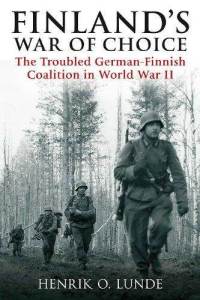
Finland’s War Of Choice: The Troubled German-Finnish Coalition in World War II

“Finland’s War Of Choice: The Troubled German-Finnish Coalition in World War II” by Henrik O. Lunde  tells the little know story of the strange partnership and joint military operations of Finland and Germany between 1941 and 1945. The coalition of these two is rarely included in English books. This is not the more well know “Winter War” of 1940 between the Soviet Union and Finland, but rather the story that has not brought pleasure to that Finns. It was a political decision and union the Finns would rather forget.

Henrik O. Lunde is an excellent writer. He gives us the necessary background of Finland’s history. He gives a necessary overview covering the country’s severance from the Soviet Union in 1917. He explains Finland’s seclusion after the Winter War in 1940. Finally he explains the decision-making process and unbelievable lack of planning and coördination used by both the Germans and Finns in forming this unlikely coalition against the Soviet Union.

We see how bizarre it was for that the German Generals allowed their military machine to accept an unsteady and rickety alliance. We see how the normal planning processes just did not happen. We see the failure to plan their goals and aims. We see inadequate command and control as well as no overall coördinated plan. We find the normally professional German General Staff not following normal rules and protocol at every turn. We see how Leningrad jaded both the Germ and Finn’s planning and strategy.

We see how the Finns quickly fell into “Goose-Step” with the Germans as the willing followed their leadership without question. We learn that their best trained and most powerful army made almost no major contribution because of its misuse in central and northern Finland. German lack the troop strength in this harsh climate theater to achieve success without the Finns. The Finns were unwell in provide the necessary assistance.

The book concludes with the Finns battling the USSRs counterattack in 19944. We see how Finland lost all military gains. To the German’s dismay the Finns engaged in a separate peace agreement with the Soviets. This resolution gave the German’s no option due to their troop strength levels except to fight their way from the region. The casualties for this theater of operation were a staggering 1,000,000 plus.  Compared to the Soviet losses of over 800,000 the Finland/German total of just fewer than 300,000 were meager.

Former US Army Colonel Henrik Lunde has produced a well written, well researched book. It should be part of any World War II students library and is must reading for any student of 20th century European history. It is well done.

Hitler’s Master of the Dark Arts: Himmler’s Black Knights and the Occult Origins of the SS

Mr. Yenne takes a well-known subject, the SS, and examines it through an unusual point of view. Instead of just looking at the organizational structure and providing a time line of it’s history he digs into the historical background it through the scope of paganism showing the background and origins of Nazi racial philosophy and how these philosophies became the motivating force of the SS .

Mr. Yenne explores the roots of Himmler’s racial philosophies as he developed the SS in the book’s first half. The activities of the SS during World War II and the occupation of Europe by the Nazis files the book’s second half.

The reading was enjoyably, those sometimes it was repetitive. An example is Heinrich Himmler believing himself the reincarnation of Heinrich I, the first king of Germany. Mr. Yenne dwelt too long on this subject. Stating it once would have been enough.

Mr. Yenne’ research of the subject shows. The book is full of interesting sidebars and visuals. The quality of the book, presentation, and photographs are spectacular. Once again Zenith press shows why they are at the top of the list of publishers of military history books.

“Hitler’s Master of the Dark Arts” communicates the philosophies of Himmler. It drives home the point he was the man who coordinated the Holocaust. His SS carried it out.

Mr. Yenne successfully tackled the subject from a controversial point of view. He made his point. Any serious student of World War II and the SS will benefit from reading the book. The book helps in gaining a better understanding of the SS and Himmler.

Skorzeny’s Special Missions: The Memoirs of Hitler’s Most Daring Commando

“Skorzeny’s Special Missions: The Memoirs of Hitler’s Most Daring Commando” by Otto Skorzeny.  Zenith Press has produced an excellent new edition of the book.

Prior to reading the book I did not know of Otto Skorzeny. He isn’t a well-known World War II German soldier. From a little research I found his memoirs had been originally written in German. At first, the book didn’t grab my attention. Maybe this was because I had never thought of viewing World War II from the point of view of a German commando.

As I read the book I found Otto Skorzeny does something few do. He lets us into his mind. It helped me understand his point of view. The book is action paced. It experience commando action as if you were there. The more I read the more I came to realize this book is one of the must read, must have books of World War II. I would call the book historical literature and a required study for all World War II buffs.

The telling of the story of the rescue of Mussolini is worth the purchase price alone. You learn that Skorzeny was selected for the mission because Hitler was aware the shared an Austrian heritage. The story of how the German intelligence learned of Mussolini’s location is amazing. You experience the planning and execution of the mission. You experience the concept of the operation down to Skorzeny deployed his unit.

After the Mussolini mission you journey with Skorzeny to France to put down a possible coup whose mission is the overthrow of the Germany loyal Vichy government.  The threat failed to materialize.

Skorzeny became involved in research and development of tactics and the weapons needed for commando operational support. You travel with him to the Russian front were he began commando operations. You next find him back on the western front. Here he used one of the most controversial attacks deployed during the war. He used English-speaking German soldiers to work behind American lines during the Battle of the Bulge. The detail of the plan is shared including its development, organization, equipping, implementation, and what caused the plan be found out and it failure.

It is always interesting to look at military events from a different point of view. Here you get the best insights into German commando operations. It is amazing. It is worth the purchase price and should be part of your library.

After reading the book, I believe no military education of World War II is complete with having read this classic work.

Review: War in the Pacific Skies

“War in the Pacific Skies” is an excellent work on the war in the Pacific during World War II. The book is a wonderful intermingling of story, photography, and art.

The authors tell the story in words and pictures. The pictures and paintings take a part of the story bringing it to life. This is a well-written and beautifully illustrated book. It provides a matchless look into the Pacific Air War during World War II. You cover all the major battles/campaigns. The reader gets an excellent overview of the air war in World War II in the Pacific Theater.

Charlie Cooper (Author), Ann Cooper (Author), and Jack Fellows (Illustrator) have created a masterpiece. The book would make an excellent addition to any aviation buff or military historian’s library. It would make a wonderful addition to school or community libraries.

The Pacific War: The Strategy, Politics, and Players That Won the War

“The Pacific War: The Strategy, Politics, and Player That Won the War” is the best book I have read on the Pacific War Theater of World War Two. The book presents the decision-making processes, strategies, and at times politics that guided the Allied Forces to victory. You are there decision by decision and campaign.

This is both an extremely readable book filled with recent scholarly research. It is as entertaining as a novel. The prose is amazing. I cannot over emphasize how well written the book is. It has an amazing freshness readers will enjoy and is a book you will read from cover to cover. The book covers all the familiar episodes as well as censored or little known events that played a major role in ultimate victory.

The book begins with the first few chapters setting the background. The chapters that follow tell the story chronologically. The chapters are so well written they could stand as independent historical journal articles. They cover the various campaigns.

You receive insights into all aspects of the war. You learn about the big picture items like Plan Orange (a series of United States Joint Army and Navy Board war plans for dealing with a possible war with Japan during the years between the First and Second World Wars) and it’s implementation.

You learn of the economic mobilization of the USA. You learn of the size of the role of Australia’s involvement in the defeat of Japan as well as the size of General MacArthur’s ego. You learn of the role of breaking code and how it was critical to victories in the Coral Sea and Midway.

The battle between the Army and Navy over command and control amazed me. The infighting between services was childish. It shows the need for strong command and control – I think of the removal of an Army general by a USMC general which from the facts given was justified, but caused interservice strife. You learn how 1944 presidential candidate Thomas Dewey was made aware of the role of the code breaking by General Marshall to keep him from causing grave injury to the war effort.

The role of the submarines is given due credit. The problems with the torpedoes at the war’s beginning and their resolution show bureaucratic failures and American ingenuity. The decisions to keep US Army Divisions out of Burma and China as well as the struggles between Generalissimo and Madame Chiang Kai Shek and Lieutenant General Joseph W. Stilwell, Commanding General, China Expeditionary Forces. You learn the details of the Battle of Leyte Gulf and Philippines as well as realize General MacArthur’s personal obsession with the Philippines.

I highly recommend the book. It should be required reading for every Army, Navy, and USMC officer. It should be included in every military and university library as well. This is a very import addition too the history of the Pacific War in World War Two.

Company Commander: The Classic Infantry Memoir of World War II by Charles B. MacDonald

Company Commander: The Classic Infantry Memoir of World War II by Charles B. MacDonald. I highly recommend Company Commander: The Classic Infantry Memoir of World War II by Charles B. MacDonald. At just 21 years of age, Captain Charles B. MacDonald first commanded I Company, 3 Battalion 23rd Infantry, 2nd Infantry Division from October 1944 to January 1945 and later G Company, 2 Battalion 23rd Infantry, 2nd Infantry Division from March to May 1945. This memoir was written in 1947 when recollections were still sharp. It resulted in a very detailed account of what it was like to take command of a line infantry company and lead it into battle. The book gives us template for writing a personal military memoir.

It is by far the finest memoir of any junior officer in World War II. Charles MacDonald does a great job of keeping his focus on his own experiences. He does not speculate or waste my time by giving conjecture on the big picture. We only have first hand information from the events of his personal participation. He sticks to what life was like for a junior officer in command of an infantry company, sleepless, hungry, dirty, stressful, and very dangerous. He takes us from the Siegfried Line in the Ardennes, through the Battle of the Bulge, and to the end of the war in the Czechoslovakia.

This book is a must-read for all army officers who seek to command at company-level and it is informative for military historians as well. It is still required reading at West Point and on the company level officer (second lieutenant, first lieutenant, and captain) recommended reading list by the U.S. Army today. Upon this book’s publication in 1947, Charles B. MacDonald was invited to join the U.S. Army Center of Military History as a civilian historian, the start of a career during which he wrote three of the official histories of World War II in Europe and supervised the preparation of others. The book is simply the best. Read and reviewed by Jimmie A. Kepler in June 2006.

Eight Stars to Victory: A History of the Veteran U.S. Ninth Infantry Division by Joseph B. Mittelman

Eight Stars to Victory: A History of the Veteran U.S. Ninth Infantry Division by Joseph B. Mittelman was written for and published by the Ninth Division Association in 1948. The book tells of how eight battle stars were won. It covers from the shores of North Africa, in 1942, to the banks of the Elbe, in 1945. Over 50,000 men served in the Ninth Infantry Division during World War II. The division had nearly 25,000 casualties including 4,747 killed in action. The copy of the book I read was found through the Dallas Public Library.

The book is 408 pages and begins by telling the story of the activation of the division and its participation in World War I.

Next the author goes into extensive detail about the division’s reactivation in 1940 at Fort Bragg, North Carolina. Stories are shared of living in tents and not having enough hot water.

We learn how in late 1942 the Ninth Infantry Division was split between the Eastern and Western Task Forces and of the division’s role in the invasion of North Africa. Part of the Ninth Infantry Division made a beach landing in French Morocco. The other part of the division landed in Algeria.

The division’s role in the Sicilian campaign is examined next. We learn of their involvement in the fighting in the mountainous heart of the island along the central route toward Messina. After Messina was taken and Sicily fell, the Ninth Infantry Division remained on Sicily. It did not move to the Italian mainland. The division’s next destination was England.

The author then informs of the Ninth Division’s time in England. He tells of the city of London, English pubs, and Constable Lane. He shares about training and planning for the invasion. We learn that although the division had heavy amphibious experience they entered the continent on D-Day + 4 at Utah Beach. The Old Reliables were involved in the campaign on the Cotentin peninsula and the assault on Cherbourg. They fought in the battles in the hedgerows. In early August the division assisted in the final breakout by American forces. They were involved in halting of the Mortain counter-offensive. They entered Belgium on September 2nd. They were involved in battle of the Huertgen Forest.

Next the Ninth Division went on to the Battle of the Bulge. They held the northern shoulder of the front. They captured Roer dams. The Ninth Infantry Division was among the first across the Rhine River and instrumental in the capturing of the Remagen bridgehead. From here we move to the final stages of the war with the battle of the Ruhr pocket and the division plunging eastward to the banks of the Elbe as the German army crumbled.

The book concludes with the Ninth Division’s role as Occupation forces and the deactivation of the division at the beginning of 1947.

The book has numerous maps, photos, and coverage of each campaign that earned the division its eight battle stars. The book falls between a divisional souvenir and a hard hitting historical research. It is what it is. It will disappoint the serious scholar. Reviewed by Jimmie A. Kepler.

Victory Road by Robert C. Baldridge

Victory Road by Robert C. Baldridge is a great World War II memoir. It is the gripping story of a determined young soldier in an artillery battalion of the famous 9th Infantry Division of the U.S. First Army. The Ninth Division invaded Normandy in June 1944 and fought on through five battle campaigns to victory over Germany in May 1945 at the Elbe River.

Robert C. Baldridge accurately and compellingly describes a soldier’s experiences in Army basic training. He describes what is like being shipped overseas to England in December 1943 on the ocean liner Queen Mary. He gives a clear picture of further training in England. We learn the story of crossing the English Channel to Utah Beach in Normandy on D-Day + 4. We experience fighting the German forces for almost a year while living in the field during all four seasons. This book is available online from Merriam Press. Read and reviewed by Jimmie A. Kepler.

Nudge Blue: A Ninth Infantryman’s Memoir of World War II by Donald E. Lavender

Donald E. Lavender was a member of Company I, 39th Infantry Regiment, 9th Infantry Division, originally arriving as a replacement in early October 1944 in the Hürtgen Forest.

There are a lot of stories about the war. Some have been made into movies. If you are looking for sensationalism, you won’t find it here. If you have an interest in what war was like to a 20-year-old in the Infantry, Nudge Blue comes close to describing that experience.

The combat portion of this story was written directly from notes accumulated during the actual fighting. In the over 50 years since, facts about places and unit action have been verified to assure accuracy. It includes action in several places that are famous—the Hürtgen Forest, the Bulge, the Rhine River crossing at Remagen and contact with the Russians on the Elbe River.

Lavender’s experiences in combat make for fascinating, insightful reading, and an excellent companion to Bob Baldridge’s Victory Road, showing what it was like to be an infantryman in the 9th Division during World War II. Read and reviewed by Jimmie A. Kepler.