Fighting With the Filthy Thirteen: The World War II Story of Jack Womer – Ranger and Paratrooper by Jack Womer and Stephen C. Devito

Travel with Jack Womer from the steel mills of Dundalk, Maryland through his being drafted (which he resented) and assigned to the 29th Infantry Division to his deployment to England. Experience with him his selection to and the nearly yearlong training with the British commandos as a member of the 29th’s elite Provisional Ranger battalion. You will learn how he joined the 101st Airborne Division after the disbanding of 29th Ranger Battalion.

You will meet the group of demolitionist he joined in the 506th Parachute Infantry Regiment’s demolition platoon as they fight in Normandy, Holland, the Ardennes and Germany. The detail of the combat jump into Normandy gives you the sensation of being there as well as showing the confusion on the group. Wormer shares examples how his Ranger training helped him survive in combat. Unfortunately, he does not share the same level of detail in the campaigns following Normandy.

Co-author Stephen Devito did a great job of interviewing Wormer and putting his stories into a first person narrative. The book gives the feel of a veteran telling the actions of his youth.

Wormer shares how he and other soldiers had girlfriends when in England, but his heart yearned to return to the United States and his fiancée Theresa. A side note I enjoyed was the story of how he asked Theresa for a new picture and she refused. He told the story of his desire for a replacement picture. The press picked up the story. The Baltimore newspaper carried the story. We see his fiancée Theresa’s response/reactions.

The book’s title “The Filthy Thirteen” is the nick-name of the section in the 506th’s demolition platoon that Wormer was assigned. It operated/used special equipment like flame-throwers and explosives to attack and clear German positions. These men were infamous for hard living, tough fighting, and poor personal hygiene that earned them their name. The claim is made that The Filthy was an inspiration for the film the Dirty Dozen.

I recommend this well-written and interesting book.

Battered Bastards of Bastogne by George Koskimaki

George Koskimaki wrote three books on the 101st Airborne Division. They are 1) D-Day with the Screaming Eagles, 2) Hell’s Highway: Chronicle of the 101st Airborne Division in the Holland Campaign, September – November 1944, and 3) Battered Bastards of Bastogne. This is a review of book three, Battered Bastards of Bastogne. George Koskimaki offers unique insights, as he was 101st Airborne Division commanding general, General Maxwell Taylor’s radio operator.

Battered Bastards of Bastogne fleshes out in vivid detail the entire story of the Screaming Eagles’ valiant struggle. It gives us information not covered in the other books by interweaving the stories of 530 soldiers interviewed who were on the ground or in the air over Bastogne. They lived, made this history and much of it is told in their own words.

The story of the Battle of the Bulge is amazing. We learn how little time had passed from the Holland Campaign before the 101st is pulled from being their reserve role. We see ill-equipped they were in terms of weapons. We find out their equipment and uniforms had not been replenished after Market Garden/Holland Campaign. We hear the often-told story of the lack of winter weather gear. We see how stupid some were in tossing their limited cold weather gear like over shoes when the weather was a little less cold at the beginning of the battle. We see circumstances with General Taylor being called back to the USA for a staff conference, the shifting of key senior NCO’s due to enjoying their time off line too much, and how the division moved into combat via ground transportation for the first time.

I especially enjoyed the detail and interweaving of the soldiers stories. It is amazing to view moments on the battlefield through multiple points of view. Some readers may find the book hard or even tedious to get through because of the detail. I did not. I found it added to the story. As in the author’s two previous works on the 101st I find the personal accounts gave vitality to the story. It kept it flowing instead of reading like a military after action report. Once again, Mr. Koskimaki did a superb job of telling the history the 101st Airborne Division. I appreciated the way the book is both descriptive and detailed. It gives you a feel that you are there with the men. The author did an outstanding job in this area. This is must reading for any student of World War II history.

Hell’s Highway by George Koskimaki

George Koskimaki was 101st Airborne Division commanding general, General Maxwell Taylor’s radio operator. He wrote the three-book history of the 101st Airborne during World War Two. Hell’s Highway: Chronicle of the 101st Airborne Division in the Holland Campaign, September – November 1944 is the second book in the series.

I had previously read Cornelius Ryan’s “A Bridge to Far”, Stephen Ambrose’s “Band of Brothers” and “Citizen Soldiers”, Robert Kershaw’s “It Never Snows in September: The German View of Market-Garden and the Battle of Arnhem, September 1944”, Martin Middlebrooks’s “Arnhem 1944: The Airborne Battle” (focusing on the British specifically at the Arnhem sector), and James Gavin’s “On to Berlin”. All of the books gave good presentations and different points of view of Operation Market Garden. George Koskimaki’s book is based on interviews with more than six hundred paratroopers journals the soldiers intense personal accounts. It gives the vivid previously untold versions of the Screaming Eagles’ valiant struggle.

Hell’s Highway gives us something not covered in the other books. It tells of the Dutch people and members of the underground and their liberation after five years of oppression by the Nazis. It shares how they have never forgotten America’s airborne heroes and how the 101st endangered and even sacrificed their lives for the freedom of the Netherlands and Europe.

While some readers may find the book hard or even tedious to get through because of the detail, I did not. The personal accounts gave vitality to the story. It kept it flowing instead of reading like a military after action report. Mr. Koskimaki did a superb job of telling the history the 101st Airborne Division during Operation Market Garden.

The book is just right for beginners and experts of the 101st Airborne Division. The three books George Koskimaki wrote on the 101stAirborne Division are 1) D-Day with the Screaming Eagles, 2) Hell’s Highway: Chronicle of the 101st Airborne Division in the Holland Campaign, September – November 1944, and 3) Battered Bastards of Bastogne. I highly recommend the book.

My Father’s Secret War: A Memoir

My Father’s Secret War: A Memoir is the best book I’ve read in a long time. This is no surprise being written by Pulitzer-Prize winning journalist Lucinda Franks. It reads more like a novel, than a memoir.

The book is both an intellectual search for an understanding of her father’s secret past as a spy in World War II as well as a heart-wrenching story of the complexities of the author’s relationship with him. What makes this book so very compelling is the honesty and poetic telling of naked truths in a truly real family drama. Everything is here: burning hatred and welcome forgiveness, love’s disappointments, parent’s failings, alcoholism, psychological torture, adultery, rebellion, revelation and resolution.

We care deeply as the author so desperately searches to understand why her relationship with her father had changed from childhood adoration to hatred, because of his alcoholic withdrawal. This is a universal story of every daughter’s struggle to know and forgive her father as he ages and declines. This author’s telling is unbelievably poignant. A must read!

Source: http://www.keplersmilitaryhistorybookreviews.com/2008/06/my-fathers-secret-war-memoir-by-lucinda.html

The American Aircraft Factory in World War II

The American Aircraft Factory in World War II by Bill Yenne is truly magnificent. When I first had the book in my hand I thought “coffee table book”. After reading the book and looking at the pictures it is so much more. It is a wonderful tribute to the men and women who built the airplanes. It is an excellent history of the aircraft industry in the Unites States. The author gives a great background and understanding of the founders and companies like Boeing, North American, Curtiss, Consolidated, Douglas, Grumman, and Lockheed.

I learned of the Air Mail Act of 1934. The act required the separation of the airlines from manufactures. It caused some like William Edward Boeing to leave the industry. He gives great tribute to the gender shift in the work place and the ramping up of the industry for the war. He takes us through the construction of the facilities as well as the transition back to a peace time production.

The photographs in the book are amazing. I have never seen so many high quality photographs of this era in one collection. Without the pictures the book is a wonderful history of the aircraft industry. With the pictures it is transformed into a work of art.

I highly recommend the book for all aviation and World War II buffs. It would be an excellent addition to community and public school libraries as well. This is a masterpiece that will stand the test of time.

Sacrifice On the Steppe: The Italian Alpine Corps in the Stalingrad Campaign, 1942-1943

As a lifelong history buff, military history enthusiast, former US Army officer and holder of a BA degree in history, I find myself pleasantly surprised from time to  time when I encounter a book that fills a void in my historical education. “Sacrifice On The Steppe: The Italian Alpine Corps in the Stalingrad Campaign, 1942-1943” written by Hope Hamilton and published by Casemate is one such book. The idea for the book originated when the author listened to her uncles’ reflections of his participation in World War II.

When Hitler had Germany invade Russia in June 1941, Prime Minister of Italy Mussolini declared war on Russia. He quickly sent a hastily organized Italian Expeditionary force of 62,000 men to join the Russian campaign even though Adolf Hitler discouraged such a move. Italy was unprepared militarily. Mussolini’s motivation was to join Hitler in receiving the spoils following an imagined rapid Nazi victory against Russia.”

Hope Hamilton’s book draws on personal interviews, exhaustive research and the written accounts of Italians who participated in and survived Mussolini’s tragic decision of Italian involvement. Mussolini compounded his mistake by sending even more troops the following year. The author does a good job of showing the human side of the Italian involvement on the Russian front. This is not a scholarly work on the tactics and logistics of the Italian involvement. Rather, it is the story of the people who made the terrible trek from Italy to Russia to support their German ally. The German’s had little trust of and kept the Italians minimally informed and I believe misused the Alpine troops by not maximizing the troops mountain fighting ability by their placement along the Don River.

The author does a great job of telling the soldier’s story. Her writing style focuses on the individual accounts of the soldiers. She discusses how the Alpine Corps was caught up in the German campaign capture Stalingrad in the autumn of 1942. She takes us through the Soviet offensive that followed in late November. We experience the collapse of the entire Axis front and the Alpine Corps’ withdrawal to the Don. I could have used a more background about the Stalingrad Campaign. The book does not take a strategic view of the campaign. Little attention is given to the big picture. The story is told from the Italian point of view instead of looking at it from the Axis point of view.

The book includes good notes, is well indexed, and has a great bibliography. I enjoyed the book. If you are looking for an after action report of the Italian participation or a critical analysis of the campaign this is not the book for you. If you’re looking for a good overview and an understanding of what the Italian soldiers experienced then you’ll enjoy the book. I give it four stars. It is a must addition to any military historian’s library. It is a good first volume to fill a long void of an English language account of the Italian involvement on the eastern front.

Voices of the Bulge: Untold Stories from Veterans of the Battle of the Bulge by Michael Collins and Martin King

Oral histories are fashionable these days. When the oral history is tied to a battle or events that have been reported on repeatedly it is a challenge. “Voices of the Bulge: Untold Stories from Veterans of the Battle of the Bulge” by Michael Collins and Martin King is a book where the writers have used a dozen years’ worth of research and interviews with veterans along with historical accounts of the battle to tell the story through the eyes of the participants.

The book is a clear and direct account of the Battle of the Bulge. The authors give good coverage to the first ten days. As I read the book, I was at first taken aback by the redundancy of many of the soldier’s accounts. Their interpretations of the events were focused on the weather and retreating or being away from the front lines, either for rest and recuperation or on leave and then riding or marching to the recuse of their fellow Americans. So many of the G.I.’s included a mention of Bastogne that I wondered if this was coverage of the Battle of Bastogne. The personal recollections included are general experiences of the common G.I. There is token coverage at best of the German side of the story. If that’s what you want, it isn’t here.

The book has a number of issues I won’t address in detail.  One I will mention is when a veteran’s memory of events don’t match what actually happened (e.g. saying soldiers of the 3rd Parachute Division were dropped well behind US lines and then telling apocryphal tales) they needed to have a note saying the events recalled were incorrect and then tell what actually happened. There are a few sidebars included in the book. Unfortunately, they are somewhat redundant.

The book needs a bibliography. It needs a listing of secondary sources. It would be helpful to have both a listing of the interviews with the units of service for the individuals. Did they verify the individuals were actually in the unit at the time of the Battle of the Bulge?

The inclusion of the DVD is nice. I was disappointed at the brevity of the DVD. I was expecting more. Yes, Oral histories are fashionable these days. All in all, it could have been better.

Tiger Tank Manual: Panzerkampfwagen VI Tiger 1 Ausf.E (SdKfz 181) Model (Owner’s Workshop Manual)

“Tiger Tank Manual: Panzerkampfwagen VI Tiger 1 Ausf.E (SdKfz 181) Model (Owner’s Workshop Manual)” by David Fletcher, David Wiley and Mike Hayden and published by Zenith Press.  The Tank Museum in South Dorset in the United Kingdom (UK) was in a unique position to write a new chapter in the Tank story with its own discoveries on restoring and running Tiger 131, which is the centerpiece of the manual.

“Tiger Tank Manual” is unique as we follow the story of Tiger 131 from April 1943 in Tunisia in North Africa to its arrival in the UK in October 1943 to its renovation and refurbishing thanks to the national Lottery. It is a short work of only 164 pages. “Tiger Tank Manual” gives an amazing insight and inside look into purchasing, owning, and even operating one of the world’s most outstanding engineering feats and fighting vehicles.

The use of personal remembrances of what it was like to operate and command such a vehicle in wartime gives you a “you were there” feeling. he recollections of what it was like to be on the receiving end of the Tiger’s 88 mmm gun shared by Lieutenant Gundgin in the Foreword really helps set the book’s tone.

The pictures, illustrations, line drawings, statics are amazing. The “Tiger Tank Manual” gives the necessary background on the history and development of the tank. You get the story of Tiger 131 down including forensic and crime scene analysis of the battlefield damage to the tank to include the ammunition used against the tank!

You are given a specular cutaway drawing of the tank from the School of Tank Technology. Note: I am a former US Army Ordnance Corps officer whose military occupational specialty was maintenance. I supported the old US Army M60A2 tank. The detail in “Tiger Tank Manual” rivals any Technical Manual. I cannot over emphasize the quality and variety of the pictures. They left me with the felling I had crawled all over the vehicle as well as I examined every detail inside the tank. They are amazing.

You get a glimpse into the mind of the museum as to why they restored Tiger 131. Again, detail pictures as well as description guides you through the process. Such details as paint selection and viewpoints from volunteers working on the project make you feel part of the project.

The “Tiger tank Manual” includes a chapter on running the tank. The detail given to the start-up procedures and riving the tank makes me want to get in the driver’s seat and take it for a test drive.

The detail given to “The May back Engine” may appear to be overkill to some, but the tank enthusiast or automotive engineer will enjoy the examination of the engine and its auxiliaries. Everything from ventilation to the gearbox and transmission as well as the steering and drive shafts (final drive) is covered.

Having supported annual tank gunnery for several years had my curiosity peak in the chapter devoted to firepower. Excellent coverage is given to tank gunnery from the ammunition down to aiming and firing the gun.

The explanation of the deployment and tactics of the Tiger lets you have an understanding of the German’s strategy. The book concludes with a nice appendix of the surviving Tigers.

While the book may not be for everyone, any military enthusiast will enjoy the book. Any tanker or former tank crewmember will enjoy the book. I believe it would be a worthwhile addition to any military history library as well as any collection dealing with World War II. Additionally, automotive engineers will find the book simply amazing.

Read and reviewed by: Jimmie A. Kepler February 29, 2012. Note: Jimmie is honorably discharged as a Captain in the ordnance Corps US Army where he served as a maintenance office and supported a tank battalion (2nd Bn 77th Armor 2nd Brigade 9th Infantry Division) in 1978.

Bombs Away!: The World War II Bombing Campaigns over Europe

Zenith Press‘s “Bombs Away!: The World War II Bombing Campaigns over Europe” by John R. Bruning is a must have for all World War II and aviation buffs.  The book is large, coffee-table size volume. The book is full of amazing pictures.  The photographs give greater coverage of the people in the war than most books. The coverage is more about the aircraft crews and ground support personnel than the aircraft specs. You learn about the people who endured the bombardment as well.

“Bombs Away!” takes account of the fascinating human element. It also describes the types of aircraft used on both sides and used in every major bombing campaign in the European Theater.

The author discusses strategic bombing theories.  John R. Bruning provides a foundation by taking the reader through the different air campaigns in the Spanish Civil War, Blitzkrieg attacks on Poland, France and Britain before applying the majority of the book to the American and British assaults on the Third Reich.

Mr. Bruning gives the particulars on how each command determined on their own approach to bombing Germany (the US daylight vs. the UK night-time), the aircraft they employ, their particular achievements and disappointments. We learn of the eventual impact of the combined strategic bombing campaign.

The book’s manuscript provides a first-rate rundown of bombing campaigns in the European Theater. However, the book’s selling-point is the illustrations. While some of the pictures have been seen before and are familiar. The author collects them in one place. The volume contains nearly 480 black and white plus color photographs and maps. They describe both Allied and Axis aircraft, aircrew and the commanders. You experience in-flight air battles. You understand the damage to different targets.

Mr. Bruning covers the major campaigns, the plans, the planes, and the people. He does this with fine prose, wonderful quotes, and dazzling photographs that bring the story to life. The book is a must for both military and community libraries.

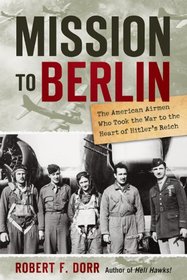
Mission to Berlin: The American Airmen Who Struck the Heart of Hitler’s Reich

Robert F. Dorr’s “Mission to Berlin” documents the mission that took place on February 3, 1945 to bomb Berlin, the capital of Nazi Germany.  The author does a very skilful job of telling the stories of the men who flew on it. He shares the incredible story of American fearlessness in the last months of World War II. The size of the air battle challenges our belief as in excess of 1,000 bombers and multiple-hundreds of fighter aircraft originating from Allied bases journey to the heart of Nazi Germany. You also get a good overview and understanding of the structure and operations of the United States Eighth Air Force.

Author Robert F. Dorr gives a detailed report of its evolution. He takes us from the pre-takeoff preparation and activities to the concluding landing.  The book is well paced. The basic structure of the book is spellbinding narrative. The storyline presents a mesmerizing description of many of the aviators on this historic mission. His use of primary source references such as first person interviews and personal letters adds warmth and the human touch to the narrative.

I found the way Mr. Dorr combines his interviews and letters with the detailed duties of each member of the crew a great way to explain the duties and procedures of the B-17 crew. The way he tells the story you feel as if you are there from take off to landing seeing the point of view of each member of the crew. He does an amazing job of drawing the reader into the life of the crew. This alone is reason to read the book.

Another reason to read the book includes the good picture of how the war affected the young crews, the technical side of the B-17 and its development and deployment as well as the evolution of fighting strategies. It was fascinating to see the change in philosophy as to the use of the fighters and to see how the Thunderbolts and especially the P-51s made a great difference in the  survival rates of the B-17s once they were able to escort all the way to Berlin.

I enjoyed the appendix that explained “What Happened to Them?” It told us of what key personalities mentioned in the book did after the war. It was a pleasant addition to the book.

This is an outstanding book.  Every World War II buff as well as aviation enthusiast will want it in their library. This is the second book I have read written by Robert F. Dorr. The first was “Hell Hawks!” which I also strongly recommend.  Zenith Press is the publisher.