Poem: Armistice Day

Armistice Day

On November eleven
As all of us knows
We signed an armistice
With all of our foes
And threw off our gas masks
We laid down our gun
And buried our hatchet
Along with the Hun

Now eight years have passed
Since that glorious day
When we signed that armistice
That ended the fray
And thousands of boys
Emerged from the strife
To come home a cripple
For the rest of his life

And thousands of others
Are over there still
Who never came home
And of course never will
They followed old glory
To a faraway shore
And to the loved ones at home
They returned never more

Althou’ we won glory
Across the big pond
We owe our respects
To our comrades that’s gone
And we’ll pause from our labor
Our tribute to pay
To our fallen companions
On Armistice Day

Written by Thomas Aaron Kepler in 1926
Copyright © Estate of Thomas Kepler
The poem was written by my grandfather, Thomas Aaron Kepler. It is one of several I have that he wrote and published.  He was a resident of Jamestown, Ohio. He passed away before I was born.  His poetry and writing are the only way I have had to know him.

101st Airborne: The Screaming Eagles at Normandy

“101st Airborne: The Screaming Eagles at Normandy” by Mark A. Bando is a well presented book. It has a nice blend of photography and prose. It is organized into ten chapters. They detail the training, preparation as well as the jump into Normandy of the 101st Airborne Division.

The 10.5 x 10.5 inches format allows for an excellent presentation of the photographs. The pictures cover the entire spectrum. Some are very familiar. Some are rare. Some are disturbing. The photograph on page 73 of a double row of dead German paratroopers is an example. There were so many dead in the photo than I could count them all!  I was surprised at the large amount of color pictures in the book. Amazing best describes the collection of photographs.

As good as the pictures were I especially enjoyed the story. The book chronicles the 101st in a way that blends a well-written narrative with first person testimonials of the veterans. Their recollections illustrate and explain the events of the chapter with a human touch.

Interestingly Bando includes one chapter on the 82nd Airborne Division and a chapter about the true story of the movie “Saving Private Ryan” titled “Saving Sergeant Niland”.  The book also contains a glossary of terms and an abbreviated index.

The book would be a great addition to the library of a military historian and is ideal for inclusion in a community or school library.

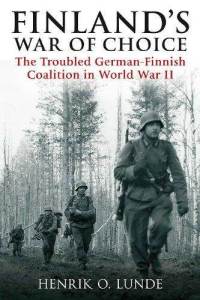
Finland’s War Of Choice: The Troubled German-Finnish Coalition in World War II

“Finland’s War Of Choice: The Troubled German-Finnish Coalition in World War II” by Henrik O. Lunde  tells the little know story of the strange partnership and joint military operations of Finland and Germany between 1941 and 1945. The coalition of these two is rarely included in English books. This is not the more well know “Winter War” of 1940 between the Soviet Union and Finland, but rather the story that has not brought pleasure to that Finns. It was a political decision and union the Finns would rather forget.

Henrik O. Lunde is an excellent writer. He gives us the necessary background of Finland’s history. He gives a necessary overview covering the country’s severance from the Soviet Union in 1917. He explains Finland’s seclusion after the Winter War in 1940. Finally he explains the decision-making process and unbelievable lack of planning and coördination used by both the Germans and Finns in forming this unlikely coalition against the Soviet Union.

We see how bizarre it was for that the German Generals allowed their military machine to accept an unsteady and rickety alliance. We see how the normal planning processes just did not happen. We see the failure to plan their goals and aims. We see inadequate command and control as well as no overall coördinated plan. We find the normally professional German General Staff not following normal rules and protocol at every turn. We see how Leningrad jaded both the Germ and Finn’s planning and strategy.

We see how the Finns quickly fell into “Goose-Step” with the Germans as the willing followed their leadership without question. We learn that their best trained and most powerful army made almost no major contribution because of its misuse in central and northern Finland. German lack the troop strength in this harsh climate theater to achieve success without the Finns. The Finns were unwell in provide the necessary assistance.

The book concludes with the Finns battling the USSRs counterattack in 19944. We see how Finland lost all military gains. To the German’s dismay the Finns engaged in a separate peace agreement with the Soviets. This resolution gave the German’s no option due to their troop strength levels except to fight their way from the region. The casualties for this theater of operation were a staggering 1,000,000 plus.  Compared to the Soviet losses of over 800,000 the Finland/German total of just fewer than 300,000 were meager.

Former US Army Colonel Henrik Lunde has produced a well written, well researched book. It should be part of any World War II students library and is must reading for any student of 20th century European history. It is well done.

Skorzeny’s Special Missions: The Memoirs of Hitler’s Most Daring Commando

“Skorzeny’s Special Missions: The Memoirs of Hitler’s Most Daring Commando” by Otto Skorzeny.  Zenith Press has produced an excellent new edition of the book.

Prior to reading the book I did not know of Otto Skorzeny. He isn’t a well-known World War II German soldier. From a little research I found his memoirs had been originally written in German. At first, the book didn’t grab my attention. Maybe this was because I had never thought of viewing World War II from the point of view of a German commando.

As I read the book I found Otto Skorzeny does something few do. He lets us into his mind. It helped me understand his point of view. The book is action paced. It experience commando action as if you were there. The more I read the more I came to realize this book is one of the must read, must have books of World War II. I would call the book historical literature and a required study for all World War II buffs.

The telling of the story of the rescue of Mussolini is worth the purchase price alone. You learn that Skorzeny was selected for the mission because Hitler was aware the shared an Austrian heritage. The story of how the German intelligence learned of Mussolini’s location is amazing. You experience the planning and execution of the mission. You experience the concept of the operation down to Skorzeny deployed his unit.

After the Mussolini mission you journey with Skorzeny to France to put down a possible coup whose mission is the overthrow of the Germany loyal Vichy government.  The threat failed to materialize.

Skorzeny became involved in research and development of tactics and the weapons needed for commando operational support. You travel with him to the Russian front were he began commando operations. You next find him back on the western front. Here he used one of the most controversial attacks deployed during the war. He used English-speaking German soldiers to work behind American lines during the Battle of the Bulge. The detail of the plan is shared including its development, organization, equipping, implementation, and what caused the plan be found out and it failure.

It is always interesting to look at military events from a different point of view. Here you get the best insights into German commando operations. It is amazing. It is worth the purchase price and should be part of your library.

After reading the book, I believe no military education of World War II is complete with having read this classic work.

Company Commander: The Classic Infantry Memoir of World War II by Charles B. MacDonald

Company Commander: The Classic Infantry Memoir of World War II by Charles B. MacDonald. I highly recommend Company Commander: The Classic Infantry Memoir of World War II by Charles B. MacDonald. At just 21 years of age, Captain Charles B. MacDonald first commanded I Company, 3 Battalion 23rd Infantry, 2nd Infantry Division from October 1944 to January 1945 and later G Company, 2 Battalion 23rd Infantry, 2nd Infantry Division from March to May 1945. This memoir was written in 1947 when recollections were still sharp. It resulted in a very detailed account of what it was like to take command of a line infantry company and lead it into battle. The book gives us template for writing a personal military memoir.

It is by far the finest memoir of any junior officer in World War II. Charles MacDonald does a great job of keeping his focus on his own experiences. He does not speculate or waste my time by giving conjecture on the big picture. We only have first hand information from the events of his personal participation. He sticks to what life was like for a junior officer in command of an infantry company, sleepless, hungry, dirty, stressful, and very dangerous. He takes us from the Siegfried Line in the Ardennes, through the Battle of the Bulge, and to the end of the war in the Czechoslovakia.

This book is a must-read for all army officers who seek to command at company-level and it is informative for military historians as well. It is still required reading at West Point and on the company level officer (second lieutenant, first lieutenant, and captain) recommended reading list by the U.S. Army today. Upon this book’s publication in 1947, Charles B. MacDonald was invited to join the U.S. Army Center of Military History as a civilian historian, the start of a career during which he wrote three of the official histories of World War II in Europe and supervised the preparation of others. The book is simply the best. Read and reviewed by Jimmie A. Kepler in June 2006.