One Great Way to Write a Book Review

About every five weeks I write a book review. Since December 2007, I have written 148 book reviews of military history books for my website Kepler’s Military History Book Reviews. Front Row Monthly noticed my love for reviewing books. Last year they published twelve of my reviews in their Front Row Lit Magazine.

I love reading, receiving review copies in the mail, having authors and publicists asking if I am interested in reading their book and interviewing the author.

In recent days, the newspapers and Internet have had negative articles about some reviews. Regarding any review I have written on Kepler’s Military History Book Reviews: I received no payment, the only compensation, was the book that was used to write the review and was sent by the publisher, author, publicists or media groups. Here is one great way to write a book review. It is my philosophy for writing a review.

Read the book. I know; it seems obvious but read the book! You might find out the author did a very good job.  She or she probably invested two to four years of their life in the book project, so read the book.  Don’t even think about writing a review of something you only skimmed or only partially read. Reading the book is critical to a good review.

Know what you are reading. If you don’t understand the book that you are going to write about, you cannot write a good review. If you are reading a nonfiction book on a topic you know little about, make some effort to learn something about the topic.  I write military history book reviews.  I have a formal background in history with a bachelor’s degree in the subject.  I am widely read in history with a general background in all areas of US and English History and am a serious student of US Military History.

Make notes about what you read. You may want to make note of key phrase or sentences as you meet them.  You can quote them in the review. As you read ask yourself:

  • Who is telling the story? Is it in first person or third person?
  • What genre does it belong to? Narrative history, historical fiction, memoir?
  • What about the style of writing? Is the author a good story-teller?  Is it serious scholarship with footnote after footnote? Is the style conversational or is it full of big words that need a dictionary at your side? Does it paint a word picture in your mind? When was it written? Was there a ghost writer or co-author?
  • Does the book touch your heart and mind?  Does it move you to an emotional or volitional climax about the topic being read?

Keep track of the storyline or chronology of the book.  It will help you when reading long, complicated works.

Know the author and his or her works. When you finished gathering the information and you have enough notes, then you are ready to write the article.

Start with an introduction. The way you start will depend on your target audience. Consider beginning with a paragraph that describes your first impression of the work, or an interesting story that you had experienced through the book, or a more technical introduction where you briefly state the author, title, publisher, and any other information about the book you see pertinently.  I like to ask a thought-provoking question.  An example is “Have you ever wondered what it would be like being a marine in Iraq?” It gets the reader thinking.a.  Give a brief history of the author with some relevant information such as earlier works, awards, etc.

  • Cover the structure of the book without giving away the plot or ending.
  • Explain your opinion of the book and give a summary of the review.
  • Finish by recommending the book. State who would benefit and enjoy the book, using general terms (students, veterans, etc.).
  • I like to tell the reader where and how they can get the book.

Include your full name in the end with the date of the review. On my book review site, I allow feedback. I have had a few authors contact and challenge me. I have had some authors point out grammar or spelling errors. An example of the most frequent comment are in the words of David Laskin of the University of Washington. He wrote, “The Long Way Home: An American Journey from Ellis Island to the Great War”. He thanked me for reading the book. He said from my review he had no doubt I had read the book.  By the way, the book was amazing.

I am a Military Brat

Pease Air Force Base at Portsmouth, New Hampshire. The picture was taken in the May 1966 from the balcony of the operations building. I was in the 7th grade. There is one KC-135 and six B-52s on the runway.
Pease Air Force Base at Portsmouth, New Hampshire. There is one KC-135 and six B-52s on the runway. The picture was taken in the May 1966 from the balcony of the operations building. I was in the 7th grade. I lived on Pease AFB from February 1966 to May 1967 and was in the 7th and 8th grades while we lived there.

What is a military brat? A military brat is the son or daughter of an airman, marine, sailor, or soldier. These children of career military have common characteristics. They grew up in a community of service. Sacrificing for the greater good is part of their character. They moved on average once every three years to a new state, region, or country.

Academic studies show military brats lack racism.1 They are the only color blind group in the USA. They are the most open-minded of any subgroup in the world. They are more tolerant and embrace diversity with respect for others better than their civilian counterparts to include those raised in liberal homes. They are equally respectful and tolerant of conservative, moderate and liberal points of view.2

They adapt to change and new situations better than any group in the United States. 2

They are socially independent. They do well in personal relationships. They put the needs of the other people ahead of their own needs.

Military brats who grew up as military dependents particularly in the late 1940s to early 1970s are kinder, caring, and more loyal than their raised as civilian children counterparts. They were higher achievers academically and professionally make the best employees due to characteristics like self-discipline, self-starter, flexibility, and their personal fiscal responsibility. 2

Most military brats do not have a real home town.2 Most do not know their cousins, aunts and uncles or grandparents very well. Many, including me, do not trust the governments of North Korea, Russia and China.

The word brat is not derogatory. It stands for:

B – Born

R – Raised

A – And

T – Trained1

I’m a military brat. My father served in the United States Army, United States Army Air Force and the United States Air Force (USAF). He retired from the USAF.

I am also a former United States Army officer. Growing up as a military brat helped prepare me for my service. It was all natural and comfortable to me. I felt it was where I belonged more than anyplace else in my life.

1 http://www.urbandictionary.com/define.php?term=military%20brat

2 http://en.wikipedia.org/wiki/Military_brat_(U.S._subculture)

My Writing Room

Jimmie A. Kepler here, greetings from the blast furnace called north Texas and the Dallas-Fort Worth area. The temperature reached 109 degrees on my front porch today. That’s hot!

This morning I went to Starbucks for my morning writing. I love the early morning right before the sun comes up. There is a peacefulness found there not found elsewhere. Starbucks is where I do about third of my writing. I do over half of my writing at home. I thought today I would show you   my modest home office. It is a combination bedroom/office. It is the bedroom where I sleep each night.

I’ve created a three-minute and fifty-one second video tour of my home office. I hope you have as much fun seeing the video as I had making it.

My home office, by Jimmie A. Kepler …

Exciting and Sad

Bewildering StoriesI live in the Dallas Fort Worth metropolitan area of north Texas. The area includes 12 counties, over 9,000 square miles (larger than the states of Rhode Island and Connecticut combined), with just fewer than 7,000,000 million people, it is the fourth largest metro area in the USA. Only the New York, Los Angeles, and Chicago metro areas are larger. It’s big!

The blast furnace has returned to north Texas. After a week of overnight lows in the lower 60s I awoke to 77 degrees at 5 AM. Ugh, that is hot. Heat is on the schedule the rest if the month. It is August, so we should have highs around 100 and low temperatures around 80.

The last week has been exciting and sad. Let us look at the sad first. Another of my high school classmates passed away. Her name was Deborah. She went in for routine surgery on August 13. There were complications. She died on August 15. She was a sweetie. She loved her children and grandchildren. Her funeral was Monday August 19.

On Sunday evening I found out my friend Christy (Judy) had passed away from pneumonia. I had only known her eight years. I met her through Yahoo 360 and then became friends through Multiply. She was only a couple of years older than me. When I worked in Los Angeles last summer she was a great help. She told me which places to see, visit (like the bookstores), and I even made my way out to Simi Valley.

The exciting is I had a short story come out this week in Bewildering Stories. While it has been over thirty years since I had my first writing sale, I still get excited seeing my by-line and reading my articles and stories. You can check it out by clicking HERE.

I write because I am a writer.

I am a WriterSometimes a man just has to do speak to himself, to run things through his mind, to think things out. He might reflect about things like should I consider changing jobs, ask her out (if he’s single and she’s single), consider starting  an exercise program or investing in continuing education. It helps if you have a friend or spouse that will let you talk it out, but if not, I guess this is about the next best thing.

The last few days I’ve been thinking about my passion of writing. I have been writing since I was in high school when Lyndon Baines Johnson was president of the United States. I had my first professional writing sale in 1981. I’ve been writing a long time. Even though I’ve never published a book I have published a short story, poetry, and dozens of non-fiction articles. I have dozens of paid writing credits. I am a writer. I even have a short story that will be in next Tuesday’s issue of Bewildering Stories.

I remind myself of the these credits where I don’t let an agent, editor, publisher, writing group or friend get me down. I am not the reason they are having a bad day, don’t need what I wrote, or don’t like what I am writing. They are not the reason my writing sucks, story isn’t interesting or good enough. Sometimes I need to man up, work harder, and not be so tough on myself. Only my mother will say she likes everything I write and she has to because she’s my mother.I have to remind myself that sometimes the timing is off, sometimes the market isn’t right, sometimes ….

I need to do what I always do when rejected … cry, scream, think how dumb they are … take a deep breath and get back to reality. Continue writing and continue submitting … just maybe the next one will need what I’m writing, won’t have a client they represent who has written something similar and just maybe my writing will continue getting better.

I write because I am a writer. Writing is what we do.

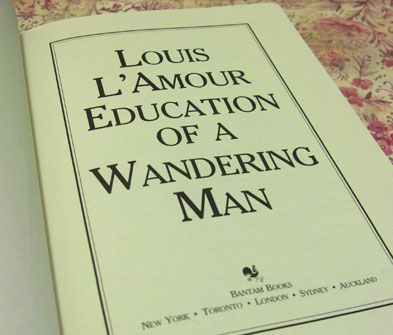
Education of a Wandering Man by Louis L’Amour

Education of a Wandering Man

This is about as close as an L’Amour fan will come to an autobiography. This is not a western novel, though it gives great insight into how he wrote and researched his books. The book starts with a reference to his high school class graduating while he was on a steamer in Indonesia.

L’Amour gives the reader a lengthy discussion of becoming self-educated through books, travel, and experience. I enjoyed the lengthy lists of books L’Amour read during his wandering years in the 30s.

I have logged what I read since reading the book in November 1990. It is a worthy discipline. I also started writing a short, generally no more than on page review of what I read after reading this book. It was the beginning of my writing a review or summary of each book I read.

L’Amour gives a breathtaking discussion of walking out of the Mojave Desert. It reminded me of my time at Fort Irwin, California (about 50 miles north of Barstow in the middle of similar land). L’Amour was a great researcher, and wrote from both personal experience and knowledge.

Disorganized, rambling, and repetitious, it is still an enjoyable book. Louis L’Amour emphasizes the value of education through experience and self-guided reading. He never degrades formal education. Required reading for any aspiring writer must include this book. Read by Jimmie A. Kepler.

If you have ever had a kitty or dog die, you understand.

Calico Kitty
Calico Kitty

Great big crocodile tears were streaming down my face. They wouldn’t stop flowing. My sobbing was so loud my sons, Kristopher and Jason, wondered if I would be all right. My wife Miss Benita’s comforting arms had never seen me this way before. She assumed one or both of my parents were dead from the magnitude of my grief. I was glad my daughter Sara was spending the night at her best friend Amelia’s house.

What had brought about this emotional upheaval in me? What would have me grieving with more intensity than when my grandparents or wife’s brother died?

A car squashed my cat Hallie. Specifically, it crushed her skull. Sadly, my two sons had witnessed the tragedy. They ran crying to get me to make it all better. I couldn’t make it better. While her little body was still warm, my kitty was dead.

Hallie was a beautiful, small Calico Cat. She had been born on Saint Patrick’s Day, March 17th. She died less than six months later on my wife’s birthday, September 14th.

Why make all the fuss about a cat? I loved my kitty. She loved me. It was a love that demanded nothing from me. A love that would rub up against my pants leg even after I accidentally stepped on her tail. A love that would sit nervously in my lap as we rode to the vet’s to get shots, “get fixed”, and the very day she died, to get stitches out from the above mentioned surgery.

She had a love for me that would wait for me to finish mowing the yard to get petted or have her tummy scratched. Hallie was one of the few that demanded nothing from me. She gave me her love and affection in return for hearing her name, a bowl of dry cat food, or an occasional saucer of milk. If you have ever had a kitty or dog die, you understand.

We can learn from a cat. We too, should love with no strings attached.

NOTE: At the time my kitty was run over I served as Associate Pastor and Day School Headmaster at First Baptist Church, Jasper, Texas. My sons were 13 years old, 10 years old and my daughter was two months shy of her sixth birthday. Hallie died on September 14, 1990. It was a Friday. I wrote the article on Monday, September 17, 1990.  This piece was originally published in The Announcer of First Baptist Church, Jasper, Texas and the Jasper News-Boy in September 1990.

Devotional: Contentment

Carrier Air-conditioner

Waves of heat radiated from the concrete as I leave the cocoon of my day job. Temperatures skyrocket twenty-five to thirty degrees. The hot wind slapping my face reminds me of a blast furnace. Even my eyes burn from its unwanted embrace.

As I enter the parking garage the heat and humidity mix makes me move with a purpose to my Ford Taurus. As soon as the engine starts I turn on the air-conditioner and adjust the fan to a near flash-freeze setting. My body demands immediate relief from the triple-digit inferno.

As I settle into the driver’s seat and my body cooperates by not going into a heat stroke state though I fear heat exhaustion was mere seconds away, I unscrew the cap on my bottle of water. Condensation covered it immediately with sweat when I exited the day job’s building. It’s cool, clear contents help me return to normalcy. The combination of water with the refrigerated air make sure I can survive the hour drive home.

During the trip I notice several drivers sipping from their water bottles. Observation finds no one driving with their windows rolled down. The time and temperature signs signal the dangerous warning as I see triple digit numbers flashing. Some are as high as 111. I am grateful for my air-conditioning. I am blessed as I sip on the cool, clear, chilled water.

As I slow my car to a stop in front of my home, put the transmission in parking gear, turn off the air-conditioning and exit back into the blast furnace I again feel hot wind slapping my face and my eyes burn from its unwanted embrace.

The temperature feels even hotter as I walk to the door that leads into my home. I cool air greets me as I open the door and walk into the entry hall. I closed the door behind me glad I have a barrier between the heat and the cool. And I reflect with amazement remembering my parents, grandparents, and even myself living in the heat without Mr. Willis Haviland Carrier’s wonderful invention.

While we dream of the good old days, it is wise to remember they really weren’t that good. We had no air-conditioned cars, workplaces, schools, businesses, or homes. Heck, we didn’t even have bottled water.

The words of the Apostle Paul from the Bible come to mind. “Not that I speak in respect of want: for I have learned, in whatsoever state I am, therewith to be content.” – Philippians 4:11. I was happy without air-conditioning as a child. I am happy with it as an adult. The key isn’t having or not having it, but to be satisfied. Of course, on a hot day, it is easier to be happy when cool.

Hello, I’m a Writer and Poet

Poetry & Prose Magazine February 2011

I’m Jimmie A. Kepler. I write poetry, nonfiction, science-fiction, historical fiction, and book reviews. You’ll find my blogs and websites are: Speaking of … , Kepler’s Book Reviews, Kepler’s Military History Book Reviews, Kepler’s Military History, and Jimmie A. Kepler – Writer & Poet. You can find a list of my publications and poems at Jimmie’s publications and poems.

I have completed a Christian historical fiction novel, “Honor and Jealousy in Texas.” I support my writing and reading habit by working a day job. I work as a solutions support analyst for a Fortune 500 privately held company. I belong to the Wholehearted Writing group in Dallas.

Reading, poetry and writing are my passions. I grew up in a career United States Air Force family. In my youth, I worked in a grocery store, warehouse, folk-rock band as a rhythm guitar player, a vendor at a major league baseball stadium, and for a milk distributor. I graduated college with a Bachelor of Arts degree in history with minors in English and military science.

I served as a commissioned officer in the United States Army on active duty for three years and then five years in the United States Army Reserves. I graduated from the Infantry Officer Basic Course and Airborne School. I am honorably discharged as a Captain, United States Army Reserves.

Coming off active duty I went to graduate school full-time completing Master of Religious Education/Master of Arts degree. During graduate school, I worked as a custodian, day laborer, painter, preschool teacher, and as a route auditor for a soft drink distributor. For 16 years, I worked as a director of education and private school principal. I earned a doctor of education degree in educational administration.

I have been freelance writing over 30 years selling his first article in 1981. I have sold nonfiction magazine and trade journal articles including getting three cover articles. I also have short stories and poems published. I wrote a weekly column for over sixteen years as well over 150 books reviews in the military history genre for several publishers. I have written a historical fiction novel, “Honor and Jealousy in Texas” and am an active member of Wholehearted Writing in Dallas.

In the late 1990s, I went back to college studying computer science completing the core curriculum for the associate of applied sciences in computer systems. I earned CompTIA A+, i-Net+ and Network+ computer certifications as well as induction in for Phi Theta Kappa for academic excellence. While born in Texas, I have lived in Ohio, Illinois, South Carolina, Arizona, New Hampshire, Kansas, Georgia, Louisiana, California, Washington, and Texas. I am married, have three grown children and one grandchild.

Sunday, IKEA, and Oz

IKEA, Frisco, TexasToday is Sunday, July 7, 2013.

Speaking of Sunday … here is my weekly weight loss update. I have dropped from 200 pounds to 196 pounds in the last week. Walking 10,000 steps in a day several day during the week helped. 10,000 steps is about 4 miles. I also stopped all M&M, Kit Kat and Snickers consumption at work and home. I dramatically reduced the number of soft drinks I consume. I replaced the majority with coffee or decaf drinks. The problem with this is the aspartame has caused me joint pain.

Speaking of pain … today my wife and I attended a new Bible fellowship class at church. Almost all from our old class are attending this class. Change is still painful. The Bible teacher was excellent. The class was a little noisy and rowdy before the lesson.

Speaking of rowdy … No one was rowdy when I visited IKEA in Frisco, Texas this afternoon. The familiar blue and yellow colors of the giant IKEA store greet me from a half-mile away. Drawing nearer to the store the traffic equivalent of a rock concert at the American Airlines Center requires negotiation. A trip to IKEA is worth the effort. Whether it is the hike in from the remote parking spot you are happy to find or just snaking your way through two levels of merchandise, it is an adventure for your senses that also includes fulfilling your daily exercise needs. A full palette of colorful merchandise is waiting to be mixed and matched. Today I heard over a dozen languages being spoken by the patrons. English was not the most common tongue spoken. Your senses are popping from the experience. IKEA is a place of ideas. Demonstration rooms display designs demanding application in your home. People use tape measures to see if the dream transforms from store to their available space. I’m not sure I will ever grow tired of visiting the IKEA store. The store and their helpful associates facilitate ideas into reality. I wrote this to tell Karen Garrison what it was like. This picture is licensed under the Creative Commons Attribution 3.0 Unported license. The IKEA store in Frisco, TX, USA. Author: Rainchill. It seems everyone had IKEA as part of their weekend plans.

Speaking of weekend plans … I saw the movie “Oz: The Great and Powerful”. Oz the Great and Powerful is set in the year 1905, 20 years before the events of the original Wizard of Oz novel. The film features several artistic allusions and technical parallels to the books and the 1939 film.

The film’s opening sequence is presented in black-and-white, fading into color when the protagonist arrives in Oz; additionally, the aspect ratio gradually widens from 4:3 Academy ratio to 2.35:1 widescreen, and the audio transitions from monaural to surround sound. As in the 1939 film, Glinda travels in giant bubbles, and the Emerald City is actually emerald; in the novel, characters wear tinted glasses to make it appear so. The iconic green look of the Wicked Witch of the West is closer to her look in the classic film, as the Witch is a short, one-eyed crone in the novel. The Wicked Witches are portrayed as sisters, an idea which originated in the 1939 film. Several actors who play Oz characters make cameos in the Kansas segments, such as Frank, Oscar’s assistant whom he refers to as his ‘trained monkey’ (Frank’s “Oz” counterpart is the winged monkey Finley) and a young girl in a wheelchair who serves as the Kansas counterpart to China Girl (in Kansas Oscar was unable to make the wheelchair-bound young girl walk and he gets a chance to do so when he repairs China Girl’s broken legs). Another character, Annie (Michelle Williams), informs Oscar that she has been proposed to by a John Gale, presumably hinting at Dorothy Gale’s parental lineage.

Other referenced characters include the Scarecrow, who is built by the townspeople as a scare tactic; the Tin Woodman, whose creator is introduced as the Master Tinker; and the Cowardly Lion, who is frightened away by Oscar after attacking Finley. Similarly, various other races of Oz are depicted besides the Munchkins; the Quadlings, the china doll inhabitants of Dainty China Country, and and the Winkies (who went unnamed in the classic film). Similarly, Glinda – at least during her temporary banishment – is referred to by her title in the novel (the Good Witch of the South), unlike the 1939 film, where her character’s title is “The Good Witch of the North” (due to her character being merged with The Good Witch of the North). Theodora’s tears leave scars on her face, reflecting her weakness to water (which would cause her eventual downfall against Dorothy the savior of Oz). Also, Oz is presented as a real place as it is in the novel, and not a dream as the 1939 film presents, though this could be seen as a reinterpretation of what the previous film implied, rather than faithfulness to the novel. Source on “OZ”: http://en.wikipedia.org/wiki/Oz_the_Great_and_Powerful