Writer’s Life: Thinking and Liberal Arts Curriculum

Albert Einstein said, “The value of an education in a liberal arts college is not the learning of many facts but the training of the mind to think something that cannot be learned from textbooks.

“My undergraduate education is a liberal arts education. My major was history and my minors were English and military science. My Master of Arts degree is in Religious Education. My broad-based liberal arts education did more than prepare me for a job. It allows me to compete in the marketplace of ideas.

It has been thirty-seven years since I heard then university president Dr. Wendell Nedderman say I had met the requirements for my bachelor’s degree. Within minutes of his pronouncement, I raised my right hand and received my commission as a second lieutenant in the United States Army through the Army Reserve Officer Training Corps (ROTC).

I did not make the military a career. Three years of active duty followed then I headed to graduate school. I was amazed at how ready I was for graduate work. I knew how to read, write, study, do research and research papers, and how to think.

My University of Texas at Arlington liberal arts education taught me how to think independently and make sound judgments. I learned how to expand my horizons, discover new perspectives, and acquire the tools to defend my point of view. My education helped me learn to reflect on life, have a moral and historic compass where I can distinguish good from evil, justice from injustice, and what is noble and beautiful from what is simply useful.

How have I paid the bills? Working as a commissioned officer in the US Army, a minister, corporate trainer, Internet Coordinator, IT Support Analyst, and IT Systems Administrator have been my day jobs supporting my thirty-one plus years of freelance writing.

Employed in Information Technology I find it interesting to see how many persons have an undergraduate degree in the liberal art disciplines. These people know how to think outside the box. They have excellent critical thinking skills. They have great oral and written communication skills. They accept, embrace change and know how to successfully deal with it.

What else have I done with my history degree? All the above plus I have published over two dozen magazine and trade journal articles in over a dozen publications though the years. I have published poetry through the years. I have written over one-hundred book reviews. I have a website “Kepler’s Military History Book Reviews”. The site is a 100 best websites for history buffs. I read and review military history books published under more than a dozen different imprints. I have a publisher/editor reading the first five chapters of the historical fiction novel I am working on.

Younger coworkers often ask how I know so much about a variety of disciplines. They say I am a modern renaissance man. My answer: I have a liberal arts education from UT Arlington.

How committed am I to liberal arts education? I have three grown children and a son-in-law – all have liberal arts degrees. One is employed in a senior business management position, a second is a teacher, and the third has worked in customer service and information technology fields.

101st Airborne: The Screaming Eagles at Normandy

“101st Airborne: The Screaming Eagles at Normandy” by Mark A. Bando is a well presented book. It has a nice blend of photography and prose. It is organized into ten chapters. They detail the training, preparation as well as the jump into Normandy of the 101st Airborne Division.

The 10.5 x 10.5 inches format allows for an excellent presentation of the photographs. The pictures cover the entire spectrum. Some are very familiar. Some are rare. Some are disturbing. The photograph on page 73 of a double row of dead German paratroopers is an example. There were so many dead in the photo than I could count them all!  I was surprised at the large amount of color pictures in the book. Amazing best describes the collection of photographs.

As good as the pictures were I especially enjoyed the story. The book chronicles the 101st in a way that blends a well-written narrative with first person testimonials of the veterans. Their recollections illustrate and explain the events of the chapter with a human touch.

Interestingly Bando includes one chapter on the 82nd Airborne Division and a chapter about the true story of the movie “Saving Private Ryan” titled “Saving Sergeant Niland”.  The book also contains a glossary of terms and an abbreviated index.

The book would be a great addition to the library of a military historian and is ideal for inclusion in a community or school library.

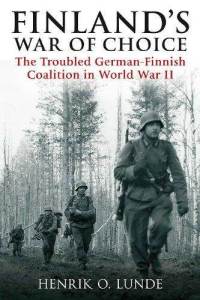
Finland’s War Of Choice: The Troubled German-Finnish Coalition in World War II

“Finland’s War Of Choice: The Troubled German-Finnish Coalition in World War II” by Henrik O. Lunde  tells the little know story of the strange partnership and joint military operations of Finland and Germany between 1941 and 1945. The coalition of these two is rarely included in English books. This is not the more well know “Winter War” of 1940 between the Soviet Union and Finland, but rather the story that has not brought pleasure to that Finns. It was a political decision and union the Finns would rather forget.

Henrik O. Lunde is an excellent writer. He gives us the necessary background of Finland’s history. He gives a necessary overview covering the country’s severance from the Soviet Union in 1917. He explains Finland’s seclusion after the Winter War in 1940. Finally he explains the decision-making process and unbelievable lack of planning and coördination used by both the Germans and Finns in forming this unlikely coalition against the Soviet Union.

We see how bizarre it was for that the German Generals allowed their military machine to accept an unsteady and rickety alliance. We see how the normal planning processes just did not happen. We see the failure to plan their goals and aims. We see inadequate command and control as well as no overall coördinated plan. We find the normally professional German General Staff not following normal rules and protocol at every turn. We see how Leningrad jaded both the Germ and Finn’s planning and strategy.

We see how the Finns quickly fell into “Goose-Step” with the Germans as the willing followed their leadership without question. We learn that their best trained and most powerful army made almost no major contribution because of its misuse in central and northern Finland. German lack the troop strength in this harsh climate theater to achieve success without the Finns. The Finns were unwell in provide the necessary assistance.

The book concludes with the Finns battling the USSRs counterattack in 19944. We see how Finland lost all military gains. To the German’s dismay the Finns engaged in a separate peace agreement with the Soviets. This resolution gave the German’s no option due to their troop strength levels except to fight their way from the region. The casualties for this theater of operation were a staggering 1,000,000 plus.  Compared to the Soviet losses of over 800,000 the Finland/German total of just fewer than 300,000 were meager.

Former US Army Colonel Henrik Lunde has produced a well written, well researched book. It should be part of any World War II students library and is must reading for any student of 20th century European history. It is well done.

Hitler’s Master of the Dark Arts: Himmler’s Black Knights and the Occult Origins of the SS

Mr. Yenne takes a well-known subject, the SS, and examines it through an unusual point of view. Instead of just looking at the organizational structure and providing a time line of it’s history he digs into the historical background it through the scope of paganism showing the background and origins of Nazi racial philosophy and how these philosophies became the motivating force of the SS .

Mr. Yenne explores the roots of Himmler’s racial philosophies as he developed the SS in the book’s first half. The activities of the SS during World War II and the occupation of Europe by the Nazis files the book’s second half.

The reading was enjoyably, those sometimes it was repetitive. An example is Heinrich Himmler believing himself the reincarnation of Heinrich I, the first king of Germany. Mr. Yenne dwelt too long on this subject. Stating it once would have been enough.

Mr. Yenne’ research of the subject shows. The book is full of interesting sidebars and visuals. The quality of the book, presentation, and photographs are spectacular. Once again Zenith press shows why they are at the top of the list of publishers of military history books.

“Hitler’s Master of the Dark Arts” communicates the philosophies of Himmler. It drives home the point he was the man who coordinated the Holocaust. His SS carried it out.

Mr. Yenne successfully tackled the subject from a controversial point of view. He made his point. Any serious student of World War II and the SS will benefit from reading the book. The book helps in gaining a better understanding of the SS and Himmler.

Skorzeny’s Special Missions: The Memoirs of Hitler’s Most Daring Commando

“Skorzeny’s Special Missions: The Memoirs of Hitler’s Most Daring Commando” by Otto Skorzeny.  Zenith Press has produced an excellent new edition of the book.

Prior to reading the book I did not know of Otto Skorzeny. He isn’t a well-known World War II German soldier. From a little research I found his memoirs had been originally written in German. At first, the book didn’t grab my attention. Maybe this was because I had never thought of viewing World War II from the point of view of a German commando.

As I read the book I found Otto Skorzeny does something few do. He lets us into his mind. It helped me understand his point of view. The book is action paced. It experience commando action as if you were there. The more I read the more I came to realize this book is one of the must read, must have books of World War II. I would call the book historical literature and a required study for all World War II buffs.

The telling of the story of the rescue of Mussolini is worth the purchase price alone. You learn that Skorzeny was selected for the mission because Hitler was aware the shared an Austrian heritage. The story of how the German intelligence learned of Mussolini’s location is amazing. You experience the planning and execution of the mission. You experience the concept of the operation down to Skorzeny deployed his unit.

After the Mussolini mission you journey with Skorzeny to France to put down a possible coup whose mission is the overthrow of the Germany loyal Vichy government.  The threat failed to materialize.

Skorzeny became involved in research and development of tactics and the weapons needed for commando operational support. You travel with him to the Russian front were he began commando operations. You next find him back on the western front. Here he used one of the most controversial attacks deployed during the war. He used English-speaking German soldiers to work behind American lines during the Battle of the Bulge. The detail of the plan is shared including its development, organization, equipping, implementation, and what caused the plan be found out and it failure.

It is always interesting to look at military events from a different point of view. Here you get the best insights into German commando operations. It is amazing. It is worth the purchase price and should be part of your library.

After reading the book, I believe no military education of World War II is complete with having read this classic work.

The Civil War: A Narrative (Three Volumes – 2974 pages)

This magnificently written trilogy of books on the American Civil War is not only a piece of first-rate history, but also an excellent work of literature. The late Shelby Foote brings an accomplished novelist’s descriptive power to this grand epic. This immense three-volume set should be on the bookshelf of any Civil War buff. It is the definitive example of narrative history and creative non-fiction.

I started reading this 2,934-page trilogy on June 6, 2007 and have completed it in September 2008. This is not a reading assignment to tackle in a single season. I read 27 other books while reading through this great work. I will review each book of the trilogy separately. I have since read the series again. I also purchased the audio book from Audible.com. It takes over 150 hours to listen to the three book set.

The Civil War: A Narrative–Fort Sumter to Perryville, Volume One. The book covers the beginning of the war through December 1862. The late Shelby Foote writes with a down home, comfortable style that is like he is sitting beside you telling a story. Make no mistake, he is a southern and tells the story from a southern point of view. The book is a work of creative non-fiction. It is a first class narrative. It is the example of how to write history.

Many students of the Civil War are limited in their knowledge of the war to the major battles of Fort Sumter, Bull Run, Fort Henry and Fort Donelson, Shiloh, Corinth, Iuka, Antietam (Sharpsburg), etc. (battles in 1861 -1862) or the generals. Foote covers all the battles. And he covers what takes place in between the battles though with minor battles that tend to be brushed over with the simple reference to their being fought buy others.

I admit some parts of the book were a struggle for me to get through. The time between the campaigns and battles, the endless maneuvers and debates were challenging. Once he moved on to the next battle or fight, the action and pace of the book picked up. Foote shared enough strategy and tactics as well as some of the intellectual processes the key players used to help us understand what leadership on both sides will do under such situations. At times it was like reading the strategy behind a chess game. The back stories of the political considerations were actually enjoyable at times and problematic to boring at others.

I recommend The Civil War: A Narrative–Fort Sumter to Perryville, Volume One to any American or person with an interest in American history. Yes, the battles may seem to be repetitious. Yes, the politics and maneuvers do at times get somewhat dry. They must be included to tell the entire story. We need know the story well to know who we are as a people.

I wish the editor had placed better divisions in the book. Even knowing the history of the civil war well, I had trouble at times with where we were at what battle. Many of the battles are referred to by their southern name, usually the nearest town e.g. Sharpsburg instead of their northern name e.g., Antietam, usually the nearest body of water.

The Civil War: A Narrative: Volume 2: Fredericksburg to Meridian covers from December 1862 and the Fredericksburg Battle to the Meridian , Mississippi campaign and the US Grant’s promotion to Lieutenant General. The late Shelby Foote continues writing in a down home, comfortable style that is like he is sitting beside you telling a story. Again, I point out as in the review of volume one, make no mistake; he is a southern and tells the story from a southern point of view. The book is a work of creative non-fiction. It is a first class narrative. It is the example of how to write history.

Foote covers all the battles. And he covers what takes place in between the battles though with minor battles tend to be brushed over with the simple reference to their being fought.

As in volume one I admit some parts of the book were a great struggle for me to get through. At times between the battles it was boring. The time from Fredericksburg to Vicksburg and Gettysburg took forever to cover. Foote occasionally repeated himself and would chase rabbits. The time between the campaigns and battles, the endless maneuvers and debates were challenging. Once he moved on to the next battle or fight, the action and pace of the book picked up. Foote shared enough strategy and tactics as well as some of the intellectual processes the key players used to help us understand what leadership on both sides will do under such situations. At times it was like reading the strategy behind a chess game. The back stories of the political considerations were actually enjoyable at times and problematic to boring at others.

I recommend this to any American or person with an interest in American history. Yes, the battles may seem to be repetitious. Yes, the politics and maneuvers do at times get somewhat dry. They must be included to tell the entire story. We need know the story well to know who we are as a people.

Again, I wish the editor had placed better divisions in the book.

The Civil War: A Narrative, Volume 3: Red River to Appomattox. Shelby Foote takes the Civil War and scrutinizes it in a writing style that feels as if you are hearing news from the front in an ongoing war. This book is not for the mildly curious, you will get bored and overwhelmed by the dates, names and places. This volume is longer than either of the first two volumes. But to military history, history, or civil war buffs, it is as detailed and factual as you could want. This is truly a definitive work on the War Between the States.

The book handles personalities of both individuals and cultures and their effects on the war. The reading can be slow going at times as armies march toward each other and the order of battle becomes established with the commanders’ names and stations, but the battle details seem incredibly well researched and the accounts of soldiers/officers bring home this conflict.

This book is well worth the effort to read, it imparts a sense of what the United States has survived and clarifies many historical perceptions of the era and the people involved in this massive conflict.

Once more I wish the editor had placed better divisions in the book.

A last thought – I have never read a better, more vivid, more understandable account of the savage battling between Grant’s and Lee’s armies. Shelby Foote stays with the human discord and distress, and unlike most Southern commentators, he does not take sides. In objectivity, in range, in mastery of detail in beauty of language and feeling for the people involved, this work surpasses anything else on the subject. It stands along the work of the best of them. These three books are my all time favorite books/book series.

Undaunted Courage: Meriwether Lewis, Thomas Jefferson, and the Opening of the American West (Lewis & Clark Expedition) by Stephen E. Ambrose


The narrative style of Ambrose takes what could be a dry lecture and makes it extremely interesting. The book reads like a best selling novel. The book gives a nice background on Captain Meriwether Lewis. It shows how this background prepared Lewis for the journey and how it provided the relationship he had with Jefferson to lead to his selection for the journey. Lewis was Jefferson’s personal secretary when selected to lead the voyage that would take him up the Missouri River, to wintering with the Indians, to the Rockies, over the mountains, down the Columbia River to the Pacific Ocean, and back. Lewis experienced hardships and saw wonderful sights. The sites included herds of buffalo and Indian tribes with no previous contact with white men. He and his partner, Captain William Clark, made the first maps of the trans-Mississippi West, provided data on the flora and fauna of the Louisiana Purchase territory, and most importantly established the American claim to Oregon, Washington, and Idaho.

The book shows how Lewis is financially underwritten by a variety of characters. This list includes Jefferson, Clark, numerous Indian chiefs, and Sacagawea, the Indian girl who accompanied the expedition, along with the French-Indian hunter Drouillard, the great naturalists of Philadelphia, the French and Spanish fur traders of St. Louis, John Quincy Adams, and many more leading political, scientific, and military figures of the turn of the century.

This is a book about a hero and national unity. This is a book also about a tragedy. When Lewis returned to Washington in the fall of 1806, he was a national hero. Lewis greatest failure was he did not get his journals and notes organized and published. The scholarly value of those would have been great. Publishing them in a timely manner would have made Lewis financially independent. Instead Lewis took to drink, drugs, engaged in land speculation, piled up debts he could not pay, made jealous political enemies, experienced severe depression (probably from the drugs), and ultimately took his own life. Read by Jimmie A. Kepler in February – March 2005.

A Life in a Year: The American Infantryman in Vietnam, 1965-1972 by James R. Ebert

Wisconsin high school teacher James R. Ebert does a masterful job as he combines interviews and printed primary sources in this remarkable telling of the infantryman’s experience during the Vietnam War. Ebert tells the story of the US Army and a few US Marine infantrymen during the Vietnam War. He takes their story from induction into the service through basic and advanced individual training, arrival in Vietnam, their first combat experiences, the first killed in action they experience, in some cases the soldier’s death, and the freedom birds that take them back to the world. Ebert points out while infantryman accounted for less than 10% of the American troops in Vietnam, the infantry suffered more than 80% of the losses.

Ebert uses an interesting technique starting every chapter with a letter by Leonard Dutcher to his parents. Dutcher just wanted to do his part for God and country and go home at the end of his 12-month tour (13 for Marines). In the last chapter, we find out that Dutcher was killed. It caught me off guard and really added to the impact of the book. Ebert takes many of the soldiers and Marines experiences word for word from the individual himself through interviews or letters. It is a collective look at similarities of the many infantry soldiers and Marines in the war. It is a very personal account from many points of view.

This is an important book in Vietnam War literature. This is what the grunts really went through. I was left with somewhat of feeling of guilt from reading the book. Why? I graduated high school in 1971. Some of my high classmates went to Vietnam and fought. Everett Maxwell was killed in action. I went to college and was ultimately commissioned a second lieutenant in the infantry, went through airborne school and served three years active duty. My becoming an officer deferred my entry on active duty from 1971 to 1975. This is the reason for my reflective thoughts. Read by Jimmie A. Kepler in August 2004.