The American Aircraft Factory in World War II

The American Aircraft Factory in World War II by Bill Yenne is truly magnificent. When I first had the book in my hand I thought “coffee table book”. After reading the book and looking at the pictures it is so much more. It is a wonderful tribute to the men and women who built the airplanes. It is an excellent history of the aircraft industry in the Unites States. The author gives a great background and understanding of the founders and companies like Boeing, North American, Curtiss, Consolidated, Douglas, Grumman, and Lockheed.

I learned of the Air Mail Act of 1934. The act required the separation of the airlines from manufactures. It caused some like William Edward Boeing to leave the industry. He gives great tribute to the gender shift in the work place and the ramping up of the industry for the war. He takes us through the construction of the facilities as well as the transition back to a peace time production.

The photographs in the book are amazing. I have never seen so many high quality photographs of this era in one collection. Without the pictures the book is a wonderful history of the aircraft industry. With the pictures it is transformed into a work of art.

I highly recommend the book for all aviation and World War II buffs. It would be an excellent addition to community and public school libraries as well. This is a masterpiece that will stand the test of time.

Writer’s Life: Thinking and Liberal Arts Curriculum

Albert Einstein said, “The value of an education in a liberal arts college is not the learning of many facts but the training of the mind to think something that cannot be learned from textbooks.

“My undergraduate education is a liberal arts education. My major was history and my minors were English and military science. My Master of Arts degree is in Religious Education. My broad-based liberal arts education did more than prepare me for a job. It allows me to compete in the marketplace of ideas.

It has been thirty-seven years since I heard then university president Dr. Wendell Nedderman say I had met the requirements for my bachelor’s degree. Within minutes of his pronouncement, I raised my right hand and received my commission as a second lieutenant in the United States Army through the Army Reserve Officer Training Corps (ROTC).

I did not make the military a career. Three years of active duty followed then I headed to graduate school. I was amazed at how ready I was for graduate work. I knew how to read, write, study, do research and research papers, and how to think.

My University of Texas at Arlington liberal arts education taught me how to think independently and make sound judgments. I learned how to expand my horizons, discover new perspectives, and acquire the tools to defend my point of view. My education helped me learn to reflect on life, have a moral and historic compass where I can distinguish good from evil, justice from injustice, and what is noble and beautiful from what is simply useful.

How have I paid the bills? Working as a commissioned officer in the US Army, a minister, corporate trainer, Internet Coordinator, IT Support Analyst, and IT Systems Administrator have been my day jobs supporting my thirty-one plus years of freelance writing.

Employed in Information Technology I find it interesting to see how many persons have an undergraduate degree in the liberal art disciplines. These people know how to think outside the box. They have excellent critical thinking skills. They have great oral and written communication skills. They accept, embrace change and know how to successfully deal with it.

What else have I done with my history degree? All the above plus I have published over two dozen magazine and trade journal articles in over a dozen publications though the years. I have published poetry through the years. I have written over one-hundred book reviews. I have a website “Kepler’s Military History Book Reviews”. The site is a 100 best websites for history buffs. I read and review military history books published under more than a dozen different imprints. I have a publisher/editor reading the first five chapters of the historical fiction novel I am working on.

Younger coworkers often ask how I know so much about a variety of disciplines. They say I am a modern renaissance man. My answer: I have a liberal arts education from UT Arlington.

How committed am I to liberal arts education? I have three grown children and a son-in-law – all have liberal arts degrees. One is employed in a senior business management position, a second is a teacher, and the third has worked in customer service and information technology fields.

Sacrifice On the Steppe: The Italian Alpine Corps in the Stalingrad Campaign, 1942-1943

As a lifelong history buff, military history enthusiast, former US Army officer and holder of a BA degree in history, I find myself pleasantly surprised from time to  time when I encounter a book that fills a void in my historical education. “Sacrifice On The Steppe: The Italian Alpine Corps in the Stalingrad Campaign, 1942-1943” written by Hope Hamilton and published by Casemate is one such book. The idea for the book originated when the author listened to her uncles’ reflections of his participation in World War II.

When Hitler had Germany invade Russia in June 1941, Prime Minister of Italy Mussolini declared war on Russia. He quickly sent a hastily organized Italian Expeditionary force of 62,000 men to join the Russian campaign even though Adolf Hitler discouraged such a move. Italy was unprepared militarily. Mussolini’s motivation was to join Hitler in receiving the spoils following an imagined rapid Nazi victory against Russia.”

Hope Hamilton’s book draws on personal interviews, exhaustive research and the written accounts of Italians who participated in and survived Mussolini’s tragic decision of Italian involvement. Mussolini compounded his mistake by sending even more troops the following year. The author does a good job of showing the human side of the Italian involvement on the Russian front. This is not a scholarly work on the tactics and logistics of the Italian involvement. Rather, it is the story of the people who made the terrible trek from Italy to Russia to support their German ally. The German’s had little trust of and kept the Italians minimally informed and I believe misused the Alpine troops by not maximizing the troops mountain fighting ability by their placement along the Don River.

The author does a great job of telling the soldier’s story. Her writing style focuses on the individual accounts of the soldiers. She discusses how the Alpine Corps was caught up in the German campaign capture Stalingrad in the autumn of 1942. She takes us through the Soviet offensive that followed in late November. We experience the collapse of the entire Axis front and the Alpine Corps’ withdrawal to the Don. I could have used a more background about the Stalingrad Campaign. The book does not take a strategic view of the campaign. Little attention is given to the big picture. The story is told from the Italian point of view instead of looking at it from the Axis point of view.

The book includes good notes, is well indexed, and has a great bibliography. I enjoyed the book. If you are looking for an after action report of the Italian participation or a critical analysis of the campaign this is not the book for you. If you’re looking for a good overview and an understanding of what the Italian soldiers experienced then you’ll enjoy the book. I give it four stars. It is a must addition to any military historian’s library. It is a good first volume to fill a long void of an English language account of the Italian involvement on the eastern front.

Tiger Tank Manual: Panzerkampfwagen VI Tiger 1 Ausf.E (SdKfz 181) Model (Owner’s Workshop Manual)

“Tiger Tank Manual: Panzerkampfwagen VI Tiger 1 Ausf.E (SdKfz 181) Model (Owner’s Workshop Manual)” by David Fletcher, David Wiley and Mike Hayden and published by Zenith Press.  The Tank Museum in South Dorset in the United Kingdom (UK) was in a unique position to write a new chapter in the Tank story with its own discoveries on restoring and running Tiger 131, which is the centerpiece of the manual.

“Tiger Tank Manual” is unique as we follow the story of Tiger 131 from April 1943 in Tunisia in North Africa to its arrival in the UK in October 1943 to its renovation and refurbishing thanks to the national Lottery. It is a short work of only 164 pages. “Tiger Tank Manual” gives an amazing insight and inside look into purchasing, owning, and even operating one of the world’s most outstanding engineering feats and fighting vehicles.

The use of personal remembrances of what it was like to operate and command such a vehicle in wartime gives you a “you were there” feeling. he recollections of what it was like to be on the receiving end of the Tiger’s 88 mmm gun shared by Lieutenant Gundgin in the Foreword really helps set the book’s tone.

The pictures, illustrations, line drawings, statics are amazing. The “Tiger Tank Manual” gives the necessary background on the history and development of the tank. You get the story of Tiger 131 down including forensic and crime scene analysis of the battlefield damage to the tank to include the ammunition used against the tank!

You are given a specular cutaway drawing of the tank from the School of Tank Technology. Note: I am a former US Army Ordnance Corps officer whose military occupational specialty was maintenance. I supported the old US Army M60A2 tank. The detail in “Tiger Tank Manual” rivals any Technical Manual. I cannot over emphasize the quality and variety of the pictures. They left me with the felling I had crawled all over the vehicle as well as I examined every detail inside the tank. They are amazing.

You get a glimpse into the mind of the museum as to why they restored Tiger 131. Again, detail pictures as well as description guides you through the process. Such details as paint selection and viewpoints from volunteers working on the project make you feel part of the project.

The “Tiger tank Manual” includes a chapter on running the tank. The detail given to the start-up procedures and riving the tank makes me want to get in the driver’s seat and take it for a test drive.

The detail given to “The May back Engine” may appear to be overkill to some, but the tank enthusiast or automotive engineer will enjoy the examination of the engine and its auxiliaries. Everything from ventilation to the gearbox and transmission as well as the steering and drive shafts (final drive) is covered.

Having supported annual tank gunnery for several years had my curiosity peak in the chapter devoted to firepower. Excellent coverage is given to tank gunnery from the ammunition down to aiming and firing the gun.

The explanation of the deployment and tactics of the Tiger lets you have an understanding of the German’s strategy. The book concludes with a nice appendix of the surviving Tigers.

While the book may not be for everyone, any military enthusiast will enjoy the book. Any tanker or former tank crewmember will enjoy the book. I believe it would be a worthwhile addition to any military history library as well as any collection dealing with World War II. Additionally, automotive engineers will find the book simply amazing.

Read and reviewed by: Jimmie A. Kepler February 29, 2012. Note: Jimmie is honorably discharged as a Captain in the ordnance Corps US Army where he served as a maintenance office and supported a tank battalion (2nd Bn 77th Armor 2nd Brigade 9th Infantry Division) in 1978.

Black Faces of War: A Legacy of Honor From the American Revolution to Today

With Black History Month just a couple of weeks away “Black Faces of War: A Legacy of Honor From the American Revolution to Today” commemorates the achievements by African-Americans in the United States military from the American Revolution to the present. I loved the perfect blend of paintings, photography and prose to tell this story. The book includes contributions from prominent historian Hal Chase, W. Stephen Morris, and Luther H. Smith, one of the celebrated Tuskegee Airmen.

My own education of “The Black Faces of War” began when I was a college history major I visited Fort Davis, Texas and first learned of the Buffalo Soldiers at Fort Davis from 1867-1885. It showed a gap in my education concerning the role of African-American’s in the US military.

Author Robert V. Morris’ work includes black military heroes such as Crispus Attucks, the first man to die in the Revolutionary War. We learn the story of Lieutenant James Reese Europe. He brought jazz music to Europe in 1918. Lieutenant Charity Adams, commander of the only all-black Women’s Army Corps unit during World War II narrative is told. The book also includes General Colin Powell, who served with merit in Vietnam. He became the first African-American Chairman of the Joint Chiefs of Staff during the Gulf War. He also retired a four-star general before becoming the first African-American Secretary of State.

This is a must addition to any military historian’s library as well as community library. The history of African-Americans in the US military is a too often neglected history. It is necessary that not only African-Americans, but also all Americans know of the import contributions made throughout history.

Bombs Away!: The World War II Bombing Campaigns over Europe

Zenith Press‘s “Bombs Away!: The World War II Bombing Campaigns over Europe” by John R. Bruning is a must have for all World War II and aviation buffs.  The book is large, coffee-table size volume. The book is full of amazing pictures.  The photographs give greater coverage of the people in the war than most books. The coverage is more about the aircraft crews and ground support personnel than the aircraft specs. You learn about the people who endured the bombardment as well.

“Bombs Away!” takes account of the fascinating human element. It also describes the types of aircraft used on both sides and used in every major bombing campaign in the European Theater.

The author discusses strategic bombing theories.  John R. Bruning provides a foundation by taking the reader through the different air campaigns in the Spanish Civil War, Blitzkrieg attacks on Poland, France and Britain before applying the majority of the book to the American and British assaults on the Third Reich.

Mr. Bruning gives the particulars on how each command determined on their own approach to bombing Germany (the US daylight vs. the UK night-time), the aircraft they employ, their particular achievements and disappointments. We learn of the eventual impact of the combined strategic bombing campaign.

The book’s manuscript provides a first-rate rundown of bombing campaigns in the European Theater. However, the book’s selling-point is the illustrations. While some of the pictures have been seen before and are familiar. The author collects them in one place. The volume contains nearly 480 black and white plus color photographs and maps. They describe both Allied and Axis aircraft, aircrew and the commanders. You experience in-flight air battles. You understand the damage to different targets.

Mr. Bruning covers the major campaigns, the plans, the planes, and the people. He does this with fine prose, wonderful quotes, and dazzling photographs that bring the story to life. The book is a must for both military and community libraries.

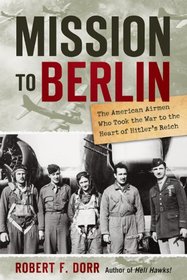
Mission to Berlin: The American Airmen Who Struck the Heart of Hitler’s Reich

Robert F. Dorr’s “Mission to Berlin” documents the mission that took place on February 3, 1945 to bomb Berlin, the capital of Nazi Germany.  The author does a very skilful job of telling the stories of the men who flew on it. He shares the incredible story of American fearlessness in the last months of World War II. The size of the air battle challenges our belief as in excess of 1,000 bombers and multiple-hundreds of fighter aircraft originating from Allied bases journey to the heart of Nazi Germany. You also get a good overview and understanding of the structure and operations of the United States Eighth Air Force.

Author Robert F. Dorr gives a detailed report of its evolution. He takes us from the pre-takeoff preparation and activities to the concluding landing.  The book is well paced. The basic structure of the book is spellbinding narrative. The storyline presents a mesmerizing description of many of the aviators on this historic mission. His use of primary source references such as first person interviews and personal letters adds warmth and the human touch to the narrative.

I found the way Mr. Dorr combines his interviews and letters with the detailed duties of each member of the crew a great way to explain the duties and procedures of the B-17 crew. The way he tells the story you feel as if you are there from take off to landing seeing the point of view of each member of the crew. He does an amazing job of drawing the reader into the life of the crew. This alone is reason to read the book.

Another reason to read the book includes the good picture of how the war affected the young crews, the technical side of the B-17 and its development and deployment as well as the evolution of fighting strategies. It was fascinating to see the change in philosophy as to the use of the fighters and to see how the Thunderbolts and especially the P-51s made a great difference in the  survival rates of the B-17s once they were able to escort all the way to Berlin.

I enjoyed the appendix that explained “What Happened to Them?” It told us of what key personalities mentioned in the book did after the war. It was a pleasant addition to the book.

This is an outstanding book.  Every World War II buff as well as aviation enthusiast will want it in their library. This is the second book I have read written by Robert F. Dorr. The first was “Hell Hawks!” which I also strongly recommend.  Zenith Press is the publisher.

Poem: Armistice Day

Armistice Day

On November eleven
As all of us knows
We signed an armistice
With all of our foes
And threw off our gas masks
We laid down our gun
And buried our hatchet
Along with the Hun

Now eight years have passed
Since that glorious day
When we signed that armistice
That ended the fray
And thousands of boys
Emerged from the strife
To come home a cripple
For the rest of his life

And thousands of others
Are over there still
Who never came home
And of course never will
They followed old glory
To a faraway shore
And to the loved ones at home
They returned never more

Althou’ we won glory
Across the big pond
We owe our respects
To our comrades that’s gone
And we’ll pause from our labor
Our tribute to pay
To our fallen companions
On Armistice Day

Written by Thomas Aaron Kepler in 1926
Copyright © Estate of Thomas Kepler
The poem was written by my grandfather, Thomas Aaron Kepler. It is one of several I have that he wrote and published.  He was a resident of Jamestown, Ohio. He passed away before I was born.  His poetry and writing are the only way I have had to know him.

101st Airborne: The Screaming Eagles at Normandy

“101st Airborne: The Screaming Eagles at Normandy” by Mark A. Bando is a well presented book. It has a nice blend of photography and prose. It is organized into ten chapters. They detail the training, preparation as well as the jump into Normandy of the 101st Airborne Division.

The 10.5 x 10.5 inches format allows for an excellent presentation of the photographs. The pictures cover the entire spectrum. Some are very familiar. Some are rare. Some are disturbing. The photograph on page 73 of a double row of dead German paratroopers is an example. There were so many dead in the photo than I could count them all!  I was surprised at the large amount of color pictures in the book. Amazing best describes the collection of photographs.

As good as the pictures were I especially enjoyed the story. The book chronicles the 101st in a way that blends a well-written narrative with first person testimonials of the veterans. Their recollections illustrate and explain the events of the chapter with a human touch.

Interestingly Bando includes one chapter on the 82nd Airborne Division and a chapter about the true story of the movie “Saving Private Ryan” titled “Saving Sergeant Niland”.  The book also contains a glossary of terms and an abbreviated index.

The book would be a great addition to the library of a military historian and is ideal for inclusion in a community or school library.

Review: Guns of the Civil War

“Guns of the Civil War” by Dennis Adler is a wonderful book. The work provides a much need detailed reference for the guns used in the US Civil War. The release of the book is timely as it helps celebrate the 150th anniversary of the war. The book is a high quality publication with a stylish and thorough history of Colt, Henry, Manhattan, Remington, Sharps, Spencer, and S&W Firearms, and guns by many other competitors and contemporaries. The history and high-level coverage given to the arms makers of the US Civil War era is without equal. The photography is high-definition, beautiful, and world-class. The photographs easily would make an excellent gallery showing by themselves.

I enjoyed sitting on the couch with my 85 years old father going through the book. We turned page by page and talked about the both the weapons, their descriptions, and the beauty of the photography. The book is an excellent reference. It will be enjoyed by historian,  US Civil War buff, as well as gun collectors.

I have provided a copy of the book to my writer’s workshop to use for a reference. Any author of historical fiction will benefit from the detailed descriptions in the book. It would make a great addition to any community library.