Essay: What if the world ends on Friday? Are you ready. I am. Here’s my story …

What if the world ends on Friday? Are you ready. I am. Here’s my story …

On July 11, 1977 my life changed. If you look up that date in history, you will find nothing historically significant happened on that Sunday. It was historically significant to me. That day was the watershed event in my life.

July 1977 found me on active duty as a lieutenant in the United States Army. I was serving as Battalion Maintenance Office, 2nd Battalion, 47th Infantry, 9th Infantry Division located at Fort Lewis, Washington. Life was good. I had a beautiful, intelligent wife. I had a new son born in January that same year. My career was going great. I had just got a commendable rating during an annual general inspection in maintenance. It was the first commendable rating since the division had returned from Vietnam. I had been named an Outstanding Junior Officer of the Ninth Infantry Division because of the commendable rating. I had been offered a regular army commission.

I always tried to be the best I could be, and do what is right. However, after all of this, I still had an empty, unsatisfied, void, and alone feeling. Beginning in my teen-aged years, I had tried such as social drinking, women, materialism, partying, and hanging with the right crowd to fill this unexplained need I had. I knew something was missing from my life.

I was attending church. I noticed a group of men that seemed to have what I was missing. I attended a Bible study with them. Here I found that God has given us an important manual for life, the Bible. He has the answers to the problems and emptiness we may face. I found out I was here for a purpose, and not by accident. I learned Jesus loves me, and desires to have a personal relationship with me. But, sin separated me from Him.

I realized I had a sin problem. The Bible says: For all have sinned and fall short of the glory of God. Romans 3:23 But no one is perfect! We have all sinned and therefore cannot save ourselves by simply living a good life. Why?

I learned there was a penalty to be paid for my sin. The Bible says: For the wages of sin is death, but the gift of God is eternal life in Christ Jesus our Lord. Romans 6:23

I learned God gives us a promise. The Bible says: For God so loved the world, that he gave his only begotten Son, that whosoever believeth in him shall not perish, but has everlasting life. John 3:16.

I learned that God made provision for me. The Bible says: If you confess with your mouth, Jesus is Lord, and believe in your heart that God raised Him from the dead, you will be saved. For it is with your heart that you believe and are justified, and it is with your mouth that you confess and are saved. Romans 10:9-10

I prayed to accept the gift of eternal life through Jesus. I prayed, Jesus, I know that I am a sinner. I believe that Jesus died for my sins and rose from the grave so that I might have eternal life in Heaven with You. I willingly repent of my sins and ask you to come into my heart and life. Take control of my words, thoughts, and actions. I place all of my trust in You for my salvation. I accept You as my Lord and Savior, and this free gift of eternal life. Amen.

Since then all has not been perfect. I have messed up from time to time, sometime big mess-ups. However, I have had direction and purpose in my life. I know where I am headed. I have the Bible to give me the principles for daily living. I am never alone. I have had real peace for the last 35 years.

You can have this same peace, too. How, follow the same steps I outlined above.

Devotional: A Personal Writing Mission Statement

I am currently attending the East Texas Christian Writer’s Conference at East Texas Baptist University in Marshall, Texas. Yesterday at the conference we received a two-part challenge. First, “as Christian writers” write a “personal writing mission statement”. Second, share it with someone to get their response. Well, I always do my homework on time. I’m sharing what I wrote with you …

My personal writing mission statement:

• sharing Jesus Christ and his teachings with an emphasis on the application of His lessons to everyday life,
• encouraging the development of poets and writers, and
• promoting appreciation of the liberal arts.

Devotional: The Classic Spiritual Disciples

Below are reviews for four books that I read that have had a profound impact on my life. The author, Dr. Richard J. Foster, is a Christian theologian and author in the Quaker tradition. His writings speak to a broad Christian audience. He has been a professor at Friends University and pastor of Evangelical Friends churches.  He earned his undergraduate degree at George Fox University in Oregon and his Doctor of Pastoral Theology at Fuller Theological Seminary in Fullerton, California. He has written four books dealing with the classic disciples of the Christian faith. Enjoy the reviews and just maybe, you will read one of the books.

Celebration of Discipline: The Path to Spiritual Growth by Richard J. Foster

The late Dr. Harry Piland who headed up Southern Baptist Sunday School work during the 1980’s and early 1990’s first introduced me to this book. He said only the Bible has had a greater impact on his life. As I respected Harry’s walk with the Lord, I wanted to see what was so great about the book. I found out in the first few chapters. I never thought that reading this book would change my life so deeply. Dr. Richard J. Foster, the preeminent Quaker theologian of this age, helped me to understand every discipline in a simple way and inspired me to put them in practice in my every day life. The book is divided into chapters that explore one of the spiritual disciplines in a deep, insightful, and yet simple way. The disciplines described are: meditation, prayer, fasting, study, simplicity, solitude, submission, service, confession, worship, guidance and celebration. After reading every discipline you’ll know what it is, learn how to do it and most of all, you’ll want to do it! I have read the book (originally published in 1978) about every two or three years since my first reading in 1981, and every time it motivates me to seek for God’s will in my life and learn how to grow in my spiritual journey. The book is one of the all time classics in Christian literature. If the Lord tarries, this book will be read regularly until His return.

The Challenge of the Disciplined Life by Richard J. Foster

I first read this book in 1986. The Challenge of the Disciplined Life has guided me often from then until now. Its clear ethics will give valuable insight to all who will apply its ageless principles. Foster’s blending of practical reality linked with biblical concepts leaves one thinking in biblical ways that still make sense in a world whose ethics seem to be changing daily. The insights expounded by Foster will continue to make a profound positive impact. It shows the dangers/temptations of money, sex, and power to draw one away from Christ.

Freedom of Simplicity by Richard J. Foster

I bought this book in Nashville, Tennessee at the Lifeway Christian Bookstore. Written in the same warm, accessible style as Richard Foster’s best-selling Celebration of Discipline, Freedom of Simplicity articulates a creative, more human style of living and points the way for Christians to make their lives “models of simplicity.” Foster provides a way to review our priorities and to “seek first God’s kingdom and his righteousness.” He shows us how to live in harmony with the rich complexity of life while stressing the relation of simplicity to prayer, solitude, and all the Christian Disciplines.

Prayer: Finding the Heart’s True Home by Richard Foster

This wonderful book is a nearly 20 years old. I have read this book twice. I have come back many other times to reread parts of the book. Richard Foster is a Quaker. He is probably the best known Quaker in the world today. He takes us into twenty-one different types of Christian prayer. He divides these twenty-one different types of Christian prayer into three movements of prayer, moving inward, upward and outward, which correspond to seeking transformation, seeking intimacy and seeking ministry. For those of us who love prayer, seek increasing intimacy with the Father or who have found difficulty with prayer in at least some of its forms, this book is a wonderful how to guide and aid. It helps us gain a better understanding of what each type of prayer is about.

Devotional: Keep My Words

Text: Proverbs 7: 1-3

My son, keep my words and treasure up my commandments with you; keep my commandments and live; keep my teaching as the apple of your eye; bind them on your fingers; write them on the tablet of your heart. – Proverbs 7: 1-3 Crossway Bibles (2011-02-09). The Holy Bible, English Standard Version (p. 531). Crossway. Kindle Edition.

As Christian writers, our witness must honor Christ. The world will not read or listen to hypocrisy. Proverbs 7: 1 (ESV) says, “My son, keep my words and treasure up my commandments with you; keep my commandments and live…” If a person follows the Lord, he/she must purposely embrace godly wisdom. Only the Bible has this wisdom. The Bible is God’s divinely inspired Word. It is the final authority in all matters. This includes human thought, speech and conduct. It is hypocritical for a person to say that they are a Christian, a Believer in Jesus Christ, if they deliberately, consistently violate His commandments. Jesus said in John 14:15, “If you love Me, keep My commandments.”

Proverbs 7:3b teaches one way to keep God’s teachings. It says, “… write them on the tablet of your heart.” When we internalize Scripture through memorization of the Word of God, His Word is in our heart to guide us. God’s desire isn’t to keep us from having fun, but rather to protect.

As Christian writers, we need to know and follow God’s Word. How we live is just as important as what we write.

Creative Commons License
Devotionals for Writers: Keep My Words by Jimmie A. Kepler is licensed under a Creative Commons Attribution-NonCommercial-ShareAlike 3.0 Unported License.

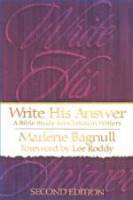
Review: Write His Answer

I found this wonderful little book while attending a seminar at the Greenlake Conference Center in Greenlake, Wisconsin. The book has 33 short chapters. You can read on a day as part of a daily devotional plan or quiet time. The chapter titles and appendix include Called to Write, Overcoming Procrastination, Seek His Kingdom First, Conquering the Deadly D’s, Driven or Led?, Proclaiming Truth to a Dying World, Laying a Bible Foundation for Your Writing Ministry, Helps for Forming Critique Groups, and From Idea to Published Manuscript.

I have gone through this book about once every year or two since it’s purchased. It reminds me of a few things I need to keep in mind and stay on task. If you are a Christian thinking about writing as a hobby, ministry, or vocation this book will point out some good foundations for you.

You will find wonderful encouragement and ideas from a Biblical point of view.

She also has a website at http://www.writehisanswer.com/.

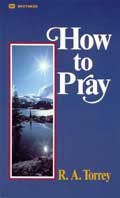
Review: How to Pray

In How to Pray by R.A. Torrey his practical pointers on prayer clearly unfold the conditions God has established for intelligent, effective prayer that brings His answers, emphasizing the purpose and importance of prayer. He gives principals on:

  • The Importance of Prayer,
  • Praying unto God,
  • Obeying and Praying,
  • Praying in the Name of Christ and According to the Will of God,
  • Praying in the Spirit,
  • Always Praying and Not Fainting,
  • Abiding in Christ,
  • Praying with Thanksgiving,
  • Hindrances to Prayer,
  • When To Pray,
  • The need of Prayer Before and During Revivals, and
  • The Place of Prayer Before and During Revivals.

I own and read the Moody Press “Moody Classic” edition of the book. Read and reviewed by Jimmie A. Kepler.

Writer’s Life: Thinking and Liberal Arts Curriculum

Albert Einstein said, “The value of an education in a liberal arts college is not the learning of many facts but the training of the mind to think something that cannot be learned from textbooks.

“My undergraduate education is a liberal arts education. My major was history and my minors were English and military science. My Master of Arts degree is in Religious Education. My broad-based liberal arts education did more than prepare me for a job. It allows me to compete in the marketplace of ideas.

It has been thirty-seven years since I heard then university president Dr. Wendell Nedderman say I had met the requirements for my bachelor’s degree. Within minutes of his pronouncement, I raised my right hand and received my commission as a second lieutenant in the United States Army through the Army Reserve Officer Training Corps (ROTC).

I did not make the military a career. Three years of active duty followed then I headed to graduate school. I was amazed at how ready I was for graduate work. I knew how to read, write, study, do research and research papers, and how to think.

My University of Texas at Arlington liberal arts education taught me how to think independently and make sound judgments. I learned how to expand my horizons, discover new perspectives, and acquire the tools to defend my point of view. My education helped me learn to reflect on life, have a moral and historic compass where I can distinguish good from evil, justice from injustice, and what is noble and beautiful from what is simply useful.

How have I paid the bills? Working as a commissioned officer in the US Army, a minister, corporate trainer, Internet Coordinator, IT Support Analyst, and IT Systems Administrator have been my day jobs supporting my thirty-one plus years of freelance writing.

Employed in Information Technology I find it interesting to see how many persons have an undergraduate degree in the liberal art disciplines. These people know how to think outside the box. They have excellent critical thinking skills. They have great oral and written communication skills. They accept, embrace change and know how to successfully deal with it.

What else have I done with my history degree? All the above plus I have published over two dozen magazine and trade journal articles in over a dozen publications though the years. I have published poetry through the years. I have written over one-hundred book reviews. I have a website “Kepler’s Military History Book Reviews”. The site is a 100 best websites for history buffs. I read and review military history books published under more than a dozen different imprints. I have a publisher/editor reading the first five chapters of the historical fiction novel I am working on.

Younger coworkers often ask how I know so much about a variety of disciplines. They say I am a modern renaissance man. My answer: I have a liberal arts education from UT Arlington.

How committed am I to liberal arts education? I have three grown children and a son-in-law – all have liberal arts degrees. One is employed in a senior business management position, a second is a teacher, and the third has worked in customer service and information technology fields.

Devotional: Proverbs 21 and God’s Sovereignty

Proverbs 21 and God’s Sovereignty

In my Bible reading this morning I read Proverbs 21. Proverbs 21 verse 1 immediately caught my attention. I meditated and reflected on the implications of Proverbs 21:1.  I read the verse in several different translations. It oftentimes helps me secure the meaning of the verse. Proverbs 21:1 deals directly with the attribute of God’s sovereignty.

Proverbs 21:1 (King James Version) – The king’s heart is in the hand of the LORD, as the rivers of water: he turneth it whithersoever he will.

Proverbs 21:1 (English Standard Version) – The king’s heart is a stream of water in the hand of the Lord; he turns it wherever he will.

Proverbs 21:1 (New American Standard Bible) – The king’s heart is like channels of water in the hand of the LORD; He turns it wherever He wishes.

Proverbs 21:1 (New International Version) – The king’s heart is in the hand of the LORD; he directs it like a watercourse wherever he pleases.

Proverbs 21:1 (New Living Translation) – The king’s heart is like a stream of water directed by the Lord; he guides it wherever he pleases.

The verse is a reminder, no, a wake-up call that God is in charge. He is in control. I recalled a couple of Bible verses that point this out, God being in control. Romans 8:28 is the first verse that came to mind.

Romans 8:28 King James Version says “And we know that all things work together for good to them that love God, to them who are the called according to his purpose.”.

Next Ephesians 1:11 was remembered.

Ephesians 1:11 King James Version says, “In whom also we have obtained an inheritance, being predestinated according to the purpose of him who worketh all things after the counsel of his own will:”

The phrase “all things” means everything.  It tells us that God is over everything. So, if we go to the Bible and look for specific examples of the “all things” that God is sovereign over we can find a never-ending list.

Here are ten examples of God’s Sovereignty found in the Bible (italics mine):

  1. GOD IS SOVEREIGN OVER THE DECISIONS OF KINGS – Proverbs 21:1 – The king’s heart is in the hand of the LORD, as the rivers of water: he turneth it whithersoever he will. — That was the verse I read this morning.
  1. GOD IS SOVEREIGN OVER THE LOSS OF OR THE GAINING OF WEALTH – Deut. 8:18 ; But you shall remember the LORD your God, for it is He who is giving you power to make wealth…”
  1. GOD IS SOVEREIGN OVER THE LOSS OF FAMILY, WEALTH AND HEALTH – Job 1:21 He said, “Naked I came from my mother’s womb, And naked I shall return there. The LORD gave and the LORD has taken away.
  1. GOD IS SOVEREIGN OVER ALL DECISIONS – Proverbs 16:33 – The lot is cast into the lap, but its every decision is from the LORD.
  1. GOD IS SOVEREIGN OVER THE BIRDS – Matthew 10:29 – Are not two sparrows sold for a penny? And not one of them(the sparrows or birds) will fall to the ground apart from your Father.
  1. GOD IS SOVEREIGN OVER ALL KINGS AND NATIONS – Daniel 4:35; All the inhabitants of the earth are accounted as nothing, But He does according to His will in the host of heaven      And among the inhabitants of earth;    And no one can ward off His hand Or say to Him, ‘What have You done?’
  1. GOD IS SOVEREIGN OVER TRAVEL PLANS –  James 4:13-15 – Come now, you who say, “Today or tomorrow we will go into such and such a town and spend a year there and trade and make a profit”; yet you do not know what tomorrow will bring. What is your life? For you are a mist that appears for a little time and then vanishes. Instead, you ought to say, “If the Lord wills, we will live and do this or that.
  1. GOD IS SOVEREIGN OVER SUFFERING IN THE LIVES OF CHRISTIANS – 1 Peter 4:19 – Therefore, those also who suffer according to the will of God shall entrust their souls to a faithful Creator in doing what is right,
  1. GOD IS SOVEREIGN OVER THE REPENTANCE OF A PERSON – 2 Timothy 2:25 with gentleness correcting those who are in opposition, if perhaps God may grant them repentance leading to the knowledge of the truth,
  1. GOD IS SOVEREIGN OVER THE SPIRITUAL MATURITY OF THE BELIEVER – Hebrews 6:1-3 Therefore leaving the elementary teaching about the Christ, let us press on to maturity, not laying again a foundation of repentance from dead works and of faith toward God, of instruction about washings and laying on of hands, and the resurrection of the dead and eternal judgment. And this we will do, if God permits.

What I was reminded of this morning was God is sovereign. He is in control. His plans ultimately are accomplished.

This is an original devotion written by Jimmie A. Kepler on March 21, 2012.

This work is licensed under a Creative Commons Attribution 3.0 Unported License by Jimmie Kepler.

Interview: Author Susan Elaine Jenkins (Scandalon: Running From Shame and Finding God’s Scandalous Love)

I recently conducted an interview with author Susan Elaine Jenkins.

Susan grew up in California as a PK, (“Preacher’s Kid.”) The eldest of three children in a parsonage gave her an early passion for knowing the Lord and studying the Scriptures. She was also given a unique view into what goes into church life behind the scenes.

She began to travel the globe in 1980, as a part of a Study Quest, where she – along with forty-nine other young graduate students – spent three months traveling to twenty-eight countries, studying leadership styles of people making a spiritual impact in the world. In fact, it was on this trip that her love affair with China began.

Susan moved to Asia in 1997, where she taught performing arts, first at the International School of Tianjin and then in the southern region of the country at The American International School of Guangzhou. She is now beginning her twelfth year of teaching in China, at a school not far from Shanghai.

Prior to moving to Asia, she taught for nineteen years, mostly at The Dorris-Eaton School in Walnut Creek and the San Ramon Valley Christian Academy in Danville, near San Francisco. She also served a public school district as a Resource Specialist and coordinator of a Gifted and Talented Program for public school district in northern California.

Susan recently spent one year back in America, living, teaching and writing in the ski resort community of Park City, nestled in the Wasatch Mountains. She taught music in a mountain school where classes ended every Friday just after lunch so that students could hit the slopes.
(From her biography)

You can buy Scandalon by clicking HERE. A review of the book is HERE as well as until 3/9/2012 get a free Kindle download by clicking HERE .

Question One: Tell us about yourself, your family growing up, and your interests in life.
Answer One: I grew up in a family of preachers and teachers. I used to play school as a child and always knew I’d become a teacher when I grew up, just like my imaginative, story-telling Mother. I was encouraged and surrounded with books, and I grew up loving to read and write stories. My favorite toy was an old, heavy, black typewriter and I lugged it around with me everywhere I went, typing stories like mad to share with schoolmates and patient grandparents.

My family was also a very musical group – creating music was something my parents did all the time and my brothers and I sang together from the time we were small children – in three-part harmony.

My father was a preacher and my two brothers and I loved going to church three times a week (or more). Church was fun! We enjoyed the atmosphere of loving support and spiritual joy, never dreaming that all would be changed dramatically someday.

I naturally followed in my Mother’s footsteps and became a teacher after graduating from Point Loma Nazarene University in 1977. My career has taken me into the hearts and lives of many unforgettable students. Much of my time is occupied with continuing education and professional development opportunities, which opens up new areas of thinking and learning as I go.

After teaching in California private schools for 19 years, I moved to China, where I have focused on teaching performing arts in 3 different international schools. I am a seasoned foreign expatriate these days and yet, the daily adventures of living in Asia continue to surprise me.

Question Two: What motivated you to write your book?
Answer Two: A friend from the UK convinced me to begin a blog. The idea of sharing my stories was inconceivable, at first, but as time went by, I got to know my readers. Little by little, I opened up the pages of my journals with them, interspersed with a few of the details of daily life in Asia. To my surprise, my online friends began commenting and sending me private letters filled with their own pain. I wanted to let them know that there really is healing and light ahead, that God’s promise really is authentic: He is a God who heals.

Question Three: Do you journal? When I read your book some sections seemed like I was getting an intimate look into your private thoughts. Did you use your journals as a primary source?
Answer Three: Yes, I have always journaled, for as long as I can remember. And, yes, much of my book was taken directly from those journals – especially the conversations between Dr. Travis and me. Those three difficult months were mind-numbing days. Writing everything that happened at the end of every confusing day helped me make more sense of it all.

Later, once I was in China, the conversations with Ouyang were important to me, as well, and I also kept detailed accounts. I knew I needed to have those talks recorded somewhere where I could retrieve them – they were too special to forget. The experiences I was having with my Chinese friends were very precious; China was rapidly developing and nothing would be the same again. I recently visited Tianjin and was stunned to see the progress made – the sleek commercial buildings and tall apartments that have replaced the ancient hutongs near the streets where I once lived and worked.

Question Four: In your book did you change any of the person’s names to protect their privacy?
Answer Four: I did change most of the names, yes. The only names I did not change were Ouyang’s and Mrs. Hua’s. I gave Ouyang a list of three possible names I wanted him to choose from, and he said he preferred I use his real name. My brothers each selected their names for the book, as well. It was important to me to allow for as much anonymity as possible, as the issues in this book are very intimate and potentially embarrassing.

Question Five: Your mother has passed away since you wrote the book. Was she supportive and/or understanding of you writing such a personal memoir?
Answer Five: My Mother was extremely supportive of this book, absolutely. She always encouraged my dream to become a writer, ever since I was a child at play. Later, when I mused about writing a book someday about the changes our family life encountered, I’d express hesitancy at discussing my Father’s issues in such a public way and she used to dismiss that, saying, “I don’t think you should worry too much about that, Susan.” When I was finally busy compiling all my journal notes into the actual book, I did much of the work while visiting her that last summer. She lay very ill in bed and encouraged me throughout the process. I left a copy of the manuscript with her when I returned to China and she told me a week before she died that she had read it. She gave her blessing to me, expressing that she hoped its message would find its way to the hearts of those who needed encouragement.

Question Six: The obvious follow up question is how did your two brothers and father respond/react to the book?
Answer Six: Do you know if your ex-husband has read the book or had any comments concerning the book? I sent both of my brothers copies of the manuscript and asked them to make any editorial changes before it went to print. I really desired their input and suggestions, because I knew that my point of view might differ from their recollections. ‘Steve’ who teaches in China, chose not to read it at all and says he probably won’t ever read it. He has been very positive, however, and has told me many times, “Whenever someone writes a book about their family, someone is bound to have hurt feelings.” Steve is not just a brother; he’s probably my best “male” friend and confidante. He has been so supportive.

My youngest brother, ‘Paul’, also elected not to read the manuscript, giving me a verbal “go-ahead”. At the time, I questioned, “Are you absolutely certain you don’t want to check it first?” He said, “Don’t worry about my opinion. Just focus on the message of the book.” I thought that was quite generous of him at the time. Later, when he actually picked up a copy, he was very upset with me for putting so much of our family’s private story into the book. He didn’t read any of the sections about China at all – he only read the portions that referred to our family life. I have phoned and written to him many times this year in an effort to understand his thinking and to discuss his feelings, but he has been unwilling to communicate. He is really quite upset. I am praying about this and hoping our relationship can heal from this pain the book has caused him.

I emailed my former husband to tell him the book was coming out and sent an additional message to him via Facebook (that incredible social phenomenon). He has not replied to my letters. I do not know if he has read it or not, but I would doubt that he would. He remarried four years after our divorce and is, by all accounts, happy. I hope he is and I wish him well.

My Dad has been truly incredible. Very supportive and understanding. He and I have a very special closeness that I treasure and this book has only brought us closer together. I am grateful.

I was disappointed that the final version of the book had the last chapter completely omitted. In that chapter, I explained the way my Dad had been taking such amazing care of Mom during her last days. I also talked about the wonderful changes in my Dad. I am still sorry those pages were left out of the final copy. I have had to learn that publishers make decisions based on many factors, and some of those might not be to my liking…but I am still thrilled with Cladach Publishing and the spiritual approach they took towards this book.

Question Seven: While your book tells of your personal journey it is a book about China. Why a book about China?
Answer Seven: I used the double journal literary device to portray my story as it occurred both in America and in China, where I’ve lived for the past twelve years. It is really a combination of two lives: my life in California and my life in Asia; two very different worlds.

I think it seemed very natural at some point, to write of a remarkably poignant journey that met in a healing point while living in a crumbled country, broken by its own history. My life at that point seemed very much the same – broken, falling apart, and dark.

Question Eight: You moved to China. How has living away from the United States assisted in dealing with the memories of the difficult situations you have experienced?
Answer Eight: Living in Asia has been wonderfully healing for me. I am certain God would have gradually healed me wherever I was living on this earth, but life in China gave me a unique perspective. There was space, for one thing, which helped me to gain both emotional and physical distance, affording me a better look at what had happened to me in California and what God wanted to do within me. The new friends I made in China taught me all kinds of lessons that illuminated God’s truth from Scripture and caused me to see the person of Jesus Christ more clearly.

I was surprised to finally feel “at home” in China. That, for me, involved a great spiritual healing and coming back to a point of rest within God’s heart; being glad to be in His loving presence; knowing that all my sins are utterly forgiven and cast away; and, sensing His divine heart of grace. Home has literally – for me – become His own Heart.

I am so thankful that God used some humble people in this vast country to teach me so much about His love and grace.

Question Nine: Music is very important in your life. Please share what music and the piano mean to you.
Answer Nine: Yes, music is important to me! Especially the piano, which is my instrument of choice. I have found that God speaks through music, and especially so – at least for me – here in China. When I sit down by myself and play through the old gospel tunes and hymns I learned as a child, it’s as if the words that He wrote into my heart come back to mind on fresh winds of renewal. I often teach these same songs to worshipers at house or countryside gatherings of praise. It sometimes feels as if God has taken all the early interests of my childhood – teaching, music and writing – and is weaving an unexpected tapestry of ministry and beauty that I can share with many.

Question Ten: Your experiences are such that you may have questioned your faith in God and decided that men cannot be trusted. Have you given up on God or every having a meaning relationship with men?
Answer Ten: Another good question. (you ask hard questions, by the way!) As Scandalon points out, I have struggled with my faith in God, yes. But, never to the point where I stopped believing. I believed He was God, I just didn’t believe I was “welcomed” into His presence anymore. But as the book also reveals, I learned the glory of His grace in specific ways and began to enjoy a close walk with God once again.

I have known a string of men who were not trustworthy, yes. That is sadly true. My father, my former husband, and “Dr. Travis”. And there have been others along the way who have shocked me in one way or another, as well.

I am circumspect when it comes to relationships, yes, but I have not given up, by any means. I still hold dreams of a wonderfully strong and happy intimate marriage. I pray for the right man to come into my life, although it is difficult meeting people while living here in a semi-remote region of China. I pray about this and trust God. I really do.

I have hope in the future because I hope in the Lord. Without Him, I have nothing and with Him, I have everything. That brings me huge joy and great hope.

Poem: The Liberator’s Helper – Part One

The Liberator’s Helper – Part One

Most who are free
Never experience true freedom.
The Liberator’s Helper knew freedom
And his knowing liberty was his prison.

Part One

For saving them from starvation,
The Pyramid People
Honored his
Memory and descendants.

And the descendants
Of the one who saved them
From the famine
Lived in the strange land
As friends
Before being enslaved.

The sun arose signaling
The beginning as a new day began.
The beauty of the morning was everywhere.
The bird’s song announced the break of day.
Then all turned black
As the news arrived that
Human Ruler had ascended to the throne.

The news brought fear
Into the hearts of all clans
For everyone knew
He was a repressive, powerful leader.
And Human Ruler knew not the one used by
The Liberator
To save the Pyramid People
From the great seven years famine
Or even his honored memory.

Brutality was Human Ruler’s method.
Fear was his motivation.
His method and motivation preceded him
And his grand army.
And he tormented and afflicted
The descendants of the one that had saved
The Pyramid People from starvation.
He did this because they were not of his clan.

Yet the children of the one
That had saved the Pyramid People
Increased in numbers in spite of Human Ruler.
They were many with more being born.
They were physically strong and
Demonstrated unusual wisdom.

Because of Human Ruler’s half-truths,
The Pyramid People’s paranoia filled the land.
Their distrust perverted to a great level.

Human Ruler believed
Male offspring
Of the one who had saved them
From the famine
Were superior to their female children.

For Human Ruler
Did not know male and female descendants
Of the one who had saved them
From the famine were fashioned by The Liberator.
The Liberator made both male and female
In the likeness of The Liberator.
Both were equally advanced creations.

Human Ruler with spite
Afflicted the descendants
Of the one who saved them
From the seven years famine.
He had his many lieutenants
Make a burden of their everyday work.
They required from them
Superior productivity with fewer resources.
And they made them
Do the tasks
The Pyramid People would not do
Because the tasks were beneath them.

Human Ruler’s mind
Also devised premeditated evil.
In his private chamber’s secret room
He feared them very much
And plotted their demise in his heart.
And then he gave a directive
To those who help birth the babies
To be part of his conspiracy of doom.

His order to those who helped
Birth the babies were
To kill the non-female babies
Of the descendants of the ones
Who have become too numerous
And say they were stillborn.
He warned less you do this
They shall become too strong and
Ultimately will rule over us.

And rage consumed Human Ruler.
He required those who help birth the babies
To give a report
Of their obedience to his directive.

The report of Human Ruler’s edict’s fulfillment
Amazed their leader.
And to those
Who helped birth the babies lied not.

The report was the impregnated females
That are descendants of the one they say saved
The Pyramid People from the seven years famine
Deliver their male offspring without travail.
“The male babies are born before we arrive,” they reported.
“The delivery is fast and without effort.”

Those who help birth the babies
Feared The Liberator more than they feared Human Ruler
Who believed not in the Liberator.
They did not obey Human Rulers’ command.
They would not kill the non-female babies
And say they were stillborn
On the day of their birth.

And with what great magic,
The magic that is of the Father-Spirit,
The Liberator provided families to care for,
Provide for,
And protect those
Who help birth the babies.

Now the fury of Human Ruler was great.
Wrath filled his heart.
While he ordered no harm for the female babies
His pronouncement was throwing the non-female babies
Into the great waterway that flowed
From the father mountain far to the south and
Into the endless saltwater lake in the north.

Yet The Liberator
Was the one who really was
In control of all things.
And Human Ruler knew this not.

© January 2011 by Jimmie Aaron Kepler