Dandelion Wine – Chapters Three, Four and Five

Dandelion wine is offered as a metaphor of summer here, bottled for the winter season of illnesses and wheezing. In Douglas’ words: “Dandelion wine. The words were summer on the tongue. The wine was summer caught and stoppered.”

Douglas discovers that his feet won’t move as fast as that of the other boys because his sneakers are worn out. He becomes entranced by a pair of brand-new Cream-Sponge Para Litefoot Shoes in a shop window, and thinks on how the need for a “magic” pair of sneakers to run in the green grass is something only boys can understand when his father argues against buying another. The local shoe seller, Mr. Sanderson, is initially resistant to selling the sneakers to Douglas, especially since he doesn’t even have enough money to pay for them upfront. Douglas, however, convinces him to try on a pair of his own sneakers, which triggers memories in Mr. Sanderson of when he was a kid and ran like the antelopes and gazelles. He agrees to let Douglas have the sneakers in return for work done by him in the shop to pay off the bill. The story ends with Douglas speeding away in the distance and Mr. Sanderson picking up his discarded old sneakers.

Dandelion Wine – Chapter Two

Chapter two has the theme of illumination. Douglas Spaulding goes with his ten-year-old brother Tom and his father to pick fox grapes. While Tom and his father act like today is just a regular day, Douglas senses a mysterious presence around them. When Tom starts a friendly horseplay fight between the two of them, Douglas suddenly realizes what the mysterious presence is. It is the revelation that he’s alive. He finds it a wonderful and invigorating feeling.

Poem: The Love Me Wall

The Love Me Wall

In your house
There’s a special place
Devoted just to you
It’s a wall
Your love me wall
Your love me wall

On that wall
Are awards and things
And when you see them
They make you sing
Your love me wall
Your love me wall

This one says they think you’re cool
That one says you finished school
It’s your degree for all to see
It pronounces you’re proud of me
Your love me wall
Your love me wall

The workplace plaque says you’re great
Just looking at it makes your spouse faint
And feel like throwing-up too
Because you are so full of you
Your love me wall
Your love me wall

No one loves you like you do
Neither your spouse nor your mother too
Will ever be in love with you
Like you love you
Your love me wall
You love your love me wall

© 2010 by Jimmie A. Kepler

In February 2010 I attend the University of Texas at Arlington Military Science Department and Cadet Corps Alumni Chapter Hall of Honor Induction Ceremony.  One of the inductees was recently selected for promotion from Colonel to Brigadier General. He used the phrase “My love me wall” referring to all the awards he has won over the past 30 years, the way he prominently displays them in his home office, and how his wife dislikes the wall because he is so proud of his accomplishments.  He said with getting inducted into the Hall of honor she will probably want to remodel the room.  I got to thinking about all the offices I have been in where men and women have their accomplishments nailed to the wall for all to see.  It leads to me writing this little poem about it.

Poem: The Liberator’s Helper – Part One

The Liberator’s Helper – Part One

Most who are free
Never experience true freedom.
The Liberator’s Helper knew freedom
And his knowing liberty was his prison.

Part One

For saving them from starvation,
The Pyramid People
Honored his
Memory and descendants.

And the descendants
Of the one who saved them
From the famine
Lived in the strange land
As friends
Before being enslaved.

The sun arose signaling
The beginning as a new day began.
The beauty of the morning was everywhere.
The bird’s song announced the break of day.
Then all turned black
As the news arrived that
Human Ruler had ascended to the throne.

The news brought fear
Into the hearts of all clans
For everyone knew
He was a repressive, powerful leader.
And Human Ruler knew not the one used by
The Liberator
To save the Pyramid People
From the great seven years famine
Or even his honored memory.

Brutality was Human Ruler’s method.
Fear was his motivation.
His method and motivation preceded him
And his grand army.
And he tormented and afflicted
The descendants of the one that had saved
The Pyramid People from starvation.
He did this because they were not of his clan.

Yet the children of the one
That had saved the Pyramid People
Increased in numbers in spite of Human Ruler.
They were many with more being born.
They were physically strong and
Demonstrated unusual wisdom.

Because of Human Ruler’s half-truths,
The Pyramid People’s paranoia filled the land.
Their distrust perverted to a great level.

Human Ruler believed
Male offspring
Of the one who had saved them
From the famine
Were superior to their female children.

For Human Ruler
Did not know male and female descendants
Of the one who had saved them
From the famine were fashioned by The Liberator.
The Liberator made both male and female
In the likeness of The Liberator.
Both were equally advanced creations.

Human Ruler with spite
Afflicted the descendants
Of the one who saved them
From the seven years famine.
He had his many lieutenants
Make a burden of their everyday work.
They required from them
Superior productivity with fewer resources.
And they made them
Do the tasks
The Pyramid People would not do
Because the tasks were beneath them.

Human Ruler’s mind
Also devised premeditated evil.
In his private chamber’s secret room
He feared them very much
And plotted their demise in his heart.
And then he gave a directive
To those who help birth the babies
To be part of his conspiracy of doom.

His order to those who helped
Birth the babies were
To kill the non-female babies
Of the descendants of the ones
Who have become too numerous
And say they were stillborn.
He warned less you do this
They shall become too strong and
Ultimately will rule over us.

And rage consumed Human Ruler.
He required those who help birth the babies
To give a report
Of their obedience to his directive.

The report of Human Ruler’s edict’s fulfillment
Amazed their leader.
And to those
Who helped birth the babies lied not.

The report was the impregnated females
That are descendants of the one they say saved
The Pyramid People from the seven years famine
Deliver their male offspring without travail.
“The male babies are born before we arrive,” they reported.
“The delivery is fast and without effort.”

Those who help birth the babies
Feared The Liberator more than they feared Human Ruler
Who believed not in the Liberator.
They did not obey Human Rulers’ command.
They would not kill the non-female babies
And say they were stillborn
On the day of their birth.

And with what great magic,
The magic that is of the Father-Spirit,
The Liberator provided families to care for,
Provide for,
And protect those
Who help birth the babies.

Now the fury of Human Ruler was great.
Wrath filled his heart.
While he ordered no harm for the female babies
His pronouncement was throwing the non-female babies
Into the great waterway that flowed
From the father mountain far to the south and
Into the endless saltwater lake in the north.

Yet The Liberator
Was the one who really was
In control of all things.
And Human Ruler knew this not.

© January 2011 by Jimmie Aaron Kepler

Review: Scandalon

From time to time I will share reviews of books by authors I personally know.  “Scandalon: Running From Shame and Finding God’s Scandalous Love” is written by Susan Elaine Jenkins.  I have read and recommend the book.  I  will have an interview with her in the days ahead and it will be posted.

Have you thought what it would like to get to know, work with the people in China, and live with them? Have you wondered what it would be like to grow up in a minister’s family? Susan Elaine Jenkins paints an insightful and sobering picture that answers these questions in her very skilful memoir, “Scandalon: Running From Shame and Finding God’s Scandalous Love.“

As I read the book her narrative format had me feeling like I was sitting in a recliner with a cup of coffee and she was sitting across the room telling me her story of how not just one, but a series of scandals hit her life. Some of events were self-inflicted. Other events were of someone else’s making. I found a bit of myself and my struggles as I read her story. Her writing and story were so interesting I didn’t want to put the book down! Yet, I feared I would read it too fast. I love the way her personality permeates the book.

In 1980, after three years of teaching in the USA in a private school (and saving her money) Susan made a trip to China. It was part of a gift she gave herself – a trip around the world. It was a prelude. In 1997 Susan accepted a two-year teaching position in Tianjin, China. She would stay in China.

Susan employs a wonderful method of telling of her adventures in China with reflections on what took place in her earlier life in the USA. The transition between the USA story and the China story is via a short statement of spiritual truth or insight. It is these earlier events in the USA that lead to her seeking refuge half way around the world. We see God’s handiwork in her life. We see her improving her language skills, her understanding of the Chinese culture, and how her American culture sometimes exasperated her Chinese friends, especially Ouyang. We reflect back on her life adventure that includes how she was used and mistreated by those in positions of authority over her and learned he had previously mistreated others. We also see how she survived!

Susan stories range from hilarious to tear inducing. I have two favorites. First, the story about her being invited back stage in Hawaii to meet Don Ho. Her parents encourage her to go. Don Ho wanted to do more than meet her. I could feel the confusion she felt from her parents encouraging her into such a situation. I wanted to take her dad aside and say you are supposed to protect your daughter! Second is the story at the Friendship Store of the two broken vases and how Susan came to the rescue of the Chinese couple. She demanded they not have to pay for the broken vase since she didn’t have to pay for one she broke a week earlier. We learn how the Chinese have two sets of rules – one for foreigners and one for other Chinese. I could feel the compassion and empathy Susan has for others.

The book is a good read and would be a valuable addition to all community and church libraries. It would also be a good study book for women’s group and even for counseling. It gives a realistic insight into the struggles we all face. The book gives answers about Chinese culture, running and finding God and finding one’s self.

Written by Jimmie A. Kepler

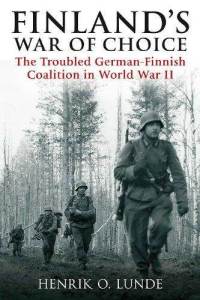
Finland’s War Of Choice: The Troubled German-Finnish Coalition in World War II

“Finland’s War Of Choice: The Troubled German-Finnish Coalition in World War II” by Henrik O. Lunde  tells the little know story of the strange partnership and joint military operations of Finland and Germany between 1941 and 1945. The coalition of these two is rarely included in English books. This is not the more well know “Winter War” of 1940 between the Soviet Union and Finland, but rather the story that has not brought pleasure to that Finns. It was a political decision and union the Finns would rather forget.

Henrik O. Lunde is an excellent writer. He gives us the necessary background of Finland’s history. He gives a necessary overview covering the country’s severance from the Soviet Union in 1917. He explains Finland’s seclusion after the Winter War in 1940. Finally he explains the decision-making process and unbelievable lack of planning and coördination used by both the Germans and Finns in forming this unlikely coalition against the Soviet Union.

We see how bizarre it was for that the German Generals allowed their military machine to accept an unsteady and rickety alliance. We see how the normal planning processes just did not happen. We see the failure to plan their goals and aims. We see inadequate command and control as well as no overall coördinated plan. We find the normally professional German General Staff not following normal rules and protocol at every turn. We see how Leningrad jaded both the Germ and Finn’s planning and strategy.

We see how the Finns quickly fell into “Goose-Step” with the Germans as the willing followed their leadership without question. We learn that their best trained and most powerful army made almost no major contribution because of its misuse in central and northern Finland. German lack the troop strength in this harsh climate theater to achieve success without the Finns. The Finns were unwell in provide the necessary assistance.

The book concludes with the Finns battling the USSRs counterattack in 19944. We see how Finland lost all military gains. To the German’s dismay the Finns engaged in a separate peace agreement with the Soviets. This resolution gave the German’s no option due to their troop strength levels except to fight their way from the region. The casualties for this theater of operation were a staggering 1,000,000 plus.  Compared to the Soviet losses of over 800,000 the Finland/German total of just fewer than 300,000 were meager.

Former US Army Colonel Henrik Lunde has produced a well written, well researched book. It should be part of any World War II students library and is must reading for any student of 20th century European history. It is well done.

Finland’s War Of Choice: The Troubled German-Finnish Coalition in World War II by Henrik O. Lunde

“Finland’s War Of Choice: The Troubled German-Finnish Coalition in World War II” by Henrik O. Lunde  tells the little know story of the strange partnership and joint military operations of Finland and Germany between 1941 and 1945. The coalition of these two is rarely included in English books. This is not the more well know “Winter War” of 1940 between the Soviet Union and Finland, but rather the story that has not brought pleasure to that Finns. It was a political decision and union the Finns would rather forget.

Henrik O. Lunde is an excellent writer. He gives us the necessary background of Finland’s history. He gives a necessary overview covering the country’s severance from the Soviet Union in 1917. He explains Finland’s seclusion after the Winter War in 1940. Finally he explains the decision making process and unbelievable lack of planning and coordination used by both the Germans and Finns in forming this unlikely coalition against the Soviet Union.

We see how bizarre it was for that the German Generals allowed their military machine to accept an unsteady and rickety alliance. We see how the normal planning processes just did not happen. We see the failure to plan their goals and objectives. We see inadequate command and control as well as no overall coordinated plan. We find the normally highly professional German General Staff not following normal procedures and protocol at every turn. We see how Leningrad jaded both the Germ and Finn’s planning and strategy.

We see how the Finns quickly fell into “Goose-Step” with the Germans as the willing followed their leadership without question. We learn that their best trained and most powerful army made almost no major contribution because of its misuse in central and northern Finland. German lack the troop strength in this harsh climate theater to achieve success without the Finns. The Finns were unwell in provide the necessary assistance. 

The book concludes with the Finns battling the USSRs counterattack in 19944. We see how Finland lost all military gains. To the German’s dismay the Finns engaged in a separate peace agreement with the Soviets. This resolution gave the German’s no option due to their troop strength levels except to fight their way from the region. The casualties for this theater of operation were a staggering 1,000,000 plus.  Compared to the Soviet losses of over 800,000 the Finland/German total of just fewer than 300,000 were meager.

Former US Army Colonel Henrik Lunde has produced a well written, well researched book. It should be part of any World War II students library and is must reading for any student of 20th century European history. It is well done.