“And the Moon Be Still as Bright” was first published in Thrilling Wonder Stories, June 1948.
The next chapter opens with the men of the Fourth Expedition gathering firewood against the cold Martian evening. The scientists have found that all the Martians have died of chickenpox (brought by one of the first three expeditions) — analogous to the devastation of Native American populations by smallpox.
The men, except for the archaeologist Spender and Captain Wilder, become more boisterous. Spender loses his temper when one of his crew-mates starts dropping empty wine bottles into a clear blue canal. He knocks him into the canal. When questioned by his captain, Spender replies “We’ll rip it up, rip the skin off, and change it to fit ourselves…We Earth Men have a talent for ruining big, beautiful things,” referring to Earth. He leaves the rest of the landing party to explore Martian ruins.
Note that, in some editions of the collection, the two stories about Jeff Spender have been combined as one.The two collections are chapters seven and eight.
A 1997 edition of the book advances all the dates by 31 years. This story is advanced from 2001 to 2032.
My late mother used to say I wanted to be a writer since I was three years old. I’m not sure that’s accurate. However, I cannot ever remembering not wanting to write.
Mom says I told stories even before I could write. I don’t know about that. I remember how excited I was when in the fifth grade at Jefferson Avenue Elementary School in Seguin, Texas. Mrs. Englebrock, which was my teacher, had us read books and then write a story telling what we read. I thought that was the neatest thing. Read the book, write a report about what we read, and if we were one of the lucky ones, we could stand before the class and read our report!
I liked that part as all the kids were looking at me I wanted to make the book sound so interesting every boy and girl would be dying to check it out of our little school’s library. I seemed to do a good job of my report writing. I would always mention something I just knew those girls would like. At the same time, I found something I knew the other fifth-grade boys would enjoy.
I used to take some of those book reports and turn them into plays that I performed with my brother and the neighborhood kids. It was such fun.
When I was in college and graduate school, I use to select professors by the criteria if they gave an essay test using examination blue books or multiple choice tests. I found the multiple guess test as I called them boring. An essay on the other hand allowed me to show what I knew. I enjoyed doing the research or term papers as well as doing book reports. If a professor gave essay tests, required two or three book reports and made you do a term paper, I would sign-up for the class. It was as if I had won the trifecta at the race track!
Mother was correct about one thing; I do like to write.
The Third Expedition was first published as “Mars is Heaven!” in Planet Stories, Fall 1948.
The arrival and demise of the third group of Americans to land on Mars is described by this story. This time the Martians are prepared for the Earthlings. When the crew arrives, they see a typical town of the 1920s filled with the long-lost loved ones of the astronauts.
Captain John Black tells his crew to stay in the rocket. The crew are so happy to see their dead family members that they ignore their captain’s orders and join their supposed family members. The Martians use the memories of the astronauts to lure them into their “old” houses where they are killed in the middle of the night by the Martians themselves. The next morning, sixteen coffins exit sixteen houses and are buried.
The original short story was set in the 1960s and dealt with characters nostalgic for their childhoods in the Midwestern United States in the 1920s. In the Chronicles version, which takes place forty years later but which still relies upon 1920s nostalgia, the story has a brief paragraph about medical treatments that slow the aging process, so that the characters can be traveling to Mars in the 2000s but still remember the 1920s.
A 1997 edition of the book advances all the dates by 31 years. This story is advanced from 2000 to 2031.
Chapter Four – The Earth Men (August 1999/2030) was first published in Thrilling Wonder Stories, August 1948. This story tells of the “Second Expedition” to Mars.
The astronauts arrive to find the Martians to be strangely unresponsive to their presence. The one exception to this is a group of Martians in a building who greet them with a parade. Several of the Martians in the building claim to be from Earth or from other planets of the solar system, and the captain slowly realizes that the Martian gift for telepathy allows others to view the hallucinations of the insane, and that they have been placed in an insane asylum.
The Martians they have met all believed that their unusual appearance was a projected hallucination. Because the “hallucinations” are so detailed and the captain refuses to admit he is not from Earth, Mr. Xxx, a psychiatrist, declares him incurable and kills him. When the “imaginary” crew does not disappear as well, Mr. Xxx shoots and kills them.
Finally, as the “imaginary” rocket remains in existence, Mr. Xxx concludes that he too must be crazy and shoots himself. The ship of the Second Expedition is sold as scrap at a junkyard.
A 1997 edition of the book advances all the dates by 31 years from 1999 to 2030.
This was first published as “The Spring Night” in The Arkham Sampler, Winter 1948. This short vignette tells of Martians throughout Mars who, like Ylla, begin subconsciously picking up stray thoughts from the humans aboard the Second Expedition’s ship. As the ship approaches their planet, the Martians begin to adopt aspects of human culture such as playing and singing American songs, without any idea where the inspirations are coming from.
A 1997 edition of the book advances all the dates by 31 years from 1999 to 2030.
First published as “I’ll Not Ask for Wine” in Maclean’s, January 1, 1950.
The following chapter, “Ylla”, moves the story to Mars.
Who is Ylla? She is a Martian woman trapped in an unromantic marriage. She dreams of the coming astronauts through telepathy. Her husband, though he pretends to deny her dreams are real, becomes bitterly jealous, sensing his wife’s inchoate romantic feelings for one of the astronauts.
He kills the two-man expedition, astronauts Nathaniel York and one simply called Bert, as soon as they arrive.
A 1997 edition of the book advances all the dates by 31 years from 1999 to 2030.
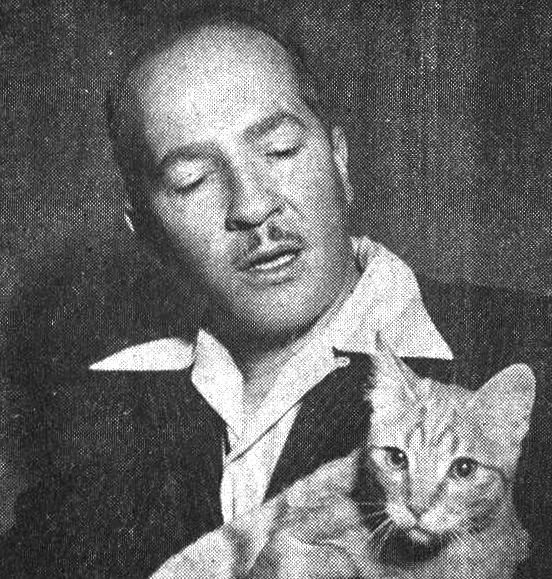
Photo of Robert A. Heinlein from Imagination, 1953 (scan of original magazine), digitally enhanced, CC0, via Wikimedia Commons
I love reading and writing short stories. A few years ago I came up with the idea of writing a nonfiction article on the five most influential pre-1950 computers in science fiction. In researching that list of potential computers, I read a number of books and short stories. E.M. Forster’s “The Machine Stops” topped off the list. It left me speechless and amazed. I wrote a review about that story last week. You can find it HERE.
The second short story on the list is “Misfit” by Robert A. Heinlein. In the weeks ahead I will share some of the science fiction gems I unearthed or rediscovered.
“Misfit” is a science fiction short story by Robert A. Heinlein. It was originally titled Cosmic Construction Corps before being renamed by the editor John W. Campbell. The November 1939 issue of “Astounding Science Fiction” first published the story. One of the earliest of his Future History stories, it was later included in the collections Revolt in 2100 and The Past Through Tomorrow.
The story concerns Andrew Jackson Libby (here nicknamed Pinky, for his red hair, but later nicknamed Slipstick), a boy from Earth with extraordinary mathematical ability but meager education. He found few opportunities on Earth. He joins the Cosmic Construction Corps, a future military-led version of the Civilian Conservation Corps (remember it from President Franklin Delano Roosevelt’s New Deal?) employing out-of-work youth to colonize the Solar System. With a group of other inexperienced young men, he is assigned to a ship traveling to the asteroid belt where their task is to move an asteroid into a more convenient orbit between Mars and Earth.
Pinky comes to the Captain’s attention during the process of blasting holes in the asteroid for rocket engines. Pinky realizes that a mistake has been made in calculating the size of the charge, preventing a catastrophic blast.
He is assigned to the ship’s astrogation computer. During the trip back to Earth, the computer malfunctions and Libby take over, performing all the complex calculations in his head. The asteroid is settled successfully into its final orbit.
“Slipstick” Libby became one of Heinlein’s recurring characters, and would later appear in several works associated with Lazarus Long, among them Methuselah’s Children and The Cat Who Walks Through Walls.
The short story includes one of the first examples of the phrase “space marine”.
Rocket Summer (January 1999/2030) – First published in Planet Stories, Spring 1947.
Arranged in chronological order, the stories of the book start in January 1999, with the blasting off of the first rocket to the planet Mars.
“Rocket Summer” is a short vignette that describes Ohio’s winter turning briefly into summer due to the extreme heat of the rocket’s take-off. The readers also learn the feelings of the nearby residence’s to the rocket’s launch.
A 1997 edition of the book advances all the dates by 31 years from 1999 to 2030.
The Martian Chronicles is a 1950 science fiction short story collection by Ray Bradbury that chronicles the colonization of Mars by humans fleeing from a troubled and eventually atomically devastated Earth, and the conflict between aboriginal Martians and the new colonists. The book lies somewhere between a short story collection and an episodic novel, containing stories Bradbury originally published in the late 1940s in science fiction magazines. For publication, the stories were loosely woven together with a series of short, interstitial vignettes.
Bradbury has credited Sherwood Anderson’s Winesburg, Ohio and John Steinbeck’s The Grapes of Wrath as influences on the structure of the book. He has called it a “half-cousin to a novel” and “a book of stories pretending to be a novel”. As such, it is similar in structure to Bradbury’s short story collection, The Illustrated Man, which also uses a thin frame story to link various unrelated short stories.
The first third (set in the period from January 1999—April 2000) details the attempts of the Earthmen to reach Mars, and the various ways in which the Martians keep them from returning. In the crucial story, “—And the Moon be Still as Bright”, it is revealed by the fourth exploratory expedition that the Martians have all but perished in a plague caused by germs brought by one of the previous expeditions. This unexpected development sets the stage for the second act (December 2001—November 2005), in which humans from Earth colonize the deserted planet, occasionally having contact with the few surviving Martians, but for the most part preoccupied with making Mars a second Earth. However, as war on Earth threatens, most of the settlers pack up and return home. A global nuclear war ensues, cutting off contact between Mars and Earth. The third act (December 2005—October 2026) deals with the aftermath of the war, and concludes with the prospect of the few surviving humans becoming the new Martians, a prospect already foreshadowed in “—And the Moon be Still as Bright”, and which allows the book to return to its beginning.
A 1997 edition of the book advances all the dates by 31 years (thus running from 2030 to 2057), includes “The Fire Balloons”, and replaces “Way in the Middle of the Air” (a story less topical in 1997 than in 1950) with the 1952 short story “The Wilderness”, dated May 2034 (equivalent to May 2003 in the earlier chronology).
Next week I’ll begin doing a summary for all 31 of the short stories in the book summarizing one each Monday.
My Father’s Secret War: A Memoir is the best book I’ve read in a long time. It is written by Pulitzer-Prize winning journalist Lucinda Franks. It reads more like a novel than a memoir.The book is both an intellectual search for an understanding of her father’s secret past as a spy in World War II as well as a heart-wrenching story of the complexities of the author’s relationship with him. What makes this book so very compelling is the honesty and poetic telling of naked truths in a real family drama. Everything is here: burning hatred and welcome forgiveness, love’s disappointments, parent’s failings, alcoholism, psychological torture, adultery, rebellion, revelation and resolution.
We care deeply as the author so desperately searches to understand why her relationship with her father had changed from childhood adoration to hatred, because of his alcoholic withdrawal. This is a universal story of every daughter’s struggle to know and forgive her father as he ages and declines. This author’s telling is unbelievably poignant. A must read!

 “And the Moon Be Still as Bright” was first published in Thrilling Wonder Stories, June 1948.