The True Story of Catch – 22: The Real Men and Missions of Joseph Heller’s 340th Bomb Group in World War II

Did Joseph Heller commit a disservice to the members of the 340th Bomb Group when he wrote Catch-22? Did author  Patricia Chapman Meder write an apologetic defending the real four officers some feel Joesph Heller blindsided when he made them into Catch-22’s four heavy hitters?

“The True Story of Catch – 22: The Real Men and Missions of Joseph Heller’s 340th Bomb Group in World War II” is a combination of both plus I feel some admiration for Joseph Heller making those men infamous.

There is a reason the original Catch-22 is found in the fiction not nonfiction section of bookstores. Joseph Heller didn’t write a memoir of his service during World War II. He wrote a satirical and somewhat historical novel.

Patricia Chapman Meder uses rare and unpublished photos to bring our actual heroes to life through use of first person narrative.

There is a third part in her book that is actually the book’s heart. She takes twelve men of the 340th and relates twelve true tales.

Fans of Catch-22 will enjoy the book. It makes good use of diaries, logs, and photos to bring the people to life. For those unfamiliar with Catch-22 the book will make you curious enough to pickup Heller’s book.

“The True Story of Catch – 22: The Real Men and Missions of Joseph Heller’s 340th Bomb Group in World War II” would make a nice companion volume or commentary for the serious student of the original work. It would make a nice inclusion in university or community libraries as a resource for Joseph Heller’s book.

I recommend “The True Story of Catch – 22: The Real Men and Missions of Joseph Heller’s 340th Bomb Group in World War II” by Patricia Chapman Meder. The publisher is Casemate Publishing.

Read and reviewed by Jimmie A. Kepler.

Ten Thoughts To Encourage Others

encourage-othersToday is Saturday March 23, 2013.

Here are ten thoughts I use to encourage others:

1. Show real interest in the person. Listen to what they are saying. Be interested in what is happening in their life. Let them know you care.

2. Concede what’s important to them.  When you acknowledge what’s important to others, you offer a form of verification and support about who they are and what they’re doing.

3. Say “congratulations”.  These magical Words of Encouragement at the right time can make all the difference between “keep going” and “give up”. Congratulate them on a job or task well done.

4. Be there for them.  Sometimes the “ministry of your presence” is all they need.  Just being there for them is encouraging.

5. Say “Thank You”.  This is common courtesy.  It is good manners.  People like a little reward after hard work. I have done it for years. A simple thank you lets others know what they have done is worthwhile and meaningful to you.

6. Return the favor. If someone does something nice for you, a great way to show your appreciation is simply to return the favor. It will both shock and encourage them.  Note: don’t ever do something expecting someone to return the favor for you.

7. Answer with something unexpected.  I have a phrase I have used for years … nice them to death!  Even when others let me down or they know I know they “dropped the ball” I don’t tell them so, I usually pick the ball up for them.  It is amazing the long-term results this can have in encouraging someone.

8. Be a “good finder”.  A good finder is a person who looks for the good, not the bad in a person or a situation.  An example would be if a person is always late to meetings, but makes in on time to your meeting instead of saying “About time you attended a meeting on time” say “I really appreciate the extra effort you made to get here on time” without any reference to their normal tardiness.

9. Smile.  Have you ever experienced the magic of a simple smile?  Have you ever noticed how when you smile at someone they smile back?  Share an encouraging smile.

10. Offer to lend a hand.  You can offer to lend a hand.  Sometimes a person feels like the weight of the world is on their shoulders and no one cares.  Show them you really care. You can be there for them.

Poem: Is Johnny Crawford from “The Rifleman” in Your Company?

Chuck_Connors_Johnny_Crawford_The_Rifleman_1960

Is Johnny Crawford from “The Rifleman” in Your Company?

We pressed our faces up against the chain linked fence.
We were supposed to be playing soccer during physical education class.
But we ran to the chained linked fence that separated our school yard from the dirt road.
We stared at the young soldiers marching to training.
They looked so army soldier in their fatigues, helmets and carrying their rifles at right shoulder arms.
They looked like a scene out of “Combat” that we watched each week on our televisions.
While barely just four or five years older than us, they looked all grown up.
A pretty seventh grade girl got up he courage and yelled,
“Is Johnny Crawford from “The Rifleman” in your company?”
There had been a news story of Johnny Crawford’s arrival at Fort Bliss for his basic training.
A kind three stripe sergeant responded,
“No miss, he’s in a different training company.”
“You boys going to Viet-Nam after basic?” asked the P.E. coach who had walked over and joined us.
“Maybe so, but first we got to survive this!” said a smiling boyish faced trainee.
“Quiet in the ranks!” screamed the drill sergeant.
The dust was getting thicker as the soldiers continued marching by.
Most of the seventeen and eighteen year old troopers were looking at the pretty thirteen year old blonde girl.
Some were thinking of their younger sisters back home,
Some were thinking the thoughts seventeen and eighteen years old young men have when seeing a pretty, young teenage girl, and
Some were wondering if they would live long enough to fall in love, marry, and ever have a daughter of their own.

Copyright © 2008 by Jimmie A. Kepler
Originally published in http://www.johnnycrawford.com, February 2008.

Photo credits:

Top photo: Photo of Chuck Connors as Lucas McCain and Johnny Crawford as his son, Mark, from the television program The RiflemanThis work is in the public domain in that it was published in the United States between 1923 and 1977 and without a copyright notice.

Why I Write

George_Orwell_in_Hampstead_-_geograph.org.uk_-_432863Today is Thursday March 21, 2013. 

In 1946, George Orwell (his real name was Eric Arthur Blair) wrote an essay titled “Why I Write”. It detailed his personal journey to becoming a writer. Orwell lists “four great motives for writing” which he feels exist in every writer. He explains that all are present, but in different proportions, and also that these proportions vary from time to time. They are as follows:

1. Sheer egoism – Orwell argues that many people write simply to feel clever, to “be talked about, to be remembered after death, to get your own back on grown-ups in childhood, etc.” He says that this is a great motive, although most of humanity is not “acutely selfish”, and that this motive exists mainly in younger writers. He also says that it exists more in serious writers than journalists, though serious writers are “less interested in money”.
2. Aesthetic enthusiasm – Orwell explains that present in writing is the desire to make one’s writing look and sound good, having “pleasure in the impact of one sound on another, in the firmness of good prose or the rhythm of a good story.” He says that this motive is “very feeble in a lot of writers” but still present in all works of writing.
3. Historical impulse – He sums this up by simply stating this motive is the “desire to see things as they are, to find out true facts and store them up for the use of posterity.”
4. Political purpose – Orwell writes, “No book is genuinely free from political bias”, and further explains that this motive is used very commonly in all forms of writing in the broadest sense, citing a “desire to push the world in a certain direction” in every person. He concludes by saying that “the opinion that art should have nothing to do with politics is itself a political attitude.”

After reading the essay, I came up with my list. They are as follows:

1. Ego/Hubris – I love to see my name listed as the author. I enjoy when my name appears on the cover of a magazine and in the table of comments of a magazine. I wish to see my name on the spine of a traditionally published book.
2. Educating People – I have loved when I have published a magazine article then get a telephone call, letter, or email asking for more information on the subject. Sometimes because of my writing, I have received job offers and speaking engagements. I enjoy informing people about historical events, writer’s lives, and the backgrounds of people and events.
3. Desire to influence others and be held in esteem by others – Maybe this goes with number one – Hubris. I recall the pride my oldest son had when he went to college and found several of my traditionally published magazine articles while doing research. He said it was somewhat cool to quote his father’s published work in a research paper. He said some of what I wrote for journals would be in the library forever.
4. Sharing my faith – I remember reading the late musician and former Beatles guitarist George Harrison’s memoir, “I, Me, Mine”. In the book, he says he purposefully wrote songs to share his beliefs and faith in Hare Krishna. I do the same to share my faith and belief in Jesus Christ. I try to do it in the normal flow of life as opposed to clobbering someone with the Bible.

If you write, why do you write?

Encourage your friends, keep reading and write.
Jimmie A. Keple
r

Photo credits: This file is licensed under the Creative Commons Attribution-Share Alike 2.0 Generic license. English: George Orwell in Hampstead On the corner of Pond Street and South End Road, opposite the Royal Free Hospital. The bookshop has long gone. Date: 11 May 2007. Source: From geograph.org.uk

Learning the Business of Writing

Today is Tuesday March 19, 2013.

Today I was sitting back and reflecting on the writer’s life. It got me to thinking. How did I get that first sale? That first book review?

The first sale involved learning the system. I attended a Smokey Mountains Christian Writer’s Conference. I was a wanna be writer. I learned basics of magazine article writing. Maybe the most important happening at the conference was meeting editors and publishers. I talked to several publishers who expressed interest in working with new writers.

All the editors required that I write on speculation. That means I write on the subject they assign, but they have no obligation to buy my work. It allows them to see if I can follow their rules, meet their deadlines, write sale-able copy, etc.  It lets them see how thick-skinned you are and if you take things personal.

I had a kind editor who loved taking a few rookie writers under his wing each year and mentoring them. He called offering me an article on speculation. I had to rewrite six times before he bought the first article. My payment was 2 1/2 cents per word, that is a check for $12.50, three copies of the magazine – one for me, one for my parents, and one for my wife’s parents – plus my name was on the by-line.

The article appeared in a little magazine called “Sunday School Leadership” published by Lifeway Christian Resources. Its circulation in the early 1980s was over 250,000 paid subscribers. It’s audience was my church members, seminary classmates, and members of the 40,000 plus Southern Baptist Churches in the USA as well as most directors of Christian education of all denominations.

I wrote an article or two for this editor every year for the next 15 or 16 years. It took me over decade before I got a cover article. Once I did get a cover article I got one every year until he retired.  The first article is very basic. It’s title was: “Who Does What“. I wrote the article in the Emory University Library in Atlanta, Georgia. I lived close to the campus. It was a favorite place for me to hang out and study. The article is available by clicking on the link with the article title.

In 1986 I asked about reviewing books. At the time I would put a book review about once a month in my church’s newsletter. My editor was on the mailing list and said I wrote good reviews. He recommended me to a colleague. The thought of having someone give me a book for free to read was exciting to me. I was buying and reading about 100 books a year so free books were a good thing.  The review for the first book is available by clicking on the link with the article title: “Book Review“.

I wrote this article while sitting in my church bus. I had taken the senior adults from my church to an event in the Smokey Mountains. We had the afternoon free and had gone to the Vanderbilt Estate in Asheville, NC.

One lady refused to tour the house. She was protesting paying homage to the rich and decadent lifestyle I think. Even though the tour was prepaid, she refused to go on it. It was fall and cool in the mountains. I would not let her stay on the bus by herself. So, I sat out there all afternoon and wrote. I can write anywhere I think. The dear lady is still living and around 90 years old and still as stubborn. The picture is of the Vanderbilt Estate.

What is my point? My point is if you love to read and write you can probably leverage it into a paying gig.  You’ll never get rich. I learned at the DFWCon (the Dallas Fort Worth Writer’s Conference) last spring that less than one percent of all writers are able to support themselves writing full-time. So don’t quit your day job. If love writing why not go for it? Just write!

Encourage your friends, keep reading and write.
Jimmie A. Keple
r

Dallas and North Texas Pictures and Places

Today is Saturday March 16, 2013.

Dallas and north Texas is a special place. It attracts people like a picnic attracts ants. The population of the Dallas-Fort Worth metropolitan region soared faster in a one-year period than any other in the country, with the Houston area coming in second, according to new figures from the U.S. Census Bureau.

Census estimates released Thursday show nearly 132,000 people were added to the Dallas-Fort Worth area from July 2011 to July 2012. Since April 2010, the region’s population has grown by nearly 275,000 people.

Let me share five pictures of the Dallas area.

Number one: Downtown Dallas from the Flower Market.

Dallas Flowers
This photo was taken on January 31, 2009 using a Nikon D3X by Trey Ratcliff. This work is licensed under a Creative Commons Attribution-NonCommerical-ShareAlike 2.0 License. Source: http://www.flickr.com/photos/stuckincustoms/3280044703/ – Some rights reserved

Number Two:

Trolley Car “Rosie” in Uptown Dallas. The M-Line’s air-conditioned and heated restored vintage trolleys run 365 days a year, providing safe, clean, reliable, and convenient public transportation free of charge (except charters) in Dallas’ vibrant Uptown Neighborhood.

Trolley Car Rosie

Number Three:

McDonald’s near the Dallas Zoo

Mickey D's

Number Four:

The Trailing Longhorns – The Dallas Convention Center is in the background.

Longhorns

Number Five:

Recognize this place? It is the South Fork Mansion Drive over at the South Fork Ranch. The Ewing Mansion is to the right in the picture. It is about 25 minutes from my house.

Southfork Ranch

I’ll share more about Dallas in the weeks ahead.

Encourage your friends, keep reading and write.
Jimmie A. Kepler

Colorado Christian Writer’s Conference

CCWCToday is Monday March 11, 2013.

I am attending the Colorado Christian Writer’s Conference in May 2013. It meets the Wednesday through Sunday after Mother’s Day. The conference fee was $350 USD. Lodging and meals $306 USD. Travel and transportation are extra. The conference is full of workshops, continuing sessions, worship, writing, and information. Workshops I will attend:

“Write a Compelling Short Synopsis” – It’s often easier to write a chapter-by-chapter synopsis than to condense your novel into a two-page synopsis. Helpful how-to tips. Teacher – Nicola Martinez.

“Writing Flash Fiction that Sells” – How to create a compelling story in 1,000 words or less and where to sell it. Teacher – Ben Erlichman.

“Character & Culture Creation” – How to create interesting personalities that defy their stereotype and build an alien/fantasy civilization. Teacher – N. Paul Williams.

“A Love Affair with Words” – Use but don’t abuse them. Play with them, take them seriously, cherish them, listen to them, pray for them, respect them, and release them. Teacher – Cathy Lawton.

“Being the Poet” – Do you want to grow as a poet? Practice, professionalize, publish! Bring a working draft of your “poet’s resume” and 2 to 3  original poems to share. Teacher – Jane Beal.

“Craft of Fantasy” – Learn the theory and how-to of creating believable secondary worlds using techniques from the art of drawing and real-life geography to help visualize your world.
Teacher – Jane Beal.

Over the four days of the conference I’ll be attending continuing sessions with one teacher. There will be a session in the morning and afternoon each day. The total hours with the teacher is six. My Continuing Session is “Inspiration and Perspiration”. The teacher is Dina Sleiman. Dina writes lyrical stories that dance with light. Since finishing her Professional Writing MA in 1994, she has enjoyed many opportunities to teach literature, writing, and the arts. Her debut novel, Dance of the Dandelion, received an honorable mention in the 2012 Selah Awards. Her latest release, Love in Three-Quarter Time, is the launch title for the new Zondervan First imprint. Dina serves as an acquisitions editor for WhiteFire. Join her as she discovers the unforced rhythms of grace. www.dinasleiman.com Writing is both a right-brained and a left-brained activity, engaging both the head and the heart. More importantly, Christian writing touches the spirit as we attempt to share the life changing message of the Word of God. This class will demonstrate how to hear God’s voice, take the lump of clay idea that the Holy Spirit births in your heart, and begin to hone and shape it into a work of art, using the model of biblical authors.

Encourage your friends, keep reading and write.
Jimmie A. Kepler

Review: We Were Soldiers Once and Young

There is a movie based on this book. I read the book before seeing the motion picture. I was very surprised when I saw the movie. They had left out the second battle. It was a battle that was just as bloody as the first, but without LTC Moore commanding.

General Moore and Joseph Galloway have written a fine book. It should be must reading for every military officer and politician. I found this book to be consuming my attention. It was very hard to put down. The narrative of the training, deployment, battle, wives back at Fort Benning, battle, deaths and death notifications by cab drivers, and the stupidity of the leadership that lead to the second battles terrible losses.

We Were Soldiers Once and Young is terrific book!

I was in junior high school when the battle of Ia-Drang took place. I remember it vividly. My dad had returned months earlier from his first duty in Viet-Nam. I was living in a military family on a military base. I watched soldiers march to and from training daily from my school’s playground.

I can still vividly recall the CBS evening news story with Walter Cronkite discussing the impact of all the deaths on Fort Benning and Columbus, Georgia. I wish I had read this before I served as a US Army Infantry platoon leader.

Buy it, read it, and keep it in your library.

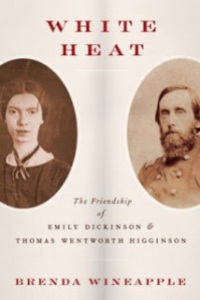
White Heat – The Friendship of Emily Dickinson and Thomas Wentworth Higginson

White HeatHe had seen men enslaved, and seen death in battle on a terrible scale. So when a young, unknown poet named Emily Dickinson wrote to ask whether he thought her verse was “alive”, Thomas Wentworth Higginson – a critic for The Atlantic Monthly and a decorated Union veteran – knew he was seeing poetry that lived and breathed like nothing he had seen before.

Higginson was immediately awed by Emily Dickinson, and went on to become her editor, mentor, and one of the reclusive poet’s closest confidantes. The two met only twice, but exchanged hundreds of deeply personal letters over the next twenty-five years; they commented on each other’s work, mulled over writers they admired, and dazzled each other with nimble turns of phrase. After she died, he shepherded the first collected edition of her poetry into publication, and was a tireless champion of her work in his influential Recent Poems column for The Nation.

Later generations of literary scholars have dismissed Higginson as a dull, ordinary mind, blaming him for the decision to strip some of the distinctive, unusual structure from Dickinson’s poems for publication. However, Brenda Wineapple offers a portrait of Higginson that is far beyond ordinary. He was a widely respected writer, a fervent abolitionist, and a secret accomplice to John Brown’s raid on Harpers Ferry; wounded in the first year of the Civil War, he returned to service as colonel of the first federally-authorized regiment of former slaves. White Heat reveals a rich, remarkable friendship between the citizen soldier and the poet, a correspondence from which Dickinson drew tremendous passion and inspiration – and which she credited, more than once, with saving her life.

Brenda Wineapple is the author and editor of five books, including the award-winning Hawthorne: A Life and Sister Brother: Gertrude and Leo Stein. Her essays, articles, and reviews have appeared in The American Scholar, The New York Times Book Review, Parnassus, Poetry, and The Nation. She teaches in the MFA programs at Columbia University and The New School in New York.

Merry Christmas

It’s Tuesday, December 25, 2012. It is Christmas Day. Today is the birthday of my Uncle Vernon May, Val Harper Chatham (member of my Bible fellowship class and friend Jerry’s wife), and Viktoria Tori (RN and friend). It is 45 degrees F at 5:30 AM. A line of thunderstorms moved through DeSoto, Texas at 1:40 AM with heavy rain, hail, and high winds. I am at my 86 years old father’s house for Christmas.

A Winter Weather Advisory was issued at 3:30 AM … Winter Weather Advisory now in effect from 9 am this morning to midnight CST tonight…

  • Timing … rain is expected to change over to snow from west to east today. All snow will end from west to east in the evening hours.
  • Location … this Winter Weather Advisory statement is for the counties of Young… Jack… wise… Denton… Collin… Hunt… Delta and Hopkins.
  • Main impact… snowfall accumulations between 2 and 4 inches.
  • Other impacts… northwest winds of 25 to 35 mph with higher gusts will result in areas of blowing snow. This may result in visibility restrictions of less than a half mile. Bridges and overpasses will be the first to ice over… but some surface roads may become icy by late afternoon in areas where heavier snow falls. Precautionary/preparedness actions… Be prepared for icy spots on area roads and highways by Christmas evening. Check Road conditions before departing if you must travel. If travel is necessary… drive with extreme caution. Some light accumulations of snow and ice are possible… especially on elevated surfaces. Bridges and overpasses will be the first locations where icy spots may develop.