My Writer’s Group

Our writing group! Minus a couple of key members.

One way a writer can improve his odds of traditional publication is having an established writer as a mentor. Writing groups can also encourage and mentor. Let me share an example of the influence a mentor.

In 1919 a young veteran returned from World War I. He moved to Chicago moving into a certain neighborhood for the purpose of being close to the author Sherwood Anderson.

The young beginning writer liked the critical praise for Anderson and his book Winesburg, Ohio. He had heard that Sherwood Anderson was willing to help aspiring writers. He worked to met Anderson. The two men became close friends. They met almost every day to read newspapers, magazines, and novels. They dissected the writings they read.

The aspiring writer brought his own works for critique having Anderson help him improve his craft. Anderson went as far as introducing the want-to-be writer to his network of publishing contacts. The aspiring writer did okay with his first book The Sun Also Rises. The aspiring writer was Ernest Hemingway.

Sherwood Anderson didn’t stop there. He moved to New Orleans where he met another aspiring writer. He took the young man through the same steps and paces of the craft. They shared an apartment. He even invested $300 in getting this writer’s first book Soldier’s Pay published. This young author was William Faulkner. Faulkner’s teacher was the encouragement of learning from how others crafted their work.

Anderson would later move to California and repeat the process with John Steinbeck. Thomas Wolfe and Erskine Caldwell were also mentored by Sherwood Anderson. Ray Bradbury says Winesburg, Ohio was on his mind when he wrote The Martin Chronicles. He basically wrote Winesburg, Ohio placing it on the planet Mars.

Only Mark Twain has had a greater influence in shaping modern American writing than Sherwood Anderson. Anderson didn’t do too badly, did he? William Faulkner, Ernest Hemingway and John Steinbeck each won the Nobel Prize for Literature and there are multiple Pulitzer Prizes between them.

If you are serious about writing find a mentor or join a writing group. My writer’s group and critique group keep me motivated. My writer’s group and group’s member are the best thing that happened to me in 2012.

Merry Christmas

It’s Tuesday, December 25, 2012. It is Christmas Day. Today is the birthday of my Uncle Vernon May, Val Harper Chatham (member of my Bible fellowship class and friend Jerry’s wife), and Viktoria Tori (RN and friend). It is 45 degrees F at 5:30 AM. A line of thunderstorms moved through DeSoto, Texas at 1:40 AM with heavy rain, hail, and high winds. I am at my 86 years old father’s house for Christmas.

A Winter Weather Advisory was issued at 3:30 AM … Winter Weather Advisory now in effect from 9 am this morning to midnight CST tonight…

  • Timing … rain is expected to change over to snow from west to east today. All snow will end from west to east in the evening hours.
  • Location … this Winter Weather Advisory statement is for the counties of Young… Jack… wise… Denton… Collin… Hunt… Delta and Hopkins.
  • Main impact… snowfall accumulations between 2 and 4 inches.
  • Other impacts… northwest winds of 25 to 35 mph with higher gusts will result in areas of blowing snow. This may result in visibility restrictions of less than a half mile. Bridges and overpasses will be the first to ice over… but some surface roads may become icy by late afternoon in areas where heavier snow falls. Precautionary/preparedness actions… Be prepared for icy spots on area roads and highways by Christmas evening. Check Road conditions before departing if you must travel. If travel is necessary… drive with extreme caution. Some light accumulations of snow and ice are possible… especially on elevated surfaces. Bridges and overpasses will be the first locations where icy spots may develop.

Devotional: Joy to the World

Joy to the World!

The words and lyrics of the old Christmas carol ‘Joy to the World’ were written in 1719 by Isaac Watts (1674-1748). Joy to the World is a popular Christmas carol which is based on Psalm 98 in the Bible. The father of John Watts was a Non-conformist and so extreme were his views that he was imprisoned twice. His father’s influence over Isaac was demonstrated when he choose to attend Non­conformist Academy at Stoke Newington in preference to a University. Watts was ordained as a Pastor of an Independent congregation. He wrote many hymns and Carols and was awarded a Doctor of Divinity degree by the the University of Edinburgh in 1728. The music to the carol is by George Frederick Handel (1685-1759).

Joy to the World
by Isaac Watts

Joy to the world, the Lord is come!
Let earth receive her King;
Let every heart prepare Him room,
And Heaven and nature sing,
And Heaven, and Heaven, and nature sing.

Joy to the world, the Savior reigns!
Let men their songs employ;
While fields and floods, rocks, hills and plains
Repeat the sounding joy,
Repeat, repeat, the sounding joy.

No more let sins and sorrows grow,
Nor thorns infest the ground;
He comes to make His blessings flow
Far as the curse is found,
Far as, far as, the curse is found.

He rules the world with truth and grace,
And makes the nations prove
The glories of His righteousness,
And wonders of His love,
And wonders, wonders, of His love.

A Visit from St. Nicholas

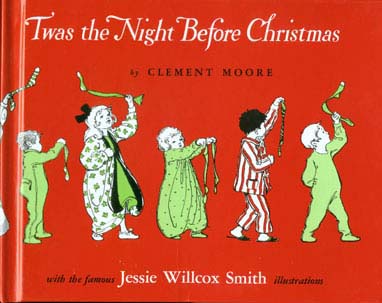
Twas the Night Before Christmas

It’s Sunday, December 23, 2012. On this date in 1823 the Troy Sentinel (a New York state newspaper) published the poem “A Visit from St. Nicholas”.

A Visit from St. Nicholas
by Clement Clark Moore

‘Twas the night before Christmas, when all through the house
Not a creature was stirring, not even a mouse;
The stockings were hung by the chimney with care,
In hopes that St. Nicholas soon would be there;
The children were nestled all snug in their beds,
While visions of sugar-plums danced in their heads;
And mamma in her ’kerchief, and I in my cap,
Had just settled our brains for a long winter’s nap,
When out on the lawn there arose such a clatter,
I sprang from the bed to see what was the matter.
Away to the window I flew like a flash,
Tore open the shutters and threw up the sash.
The moon on the breast of the new-fallen snow
Gave the lustre of mid-day to objects below,
When, what to my wondering eyes should appear,
But a miniature sleigh, and eight tiny reindeer,
With a little old driver, so lively and quick,
I knew in a moment it must be St. Nick.
More rapid than eagles his coursers they came,
And he whistled, and shouted, and called them by name;
“Now, Dasher! now, Dancer! now, Prancer and Vixen!
On, Comet! on, Cupid! on, Donder and Blitzen!
To the top of the porch! to the top of the wall!
Now dash away! dash away! dash away all!”
As dry leaves that before the wild hurricane fly,
When they meet with an obstacle, mount to the sky;
So up to the house-top the coursers they flew,
With the sleigh full of Toys, and St. Nicholas too.
And then, in a twinkling, I heard on the roof
The prancing and pawing of each little hoof.
As I drew in my head, and was turning around,
Down the chimney St. Nicholas came with a bound.
He was dressed all in fur, from his head to his foot,
And his clothes were all tarnished with ashes and soot;
A bundle of Toys he had flung on his back,
And he looked like a pedler just opening his pack.
His eyes—how they twinkled! his dimples how merry!
His cheeks were like roses, his nose like a cherry!
His droll little mouth was drawn up like a bow
And the beard of his chin was as white as the snow;
The stump of a pipe he held tight in his teeth,
And the smoke it encircled his head like a wreath;
He had a broad face and a little round belly,
That shook when he laughed, like a bowlful of jelly.
He was chubby and plump, a right jolly old elf,
And I laughed when I saw him, in spite of myself;
A wink of his eye and a twist of his head,
Soon gave me to know I had nothing to dread;
He spoke not a word, but went straight to his work,
And filled all the stockings; then turned with a jerk,
And laying his finger aside of his nose,
And giving a nod, up the chimney he rose;
He sprang to his sleigh, to his team gave a whistle,
And away they all flew like the down of a thistle,
But I heard him exclaim, ere he drove out of sight,
“Happy Christmas to all, and to all a good-night.”

Essay: What if the world ends on Friday? Are you ready. I am. Here’s my story …

What if the world ends on Friday? Are you ready. I am. Here’s my story …

On July 11, 1977 my life changed. If you look up that date in history, you will find nothing historically significant happened on that Sunday. It was historically significant to me. That day was the watershed event in my life.

July 1977 found me on active duty as a lieutenant in the United States Army. I was serving as Battalion Maintenance Office, 2nd Battalion, 47th Infantry, 9th Infantry Division located at Fort Lewis, Washington. Life was good. I had a beautiful, intelligent wife. I had a new son born in January that same year. My career was going great. I had just got a commendable rating during an annual general inspection in maintenance. It was the first commendable rating since the division had returned from Vietnam. I had been named an Outstanding Junior Officer of the Ninth Infantry Division because of the commendable rating. I had been offered a regular army commission.

I always tried to be the best I could be, and do what is right. However, after all of this, I still had an empty, unsatisfied, void, and alone feeling. Beginning in my teen-aged years, I had tried such as social drinking, women, materialism, partying, and hanging with the right crowd to fill this unexplained need I had. I knew something was missing from my life.

I was attending church. I noticed a group of men that seemed to have what I was missing. I attended a Bible study with them. Here I found that God has given us an important manual for life, the Bible. He has the answers to the problems and emptiness we may face. I found out I was here for a purpose, and not by accident. I learned Jesus loves me, and desires to have a personal relationship with me. But, sin separated me from Him.

I realized I had a sin problem. The Bible says: For all have sinned and fall short of the glory of God. Romans 3:23 But no one is perfect! We have all sinned and therefore cannot save ourselves by simply living a good life. Why?

I learned there was a penalty to be paid for my sin. The Bible says: For the wages of sin is death, but the gift of God is eternal life in Christ Jesus our Lord. Romans 6:23

I learned God gives us a promise. The Bible says: For God so loved the world, that he gave his only begotten Son, that whosoever believeth in him shall not perish, but has everlasting life. John 3:16.

I learned that God made provision for me. The Bible says: If you confess with your mouth, Jesus is Lord, and believe in your heart that God raised Him from the dead, you will be saved. For it is with your heart that you believe and are justified, and it is with your mouth that you confess and are saved. Romans 10:9-10

I prayed to accept the gift of eternal life through Jesus. I prayed, Jesus, I know that I am a sinner. I believe that Jesus died for my sins and rose from the grave so that I might have eternal life in Heaven with You. I willingly repent of my sins and ask you to come into my heart and life. Take control of my words, thoughts, and actions. I place all of my trust in You for my salvation. I accept You as my Lord and Savior, and this free gift of eternal life. Amen.

Since then all has not been perfect. I have messed up from time to time, sometime big mess-ups. However, I have had direction and purpose in my life. I know where I am headed. I have the Bible to give me the principles for daily living. I am never alone. I have had real peace for the last 35 years.

You can have this same peace, too. How, follow the same steps I outlined above.

Review: A Christmas Carol: In Prose, A Ghost Story of Christmas

300px-Charles_Dickens-A_Christmas_Carol-Title_page-First_edition_1843A Christmas Carol

A Christmas Carol is a novella by English author Charles Dickens first published by Chapman & Hall on 19 December 1843. The story tells of sour and stingy Ebenezer Scrooge’s ideological, ethical, and emotional transformation after the supernatural visits of Jacob Marley and the Ghosts of Christmas Past, Present, and Yet to Come. The novella met with instant success and critical acclaim.

The book was written and published in early Victorian era Britain when it was experiencing a nostalgic interest in its forgotten Christmas traditions, and at the time when new customs such as the Christmas tree and greeting cards were being introduced. Dickens’ sources for the tale appear to be many and varied but are principally the humiliating experiences of his childhood, his sympathy for the poor, and various Christmas stories and fairy tales.

The tale has been viewed by critics like T.A. Jackson and Paul Benjamin Davis as an indictment of 19th-century industrial capitalism, and was adapted several times to the stage. It has been credited with restoring the holiday to one of merriment and festivity in Britain and America after a period of sobriety and sombreness. A Christmas Carol remains popular, has never been out of print, and has been adapted to film, opera, and other media.

Context

In the middle 19th century, a nostalgic interest in pre-Cromwell Christmas traditions swept Victorian England following the publications of Davies Gilbert’s Some Ancient Christmas Carols (1822), William B. Sandys’s Selection of Christmas Carols, Ancient and Modern (1833), and Thomas K. Hervey’s The Book of Christmas (1837). That interest was further stimulated by Prince Albert, Queen Victoria’s German-born husband, who popularized the German Christmas tree in Britain after their marriage in 1841, the first Christmas card in 1843, and a revival in carol singing. Hervey’s study of Christmas customs attributed their passing to regrettable social change and the urbanization of England.

Dickens’ Carol was one of the greatest influences in rejuvenating the old Christmas traditions of England, but, while it brings to the reader images of light, joy, warmth and life, it also brings strong and unforgettable images of darkness, despair, coldness, sadness and death.[7] Scrooge himself is the embodiment of winter, and, just as winter is followed by spring and the renewal of life, so too is Scrooge’s cold, pinched heart restored to the innocent goodwill he had known in his childhood and youth.

Plot

Dickens divides the book into five chapters, which he labels “staves”, that is, “(song) stanzas” in keeping with the title of the book. (He uses a similar device in his next two Christmas books, titling the four divisions of The Chimes, “quarters”, after the quarter-hour tolling of clock chimes, and naming the parts of The Cricket on the Hearth “chirps”.)

The tale begins on a Christmas Eve in 1843 exactly seven years after the death of Ebenezer Scrooge’s business partner, Jacob Marley. Scrooge is established within the first stave as a greedy and stingy businessman who has no place in his life for kindness, compassion, charity or benevolence, rudely turning away two gentlemen who seek a donation from him. He hates Christmas, calling it “humbug”, and refuses his nephew Fred’s dinner invitation; his only “Christmas gift” is allowing his overworked, underpaid clerk Bob Cratchit Christmas Day off with pay (which he does only to keep with social custom, Scrooge considering it like being pickpocketed annually).

Returning home, Scrooge is visited by Marley’s ghost, who warns him to change his ways (lest he undergo the same miserable afterlife as himself). Scrooge is then visited by three additional ghosts – each in its turn, and each visit detailed in a separate stave – who accompany him to various scenes with the hope of achieving his transformation.

The first of the spirits, the Ghost of Christmas Past, takes Scrooge to Christmas scenes of his boyhood and youth, which stir the old miser’s gentle and tender side by reminding him of a time when he was more innocent. They also show what made Scrooge the miser that he is, and why he dislikes Christmas.

The second spirit, the Ghost of Christmas Present, takes Scrooge to several radically differing scenes (a joy-filled market of people buying the makings of Christmas dinner, the family feast of Scrooge’s near-impoverished clerk Bob Cratchit including his youngest son, Tiny Tim, who is seriously ill but cannot receive treatment due to Scrooge’s unwillingness to pay Cratchit a decent wage, a miner’s cottage, and a lighthouse, among other sites) in order to evince from the miser a sense of responsibility for his fellow man.

The third spirit, the Ghost of Christmas Yet to Come, harrows Scrooge with dire visions of the future if he does not learn and act upon what he has witnessed (including Tiny Tim’s death). Scrooge’s own neglected and untended grave is revealed, prompting the miser to aver that he will change his ways in hopes of changing these “shadows of what may be.”

In the fifth and final stave, Scrooge awakens on Christmas morning with joy and love in his heart, then spends the day with his nephew’s family after anonymously sending a prize turkey to the Cratchit home for Christmas dinner. Scrooge has become a different man overnight and now treats his fellow men with kindness, generosity and compassion, gaining a reputation as a man who embodies the spirit of Christmas. The story closes with the narrator confirming the validity, completeness and permanence of Scrooge’s transformation.

Sources: My knowledge of the book.

Poem: I Get Up In The Morning

I Get Up In The Morning

I get up in the morning
A new day begins
I go the mirror
And shave my face again

The years show my age
But my eyes still shine
I think of my lady
I’m so glad she’s still mine

I go to my workplace
And I do my thing
I listen to Pandora
And I start to sing

The day passes quickly
My tasks all complete
I drive to the restaurant
And order tea that’s sweet

The evening meal is fine
As fine as fine can be
And my desert
Is something for all to see

I return to my house
Now the day is done
I sit on the porch
And watch the setting sun

The day is now over
And I go to bed
I say my prayers
And meditate on Scripture in my head

I pray that my dreams
Have me thinking of you
And in my slumber
My dreams come true

I get up in the morning
A new day begins
I go to the mirror
And shave my face again.

Jimmie A. Kepler
© 2008

Originally published in:
WORDS..RHYMES..POETRY & PROSE!

Devotional: A Personal Writing Mission Statement

I am currently attending the East Texas Christian Writer’s Conference at East Texas Baptist University in Marshall, Texas. Yesterday at the conference we received a two-part challenge. First, “as Christian writers” write a “personal writing mission statement”. Second, share it with someone to get their response. Well, I always do my homework on time. I’m sharing what I wrote with you …

My personal writing mission statement:

• sharing Jesus Christ and his teachings with an emphasis on the application of His lessons to everyday life,
• encouraging the development of poets and writers, and
• promoting appreciation of the liberal arts.

Poem: Little Squirrel


Little Squirrel

Little squirrel
In the tree
I see you
Looking at me

Your color is red
In your furry coat
You look at me
Sitting in the boat

You’re eating the acorns
Found in the tree
A smile on your face
Dropping the shells on me!

© 2009 Jimmie A. Kepler

Originally published in:
WORDS..RHYMES..POETRY & PROSE
May 2011

Meet the Poets: Mona Van Duyn – Pulitzer Prize in Poetry 1991 and Poet Laureate of the United States of America 1992

Mona Jane Van Duyn (May 9, 1921 – December 2, 2004) was an American poet. She won every major American award for poetry and was appointed Poet Laureate Consultant in Poetry to the Library of Congress in 1992.

In 1921, Mona Van Duyn was born in Waterloo, Iowa, and raised in the small town of Eldora, Iowa.

She received degrees from Iowa State Teachers College and the University of Iowa. It was there she met Jarvis Thurston, whom she married in 1943, and with whom she founded Perspective, a Quarterly of Literature in 1947, a publication she co-edited until 1975.

Van Duyn’s first collection of poems, Valentines to the Wide World (Cummington Publishing), was published in 1959, followed by A Time of Bees, which appeared as part of the University of North Carolina Press Contemporary Poetry Series in 1964.

She became close friends with the poet James Merrill, and from 1964 through 1981 the two engaged in regular correspondence, which included exchanging poems by mail.

In 1970, Van Duyn published To See, To Take (Atheneum), which received the National Book Award in 1971, followed by Bedtime Stories (Ceres Press, 1972). Her later collections include: Selected Poems (Knopf, 2003); Firefall (1994); If It Be Not I: Collected Poems, 1959-1982 (1994); Near Changes (1990), for which she won the Pulitzer Prize; Letters From a Father, and Other Poems (Atheneum, 1982); and Merciful Disguises (1973), which includes the bulk of her first four books.

About her work, the poet Alfred Corn has said, “Mona Van Duyn has assembled, in a language at once beautiful and exact, one of the most convincing bodies of work in our poetry.” Cynthia Zarin has called her poetry “notable for its formal accomplishment and for its thematic ambition,” adding that the “searching intelligence of the persona we have learned to know in her poems, combined with the humor, technical ease, and the blend of the abstract and the quotidian that the poet has made her own have resulted in that rare good thing: a strong, clear voice, original without eccentricity.”

Van Duyn was awarded the Bollingen Prize, the Hart Crane Memorial Award, the Ruth Lilly Prize, the Loines Prize of the National Institute of Arts and Letters, the Shelley Memorial Prize, and both the Harriet Monroe Memorial Prize and the Eunice Tietjens Award from Poetry magazine, as well as fellowships from The Academy of American Poets, the American Academy of Arts and Sciences, the Guggenheim Foundation, and the National Endowment for the Arts.

Van Duyn has said, “I believe that good poetry can be as ornate as a cathedral or as bare as a pottingshed, as long as it confronts the self with honesty and fullness. Nobody is born with the capacity to perform this act of confrontation, in poetry or anywhere else; one’s writing career is simply a continuing effort to increase one’s skill at it.”

She was elected a Chancellor of the Academy of American Poets in 1985, and served as the first woman Poet Laureate of the United States from 1992 to 1993, the year she was inducted into the St. Louis Walk of Fame.

Mona Van Duyn died of bone cancer on December 1, 2004, in St. Louis, Missouri, where she had lived since 1950.

Selected Bibliography

Valentines to the Wide World (Cummington Publishing, 1959)
A Time of Bees (University of North Carolina Press, 1964)
To See, to Take (Antheneum, 1970)
Bedtime Stories (Ceres Press, 1972)
Merciful Disguises: Poems Published and Unpublished (Atheneum, 1973)
Letters from a Father, and Other Poems (Atheneum, 1982)
Near Changes (Knopf, 1990) – Pulitzer Prize 1991
If It Be Not I: Collected Poems (Knopf, 1992)
Firefall (Knopf, 1992)
Selected Poems (Knopf, 2002)

Sources: http://en.wikipedia.org/wiki/Mona_Van_Duyn and http://www.poets.org/poet.php/prmPID/169