The Most Dangerous Enemy: An Illustrated History of the Battle of Britain by Stephen Bungay

“The Most Dangerous Enemy: An Illustrated History of the Battle of Britain” is spectacular. It merits a five-star rating. It is in a large-format of 11.9 x 9.8 x 1.1 inches. The quality of the book is immaculate. If you are a history buff with an interest in the Battle of Britain this is the book for you. The book is divided into three sections: Part 1: Build-up, Part 2: Battle, and Part 3: Aftermath. It takes you on a journey of understanding. You learn of the organization of the air forces. You learn about the various types of aircraft. You learn of the radar and air defenses as well as air craft production. The detail of the information is astounding.
The book has over 150 photographs. This includes a large number of rare color photos. The book is a treasure full of color maps and diagrams. There are a number of excellent “sidebar” features as well. Using numerous first-hand experience stories Mr. Bungay brings this critical story from history alive in an exciting way. The quality and quantity of the photographs alone is reason enough to purchase the book. He has many never before published pictures of planes, aircraft pilots, and pivotal military leaders. The diagrams of aerial fights add clarity to the story they illustrate.
Well done Stephen Bungay. The book will be an excellent addition to any history buff’s library. Any World War II European Theater veteran will enjoy seeing and owning the book. It would make a great addition to school and community libraries.
Reviewers note: I did not compare Stephen Bungay’s “The Most Dangerous Enemy: An Illustrated History of the Battle of Britain” with the original release by Stephen Bungay of “The Most Dangerous Enemy: A History of the Battle of Britain”. That is not the purpose of this review. The non-illustrated “original” book is the definitive reference work that stands. It is the classic on the subject. “The Most Dangerous Enemy: An Illustrated History of the Battle of Britain” is spectacular and deserves to join its predecessor as the illustrated definitive work on the Battle of Britain. Well done Mr. Stephen Bungay!

The American Aircraft Factory in World War II by Bill Yenne

The American Aircraft Factory in World War II by Bill Yenne is truly magnificent. When I first had the book in my hand I thought “coffee table book”. After reading the book and looking at the pictures it is so much more. It is a wonderful tribute to the men and women who built the airplanes. It is an excellent history of the aircraft industry in the Unites States. The author gives a great background and understanding of the founders and companies like Boeing, North American, Curtiss, Consolidated, Douglas, Grumman, and Lockheed.

I learned of the Air Mail Act of 1934. The act required the separation of the airlines from manufactures. It caused some like William Edward Boeing to leave the industry. He gives great tribute to the gender shift in the work place and the ramping up of the industry for the war. He takes us through the construction of the facilities as well as the transition back to a peace time production.

The photographs in the book are amazing. I have never seen so many high quality photographs of this era in one collection. Without the pictures the book is a wonderful history of the aircraft industry. With the pictures it is transformed into a work of art.

I highly recommend the book for all aviation and World War II buffs. It would be an excellent addition to community and public school libraries as well. This is a masterpiece that will stand the test of time.

Spies In The Garden: A Novel of War and Espionage by Bob Bergin

“Spies In The Garden: A Novel of War and Espionage” by Bob Bergin takes place during the Japanese invasion of Burma and China. The book centers on the actions of the Flying Tigers (the American Volunteer Group). The book provides a good history of the Flying Tigers wrapped around the story.

The author knows the history of the Flying Tigers. I enjoyed his description of the pilots and their actions. The story begins in November 1941. The fictional hero, Harry Ross, is an American spy working undercover as a writer. He witnesses their early training. The training has with disaster after disaster. The Flying Tigers improve as the story advances into a force feared by the Japanese. Bob Bergin leaves no doubt that he views their performance as far better to the British Royal Air Force.

The narrative commences in Rangoon. Here Ross makes contact with the Flying Tigers. Ross also meets father and daughter Louie and Lucy. Louie is a trader. He supplied lavishness goods to the Chinese Nationalist leaders. Daughter Lucy is stylish and classy as well as beautiful. She and Harry become platonic friends.

Bergin tells a good story. Harry always seems to get out of the jams he encounters. His relationships with Sue and then Tai Li provide information for his work. He receives a Shanghai girl as a reward from Tai LI. She is in bed with the enemy and provides her pillow talk with the Japanese officers to Harry. This endures Harry with his superiors.

By July 1942, the Flying Tigers are winding down. Chennault becomes a Brigadier General. He finds himself working under General Joe Stilwell. We experience the differences between them. We also encounter the differences between the different arms of the Intelligence Services.

Harry does not seem to comprehend all that is happening and its consequences. Ross’ controller Doyle steers him and cautions him about getting caught up with politics.

We are left to contemplate what happens next as the book concludes with the end of the Flying Tigers in July 1942.

There is a final two-page wrap up at the end of the book – “What Became of Them?” It gives a brief winding up of the unanswered questions.

Bob Bergin knows the Flying Tigers. He tells a good story from an American point of view. If you like war, espionage, seduction, and intrigue this book is for you. Moreover, do not be surprised if you learn about the Flying Tigers along the way. I recommend buying the book. Mr. Bergin gives a good story and history of the Flying Tigers for your financial investment.

Reviewed by Jimmie A. Kepler, August 23, 2010.

One Great Way to Write a Book Review

About every five weeks I write a book review. Since December 2007, I have written 148 book reviews of military history books for my website Kepler’s Military History Book Reviews. Front Row Monthly noticed my love for reviewing books. Last year they published twelve of my reviews in their Front Row Lit Magazine.

I love reading, receiving review copies in the mail, having authors and publicists asking if I am interested in reading their book and interviewing the author.

In recent days, the newspapers and Internet have had negative articles about some reviews. Regarding any review I have written on Kepler’s Military History Book Reviews: I received no payment, the only compensation, was the book that was used to write the review and was sent by the publisher, author, publicists or media groups. Here is one great way to write a book review. It is my philosophy for writing a review.

Read the book. I know; it seems obvious but read the book! You might find out the author did a very good job.  She or she probably invested two to four years of their life in the book project, so read the book.  Don’t even think about writing a review of something you only skimmed or only partially read. Reading the book is critical to a good review.

Know what you are reading. If you don’t understand the book that you are going to write about, you cannot write a good review. If you are reading a nonfiction book on a topic you know little about, make some effort to learn something about the topic.  I write military history book reviews.  I have a formal background in history with a bachelor’s degree in the subject.  I am widely read in history with a general background in all areas of US and English History and am a serious student of US Military History.

Make notes about what you read. You may want to make note of key phrase or sentences as you meet them.  You can quote them in the review. As you read ask yourself:

  • Who is telling the story? Is it in first person or third person?
  • What genre does it belong to? Narrative history, historical fiction, memoir?
  • What about the style of writing? Is the author a good story-teller?  Is it serious scholarship with footnote after footnote? Is the style conversational or is it full of big words that need a dictionary at your side? Does it paint a word picture in your mind? When was it written? Was there a ghost writer or co-author?
  • Does the book touch your heart and mind?  Does it move you to an emotional or volitional climax about the topic being read?

Keep track of the storyline or chronology of the book.  It will help you when reading long, complicated works.

Know the author and his or her works. When you finished gathering the information and you have enough notes, then you are ready to write the article.

Start with an introduction. The way you start will depend on your target audience. Consider beginning with a paragraph that describes your first impression of the work, or an interesting story that you had experienced through the book, or a more technical introduction where you briefly state the author, title, publisher, and any other information about the book you see pertinently.  I like to ask a thought-provoking question.  An example is “Have you ever wondered what it would be like being a marine in Iraq?” It gets the reader thinking.a.  Give a brief history of the author with some relevant information such as earlier works, awards, etc.

  • Cover the structure of the book without giving away the plot or ending.
  • Explain your opinion of the book and give a summary of the review.
  • Finish by recommending the book. State who would benefit and enjoy the book, using general terms (students, veterans, etc.).
  • I like to tell the reader where and how they can get the book.

Include your full name in the end with the date of the review. On my book review site, I allow feedback. I have had a few authors contact and challenge me. I have had some authors point out grammar or spelling errors. An example of the most frequent comment are in the words of David Laskin of the University of Washington. He wrote, “The Long Way Home: An American Journey from Ellis Island to the Great War”. He thanked me for reading the book. He said from my review he had no doubt I had read the book.  By the way, the book was amazing.

Noble Warrior: The Life and Times of Maj. Gen. James E. Livingston, USMC (Ret.), Medal of Honor by James E. Livingston, Colin D. Heaton, and Anne-Marie Lewis

Noble Warrior: The Life and Times of Maj. Gen. James E. Livingston, USMC (Ret.), Medal of Honor by James E. Livingston, Colin D. Heaton, and Anne-Marie Lewis is more than the story of Maj. Gen. James Livingston and how he earned the Medal of Honor. It is an excellent book on leadership that uses his story to convey the lessons.

We learn how he went from North Georgia College and Auburn University to joining the United States Marine Corps, getting his commission and his journey to fighting in Vietnam to his post-combat career. The book is excellent. It is well written and well documented. It helps us understand the life of a Marine and his leadership.

Livingston makes clear his motivation for the unlimited and occasionally ruthless training programs for which he was known. He had his Marines doing physical training in the combat zone. He maintained discipline – personal hygiene (including shaving), weapons maintenance, and personal equipment. He was a leader by example. I have no doubt his leadership saved many lives. His men were physically fit, their equipment well maintained and in good repair, and he had earned their follow-up by providing leadership.

Livingston recounts how their under strength battalion landing team found itself in a three-day life and death battle against 7,000 experienced North Vietnamese regulars.

I found myself wondering how bad it really was as I turned the pages of the account. The narrative was captivating. He clearly painted the picture where you felt like you were there with them. I was amazed when the men left the steaks and soft drinks behind to dash to the aid of the fellow Marines. It told me a lot about how he had trained and prepared his men to be Marines. How they put the good of the mission and the unit above individual needs.

Lance Cpl. Valdez’s account of Captain Livingstone never taking a step back or flinching got my attention. It reminded me of how our actions speak louder than our words. His men saw him lead out front.

His having them fix bayonets and then a movement where he used “the tested and tried edict of penetrating and then widening the hole. We had practiced these types of small-unit maneuvers and were good at it.” Again I see the leadership. This is more than just doing your job.

These are the things you have to do to be ready. These are the types of preparation than save lives and win battles. When you do what you should do you are viewed as hard. From reading the book I am convinced that only because he had paid the price in preparation, maintained the discipline having them stay fit, sharp, and their weapons maintained allowed them to overcome such a huge force.

Livingston returned to Vietnam and was involved in the frantic mass departure of Americans and Vietnamese as Saigon fell in 1975. He retired from the Marine Corps in 1995. He went on to a successful public service career where he advised on the recovery from the destruction of Hurricane Katrina. He does not hold back where he thinks the responsibility lay for that catastrophe.

The book is excellent. It would be a good addition to any military history or Vietnam War library. I see the book also as a good case study on how to do it right in the midst of a very bad situation – an outstanding resource for junior officers of all branches. The emphasis on physical training, weapons maintenance, and the basics of being a good Marine (or soldier) should inspire all junior leaders to do their job as it should be done. The use of the sidebar and the stories was excellent. It was like an in-depth look at the main event I was reading.

Major General Livingston for your service and leadership to the United States, thank you. To Colin D. Heaton and Anne-Marie Lewis for allowing the story to be told where you get a since for the personality and grit of Major General Livingstone, thank you. To all three authors – well done.

My Writing Room

Jimmie A. Kepler here, greetings from the blast furnace called north Texas and the Dallas-Fort Worth area. The temperature reached 109 degrees on my front porch today. That’s hot!

This morning I went to Starbucks for my morning writing. I love the early morning right before the sun comes up. There is a peacefulness found there not found elsewhere. Starbucks is where I do about third of my writing. I do over half of my writing at home. I thought today I would show you   my modest home office. It is a combination bedroom/office. It is the bedroom where I sleep each night.

I’ve created a three-minute and fifty-one second video tour of my home office. I hope you have as much fun seeing the video as I had making it.

My home office, by Jimmie A. Kepler …

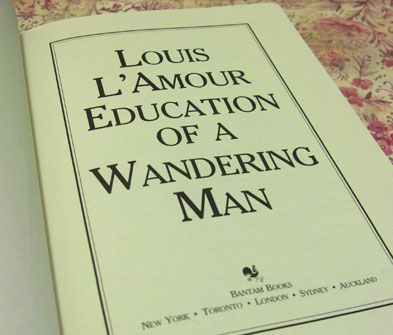
Education of a Wandering Man by Louis L’Amour

Education of a Wandering Man

This is about as close as an L’Amour fan will come to an autobiography. This is not a western novel, though it gives great insight into how he wrote and researched his books. The book starts with a reference to his high school class graduating while he was on a steamer in Indonesia.

L’Amour gives the reader a lengthy discussion of becoming self-educated through books, travel, and experience. I enjoyed the lengthy lists of books L’Amour read during his wandering years in the 30s.

I have logged what I read since reading the book in November 1990. It is a worthy discipline. I also started writing a short, generally no more than on page review of what I read after reading this book. It was the beginning of my writing a review or summary of each book I read.

L’Amour gives a breathtaking discussion of walking out of the Mojave Desert. It reminded me of my time at Fort Irwin, California (about 50 miles north of Barstow in the middle of similar land). L’Amour was a great researcher, and wrote from both personal experience and knowledge.

Disorganized, rambling, and repetitious, it is still an enjoyable book. Louis L’Amour emphasizes the value of education through experience and self-guided reading. He never degrades formal education. Required reading for any aspiring writer must include this book. Read by Jimmie A. Kepler.

Review: Girls Like Us: Carole King, Joni Mitchell, Carly Simon – And the Journey of a Generation

Tonight I watched a new installment of PBS’ My Music series. Founding Supremes singer Mary Wilson served as the host of the program showcasing many classic female singers and girl groups of the 1960s. It showcased seventeen of the singers/groups. Watching it reminded me of the book “Girls Like Us: Carole King, Joni Mitchell, Carly Simon – And the Journey of a Generation” by Sheila Weller that I read a couple of years ago. Here is a review of the book I wrote in August 2011.

The contents of “Girls Like Us: Carole King, Joni Mitchell, Carly Simon–And the Journey of a Generation” by Sheila Weller will be very recognizable to us who came of age in the 1960s and 1970s. Sheila Weller tells us that King, Simon, and Mitchell pushes back the barriers for women specifically, “one song at a time.”

The enigmatic one remains Carole King, whom Weller just can’t shed light on in any significant way. King’s life was amazing then it stopped being of any interest at all. We learn and hear again and again how she wrote all those Brill Building masterpieces before she was 21. We learn how she broke down under the strain of a troubled marriage to a husband and lyricist, Gerry Goffin whom she at married when she was 17 and pregnant by him. We see how she comes through the divorce with an LP, Tapestry, that everyone loved and bought. After that her life is bad men in abundance. They were attracted to her wealth. King once estimated that every time she divorced a man, it cost her a million dollars. Weller gives us all the facts. One still has to wonder why King did this to herself.

Carly Simon, on the other hand seems nearly normal as normal can be for someone of the upper, upper middle class. Though perceptibly spoiled and protected by wealth, Simon doesn’t seem spoiled. Her reactions are always understandable and sympathetic. This includes her meeting and marrying the drug-zombie James Taylor.

Joni Mitchell isn’t sympathetic. She has the integrated persona of the genius totally in love with herself and obsessed with her own reflection, so she’s great in a special way. The author makes fun of Mitchell’s vanity and enormous self-esteem. Weller still lets us know that, in her estimation at any rate, Mitchell actually is amazing.

Weller is interested in the ways women deal with each other. It’s nearly a biography of five people, not just three, as there is so much about James Taylor you will never need to read another word about him if you have this book on your shelf. There is also plenty of material about Judy Collins. Girls Like Us: Carole King, Joni Mitchell, Carly Simon–And the Journey of a Generation is a book that convinces us forcefully in its larger arguments and dazzles with its wide-ranging portraits of artistic life in the 50s, 60s and 70s.

Hello, I’m a Writer and Poet

Poetry & Prose Magazine February 2011

I’m Jimmie A. Kepler. I write poetry, nonfiction, science-fiction, historical fiction, and book reviews. You’ll find my blogs and websites are: Speaking of … , Kepler’s Book Reviews, Kepler’s Military History Book Reviews, Kepler’s Military History, and Jimmie A. Kepler – Writer & Poet. You can find a list of my publications and poems at Jimmie’s publications and poems.

I have completed a Christian historical fiction novel, “Honor and Jealousy in Texas.” I support my writing and reading habit by working a day job. I work as a solutions support analyst for a Fortune 500 privately held company. I belong to the Wholehearted Writing group in Dallas.

Reading, poetry and writing are my passions. I grew up in a career United States Air Force family. In my youth, I worked in a grocery store, warehouse, folk-rock band as a rhythm guitar player, a vendor at a major league baseball stadium, and for a milk distributor. I graduated college with a Bachelor of Arts degree in history with minors in English and military science.

I served as a commissioned officer in the United States Army on active duty for three years and then five years in the United States Army Reserves. I graduated from the Infantry Officer Basic Course and Airborne School. I am honorably discharged as a Captain, United States Army Reserves.

Coming off active duty I went to graduate school full-time completing Master of Religious Education/Master of Arts degree. During graduate school, I worked as a custodian, day laborer, painter, preschool teacher, and as a route auditor for a soft drink distributor. For 16 years, I worked as a director of education and private school principal. I earned a doctor of education degree in educational administration.

I have been freelance writing over 30 years selling his first article in 1981. I have sold nonfiction magazine and trade journal articles including getting three cover articles. I also have short stories and poems published. I wrote a weekly column for over sixteen years as well over 150 books reviews in the military history genre for several publishers. I have written a historical fiction novel, “Honor and Jealousy in Texas” and am an active member of Wholehearted Writing in Dallas.

In the late 1990s, I went back to college studying computer science completing the core curriculum for the associate of applied sciences in computer systems. I earned CompTIA A+, i-Net+ and Network+ computer certifications as well as induction in for Phi Theta Kappa for academic excellence. While born in Texas, I have lived in Ohio, Illinois, South Carolina, Arizona, New Hampshire, Kansas, Georgia, Louisiana, California, Washington, and Texas. I am married, have three grown children and one grandchild.

Guns of the Civil War by Dennis Adler

“Guns of the Civil War” by Dennis Adler is a wonderful book. The work provides a much need detailed reference for the guns used in the US Civil War. The release of the book is timely as it helps celebrate the 150th anniversary of the war. The book is a high quality publication with a stylish and thorough history of Colt, Henry, Manhattan, Remington, Sharps, Spencer, and S&W Firearms, and guns by many other competitors and contemporaries. The history and high-level coverage given to the armsmakers of the US Civil War era is without equal. The photography is high definition, beautiful, and world-class. The photographs easily would make an excellent gallery showing by themselves. 
I enjoyed sitting on the couch with my 85 years old father going through the book. We turned page by page and talked about the both the weapons, their descriptions, and the beauty of the photography. The book is an excellent reference. It will be enjoyed by historian,  US Civil War buff, as well as gun collectors. 
I have provided a copy of the book to my writer’s workshop to use for a reference. Any author of historical fiction will benefit from the detailed descriptions in the book. It would make a great addition to any community library.