My First Trip To The University of Texas McDonald Observatory

McDonald Observatory

In October 1974, I made my first trip to the University of Texas McDonald Observatory. It was 500 miles one-way from the campus of the University of Texas at Arlington to Fort Davis, Texas. The purpose of the trip was to do the required astronomical labs for my physics class in astronomy.

The trip was a caravan from the UT Arlington campus to far west Texas. We departed about 2 PM on Friday, October 4, 1974. We headed from Arlington west on Interstate 20 (yes it was built way back then). We drove to Lake Colorado City State Park about 3 miles south of Interstate 20 just southwest of Colorado City, Texas. I pitched my tent. I shared the tent with 4 young women and one young man that were fellow cadets in the UT Arlington ROTC program. Three of them were prior service (US military veterans).

The next morning we got up early and headed west. We stopped at a Stuckey’s (remember them?) getting two scrambled eggs with toast and bacon or sausage plus coffee for under a dollar. The journey continued to Pecos, Texas. There we left Interstate 20 and headed south on Texas Highway 17. We crossed Interstate 10 at Balmorhea, Texas and head south to Fort Davis. We camped at the Davis Mountains State Park.

That weekend the park also hosted a retreat for the Odessa, Texas Jaycees. Some of them were concerned that we had males and females cohabitating the same tent. I go a strong morals lecture from a Baptist deacon. It mattered not we were all of legal age.

That Saturday, October 5, 1974 a very good top five ranked Texas A & M football team was upset by Kansas University loosing 28 to 10. We listened to the game on the radio as we explored the city of Alpine, Texas and toured the Fort Davis National Historic site. I’ve actually been there more times than any national park or historic site with the exception of the Great Smoky Mountains National Park. Why? My brother-in-law is a retired Great Smoky Mountain Park Ranger.

We drove to the McDonald’s Observatory in the early afternoon to check-in and get ready for the night’s observations. Returned that night for one of the most memorable evenings of my life.

I’ll use my narrator voice and tell you about the observatory. An astronomical observatory located just northwest of Fort Davis, Texas, on Mount Locke in the Davis Mountains of West Texas is the McDonald Observatory. It has additional facilities on the adjacent Mount Fowlkes. It is the property of the University of Texas at Austin.

The philanthropy of Texas banker William Johnson McDonald (1844–1926) created it. He left his fortune to the University of Texas to endow an astronomical observatory.

It began operation in 1939. At that time,it was the second largest telescope in the world. The University of Chicago operated the observatory until 1960s, when control was transferred to the University of Texas at Austin.

The McDonald Observatory was the first location on earth to bounce a laser off a reflector left on the moon by Apollo astronauts. I learned this as an astronomy student on my 1974 road trip.

The McDonald Observatory is equipped with a wide range of instrumentation for imaging and spectroscopy in the optical and infrared spectra and operates the first lunar laser ranging station. It works closely with the astronomy department of the University of Texas at Austin while maintaining administrative autonomy.

The high and dry peaks of the Davis Mountains make for some of the darkest and clearest night skies in the region and provide excellent conditions for astronomical research. It is one of the darkest places on earth at night.

UT McDonald Observatory

The Otto Struve Telescope, dedicated in 1939, was the first large telescope built at the observatory. It is located on Mt. Locke at an altitude of 6,790 feet. The summit of Mt. Locke, accessed by Spur 78, is the highest point on Texas highways. The Harlan J. Smith Telescope, also on Mt. Locke, was completed in 1968.

The Hobby-Eberly Telescope (HET), dedicated in late 1997, is located on the summit of Mt. Fowlkes at 6,660 ft above sea level. It is operated jointly by the University of Texas at Austin, Pennsylvania State University, Stanford University, the Ludwig Maximilians University of Munich, and the Georg-August University of Göttingen.

As of 2012, the HET is tied with the similar Southern African Large Telescope (SALT) as the fifth largest telescope in the world. However, its cost was about 20% that of other similarly-sized telescopes in use today due to its optimization for spectrography.

Currently, the observatory operates four research telescopes at its West Texas site:

  • 9.2 m (360 in) Hobby-Eberly Telescope on Mt. Fowlkes
  • 2.7 m (110 in) Harlan J. Smith Telescope on Mt. Locke
  • 2.1 m (83 in) Otto Struve Telescope on Mt. Locke
  • 0.8 m (31 in) large format imaging telescope on Mt. Locke

The two peaks also host a number of other instruments:

  • The 1.2 m (47 in) Monitoring Network of Telescopes (MONET) North Telescope on Mt. Locke is a companion to one at the South African Astronomical Observatory in Sutherland, and was built by Halfmann Teleskoptechnik.
  • The McDonald Laser Ranging System (MLRS) operates a 0.76 m (30 in) telescope on Mt. Fowlkes to perform satellite laser ranging and lunar laser ranging.
  • A 0.5 m (20 in) Ritchey-Chretien reflector owned by Boston University on Mt. Locke is used for optical aeronomy.
  • The 0.4 m (16 in) Robotic Optical Transient Search Experiment (ROTSE) reflector on Mt. Fowlkes is used to search for the optical signature of gamma-ray bursts.

McDonald ObservatoryI have been back many times since that first trip in 1974. I took my two sons there on dad-son vacation when they were 13 and 10 years old. Since then they have built an excellent visitor center. The Frank N. Bash Visitors Center, located between Mt. Locke and Mt. Fowlkes, includes a café, gift shop, and interactive exhibit hall. The Visitors Center conducts daily live solar viewings in a large theater and tours of the observatory’s largest telescopes. It also hosts evening star parties, every Tuesday, Friday, and Saturday night which allow visitors to look through numerous telescopes of various sizes in the Telescope Park, and enjoy an indoor program.

Special viewing nights, during which visitors can stay on-site (not required for the programs) and view directly through eyepieces on the 0.9 m, Struve (2.1m), or Smith (2.7m) telescopes, are held on a reservation-only basis. Although not available for many years, as of June 2013, the 2.1m has returned to occasional public access.

The trip back to the University of Texas at Arlington was a long one. We drove back on US 67. It was 500 miles on a two lane highway. On the return trip I stopped and visited my parents at their ranch northwest of Brownwood, Texas.

It was on the 1974 trip I decided to ask Benita Breeding to marry me. I proposed the next week and we married on December 28, 1974.

Photo Credits: Jimmie A. Kepler took the photographs in May 2007. The photographs are available for use under the Creative Commons License listed below.

Creative Commons License
This work is licensed under a Creative Commons Attribution-NonCommercial-NoDerivs 3.0 Unported License.

Downtime

Downtime – I’ve never been one to take downtime very seriously. I rarely do anything for rest and relaxation. It seems like a poor use of time. Lately, I’ve been forced to reevaluate my view of downtime.

Recently, pneumonia has been the catalyst causing me to reevaluate and to take it easier. I was embracing life at my usual 90 miles an hour. Getting up early and writing the first few hours of the day seven days a week were routine. Well. the illness had me where I couldn’t do it. My brain either through exhaustion or the medications just had little in the way of creativity. It was like I had checked out and went to the ends of the earth.

I learned that if I don’t give the brain some down time, if I try to force thinking and productivity, it won’t happen. What will happen is I’ll either just sit and surf the Internet or write poor quality at best text.

While I have had paid sales in the last year, nineteen pieces I placed were nonpaying. I finished a novel. I’m shopping it with agents at present.

As I write and publish more I realize everyone looks at what I write gets looked at under a microscope. People still believe writing is no more than my hobby and a waste of my time.

When I get rejections, I allow myself a to feel sorry, but don’t let it get me down. When I allow myself to process the bad, I can usually bounce back a lot quicker than if I just try to carry on.

It matters not if accepted or rejected today. What matters is that I write. If I’m going to be a writer, I have to write.

I am a Military Brat

Pease Air Force Base at Portsmouth, New Hampshire. The picture was taken in the May 1966 from the balcony of the operations building. I was in the 7th grade. There is one KC-135 and six B-52s on the runway.
Pease Air Force Base at Portsmouth, New Hampshire. There is one KC-135 and six B-52s on the runway. The picture was taken in the May 1966 from the balcony of the operations building. I was in the 7th grade. I lived on Pease AFB from February 1966 to May 1967 and was in the 7th and 8th grades while we lived there.

What is a military brat? A military brat is the son or daughter of an airman, marine, sailor, or soldier. These children of career military have common characteristics. They grew up in a community of service. Sacrificing for the greater good is part of their character. They moved on average once every three years to a new state, region, or country.

Academic studies show military brats lack racism.1 They are the only color blind group in the USA. They are the most open-minded of any subgroup in the world. They are more tolerant and embrace diversity with respect for others better than their civilian counterparts to include those raised in liberal homes. They are equally respectful and tolerant of conservative, moderate and liberal points of view.2

They adapt to change and new situations better than any group in the United States. 2

They are socially independent. They do well in personal relationships. They put the needs of the other people ahead of their own needs.

Military brats who grew up as military dependents particularly in the late 1940s to early 1970s are kinder, caring, and more loyal than their raised as civilian children counterparts. They were higher achievers academically and professionally make the best employees due to characteristics like self-discipline, self-starter, flexibility, and their personal fiscal responsibility. 2

Most military brats do not have a real home town.2 Most do not know their cousins, aunts and uncles or grandparents very well. Many, including me, do not trust the governments of North Korea, Russia and China.

The word brat is not derogatory. It stands for:

B – Born

R – Raised

A – And

T – Trained1

I’m a military brat. My father served in the United States Army, United States Army Air Force and the United States Air Force (USAF). He retired from the USAF.

I am also a former United States Army officer. Growing up as a military brat helped prepare me for my service. It was all natural and comfortable to me. I felt it was where I belonged more than anyplace else in my life.

1 http://www.urbandictionary.com/define.php?term=military%20brat

2 http://en.wikipedia.org/wiki/Military_brat_(U.S._subculture)

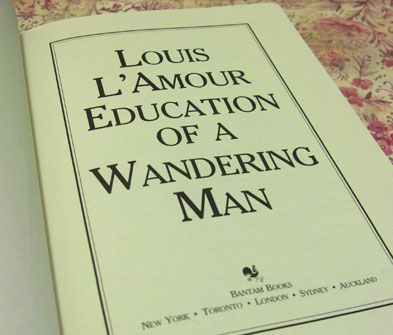
Education of a Wandering Man by Louis L’Amour

Education of a Wandering Man

This is about as close as an L’Amour fan will come to an autobiography. This is not a western novel, though it gives great insight into how he wrote and researched his books. The book starts with a reference to his high school class graduating while he was on a steamer in Indonesia.

L’Amour gives the reader a lengthy discussion of becoming self-educated through books, travel, and experience. I enjoyed the lengthy lists of books L’Amour read during his wandering years in the 30s.

I have logged what I read since reading the book in November 1990. It is a worthy discipline. I also started writing a short, generally no more than on page review of what I read after reading this book. It was the beginning of my writing a review or summary of each book I read.

L’Amour gives a breathtaking discussion of walking out of the Mojave Desert. It reminded me of my time at Fort Irwin, California (about 50 miles north of Barstow in the middle of similar land). L’Amour was a great researcher, and wrote from both personal experience and knowledge.

Disorganized, rambling, and repetitious, it is still an enjoyable book. Louis L’Amour emphasizes the value of education through experience and self-guided reading. He never degrades formal education. Required reading for any aspiring writer must include this book. Read by Jimmie A. Kepler.

Review: Girls Like Us: Carole King, Joni Mitchell, Carly Simon – And the Journey of a Generation

Tonight I watched a new installment of PBS’ My Music series. Founding Supremes singer Mary Wilson served as the host of the program showcasing many classic female singers and girl groups of the 1960s. It showcased seventeen of the singers/groups. Watching it reminded me of the book “Girls Like Us: Carole King, Joni Mitchell, Carly Simon – And the Journey of a Generation” by Sheila Weller that I read a couple of years ago. Here is a review of the book I wrote in August 2011.

The contents of “Girls Like Us: Carole King, Joni Mitchell, Carly Simon–And the Journey of a Generation” by Sheila Weller will be very recognizable to us who came of age in the 1960s and 1970s. Sheila Weller tells us that King, Simon, and Mitchell pushes back the barriers for women specifically, “one song at a time.”

The enigmatic one remains Carole King, whom Weller just can’t shed light on in any significant way. King’s life was amazing then it stopped being of any interest at all. We learn and hear again and again how she wrote all those Brill Building masterpieces before she was 21. We learn how she broke down under the strain of a troubled marriage to a husband and lyricist, Gerry Goffin whom she at married when she was 17 and pregnant by him. We see how she comes through the divorce with an LP, Tapestry, that everyone loved and bought. After that her life is bad men in abundance. They were attracted to her wealth. King once estimated that every time she divorced a man, it cost her a million dollars. Weller gives us all the facts. One still has to wonder why King did this to herself.

Carly Simon, on the other hand seems nearly normal as normal can be for someone of the upper, upper middle class. Though perceptibly spoiled and protected by wealth, Simon doesn’t seem spoiled. Her reactions are always understandable and sympathetic. This includes her meeting and marrying the drug-zombie James Taylor.

Joni Mitchell isn’t sympathetic. She has the integrated persona of the genius totally in love with herself and obsessed with her own reflection, so she’s great in a special way. The author makes fun of Mitchell’s vanity and enormous self-esteem. Weller still lets us know that, in her estimation at any rate, Mitchell actually is amazing.

Weller is interested in the ways women deal with each other. It’s nearly a biography of five people, not just three, as there is so much about James Taylor you will never need to read another word about him if you have this book on your shelf. There is also plenty of material about Judy Collins. Girls Like Us: Carole King, Joni Mitchell, Carly Simon–And the Journey of a Generation is a book that convinces us forcefully in its larger arguments and dazzles with its wide-ranging portraits of artistic life in the 50s, 60s and 70s.

Devotional: Contentment

Carrier Air-conditioner

Waves of heat radiated from the concrete as I leave the cocoon of my day job. Temperatures skyrocket twenty-five to thirty degrees. The hot wind slapping my face reminds me of a blast furnace. Even my eyes burn from its unwanted embrace.

As I enter the parking garage the heat and humidity mix makes me move with a purpose to my Ford Taurus. As soon as the engine starts I turn on the air-conditioner and adjust the fan to a near flash-freeze setting. My body demands immediate relief from the triple-digit inferno.

As I settle into the driver’s seat and my body cooperates by not going into a heat stroke state though I fear heat exhaustion was mere seconds away, I unscrew the cap on my bottle of water. Condensation covered it immediately with sweat when I exited the day job’s building. It’s cool, clear contents help me return to normalcy. The combination of water with the refrigerated air make sure I can survive the hour drive home.

During the trip I notice several drivers sipping from their water bottles. Observation finds no one driving with their windows rolled down. The time and temperature signs signal the dangerous warning as I see triple digit numbers flashing. Some are as high as 111. I am grateful for my air-conditioning. I am blessed as I sip on the cool, clear, chilled water.

As I slow my car to a stop in front of my home, put the transmission in parking gear, turn off the air-conditioning and exit back into the blast furnace I again feel hot wind slapping my face and my eyes burn from its unwanted embrace.

The temperature feels even hotter as I walk to the door that leads into my home. I cool air greets me as I open the door and walk into the entry hall. I closed the door behind me glad I have a barrier between the heat and the cool. And I reflect with amazement remembering my parents, grandparents, and even myself living in the heat without Mr. Willis Haviland Carrier’s wonderful invention.

While we dream of the good old days, it is wise to remember they really weren’t that good. We had no air-conditioned cars, workplaces, schools, businesses, or homes. Heck, we didn’t even have bottled water.

The words of the Apostle Paul from the Bible come to mind. “Not that I speak in respect of want: for I have learned, in whatsoever state I am, therewith to be content.” – Philippians 4:11. I was happy without air-conditioning as a child. I am happy with it as an adult. The key isn’t having or not having it, but to be satisfied. Of course, on a hot day, it is easier to be happy when cool.

Hello, I’m a Writer and Poet

Poetry & Prose Magazine February 2011

I’m Jimmie A. Kepler. I write poetry, nonfiction, science-fiction, historical fiction, and book reviews. You’ll find my blogs and websites are: Speaking of … , Kepler’s Book Reviews, Kepler’s Military History Book Reviews, Kepler’s Military History, and Jimmie A. Kepler – Writer & Poet. You can find a list of my publications and poems at Jimmie’s publications and poems.

I have completed a Christian historical fiction novel, “Honor and Jealousy in Texas.” I support my writing and reading habit by working a day job. I work as a solutions support analyst for a Fortune 500 privately held company. I belong to the Wholehearted Writing group in Dallas.

Reading, poetry and writing are my passions. I grew up in a career United States Air Force family. In my youth, I worked in a grocery store, warehouse, folk-rock band as a rhythm guitar player, a vendor at a major league baseball stadium, and for a milk distributor. I graduated college with a Bachelor of Arts degree in history with minors in English and military science.

I served as a commissioned officer in the United States Army on active duty for three years and then five years in the United States Army Reserves. I graduated from the Infantry Officer Basic Course and Airborne School. I am honorably discharged as a Captain, United States Army Reserves.

Coming off active duty I went to graduate school full-time completing Master of Religious Education/Master of Arts degree. During graduate school, I worked as a custodian, day laborer, painter, preschool teacher, and as a route auditor for a soft drink distributor. For 16 years, I worked as a director of education and private school principal. I earned a doctor of education degree in educational administration.

I have been freelance writing over 30 years selling his first article in 1981. I have sold nonfiction magazine and trade journal articles including getting three cover articles. I also have short stories and poems published. I wrote a weekly column for over sixteen years as well over 150 books reviews in the military history genre for several publishers. I have written a historical fiction novel, “Honor and Jealousy in Texas” and am an active member of Wholehearted Writing in Dallas.

In the late 1990s, I went back to college studying computer science completing the core curriculum for the associate of applied sciences in computer systems. I earned CompTIA A+, i-Net+ and Network+ computer certifications as well as induction in for Phi Theta Kappa for academic excellence. While born in Texas, I have lived in Ohio, Illinois, South Carolina, Arizona, New Hampshire, Kansas, Georgia, Louisiana, California, Washington, and Texas. I am married, have three grown children and one grandchild.

Devotional: Two Special Birthdays

Benita, Jimmie, and Kristopher Kepler 1977

July is the birthday of America. July is also my spiritual birthday. What’s that? You don’t know about spiritual birthdays? My physical birthday is the day I was born. It was November 25, 1953 at Brooke Army General Hospital in San Antonio, Texas. My spiritual birthday is when I was born again. It is when I accepted Jesus Christ as my Lord and Savior. It is when I was “saved”.

Did you know being good doesn’t get you to heaven. Being “saved” does. Here’s my story of “being saved”.

On July 11, 1977, my life changed. If you look up that date in history, you will find nothing historically significant happened on that Sunday. It was a noteworthy day to me. That day was the watershed event in my life.

July 1977 found me on active duty as a second lieutenant in the United States Army. I was serving as Battalion Maintenance Officer, 2nd Battalion, 47th Infantry, 9th Infantry Division at Fort Lewis, Washington. Life was good. I had a beautiful, intelligent wife. I had a new son born in January that same year. I had just gotten a commendable rating during an annual general inspection in maintenance. It was the first commendable rating since the division had returned from Vietnam. Named an Outstanding Junior Officer of the Ninth Infantry Division because of the commendable rating, I received an offer of a regular army commission. My career was going great.

I always tried being the best I could be, and doing what was right. I was a detail-oriented perfectionist, high-achieving, and a workaholic. I excelled at most things I did. However, after all of this, I still had an empty, unsatisfied, void, and alone feeling. Beginning in my college years I tried drinking, women, materialism, partying, and hanging-out with the right crowd to fill this unexplained need I had. I knew something was missing from my life.

I was attending church. I noticed a group of men that seemed to have what I was missing. I attended a Bible study with them. Here I found that God has given us an important manual for life — the Bible. He has the answers to the problems and emptiness we may face. I found out I was here for a purpose, and not by accident. I learned Jesus loves me, and desires to have a personal relationship with me. However, sin separated me from Him.

I realized I had a sin problem. The Bible says, “For all have sinned and fall short of the glory of God.” – Romans 3:23 But no one is perfect! We have all sinned and therefore cannot save ourselves by simply living a good life. Why?

I learned there was a penalty to be paid for my sin. The Bible says, “For the wages of sin is death, but the gift of God is eternal life in Christ Jesus our Lord.” – Romans 6:23

I learned God gives us a promise. The Bible says, “For God so loved the world, that he gave his only begotten Son, that whosoever believeth in him shall not perish, but have everlasting life.” John 3:16.

I learned that God made provision for me. The Bible says, “If you confess with your mouth, ‘Jesus is Lord,’ and believe in your heart that God raised Him from the dead, you will be saved. For it is with your heart that you believe and are justified, and it is with your mouth that you confess and are saved. – Romans 10:9-10

I prayed to accept the gift of eternal life through Jesus. I prayed, “Jesus, I know that I am a sinner. I believe that You died for my sins and rose from the grave so that I might have eternal life in Heaven with You. I willingly repent of my sins and ask you to come into my heart and life. Take control of my words, thoughts, and actions. I place all of my trust in You for my salvation. I accept You as my Lord and Savior, and this free gift of eternal life. Amen.”

Since then my life has not been perfect. It’s been far from it. I have messed up from time to time, sometimes failing miserably in my decisions and choices. However, I have had direction and purpose in my life. I know where I am headed. I have the Bible to give me the principles for daily living. I am never alone. I have had real peace for the last 36 years.

How about you? Have you ever been “saved”? You can do like I did. Romans 10:9-10, 13 tells us, “That if thou shalt confess with thy mouth the Lord Jesus, and shalt believe in thine heart that God hath raised him from the dead, thou shalt be saved. For with the heart man believeth unto righteousness; and with the mouth confession is made unto salvation. … For whosoever shall call upon the name of the Lord shall be saved.”

Why I Write

George_Orwell_in_Hampstead_-_geograph.org.uk_-_432863Today is Thursday March 21, 2013. 

In 1946, George Orwell (his real name was Eric Arthur Blair) wrote an essay titled “Why I Write”. It detailed his personal journey to becoming a writer. Orwell lists “four great motives for writing” which he feels exist in every writer. He explains that all are present, but in different proportions, and also that these proportions vary from time to time. They are as follows:

1. Sheer egoism – Orwell argues that many people write simply to feel clever, to “be talked about, to be remembered after death, to get your own back on grown-ups in childhood, etc.” He says that this is a great motive, although most of humanity is not “acutely selfish”, and that this motive exists mainly in younger writers. He also says that it exists more in serious writers than journalists, though serious writers are “less interested in money”.
2. Aesthetic enthusiasm – Orwell explains that present in writing is the desire to make one’s writing look and sound good, having “pleasure in the impact of one sound on another, in the firmness of good prose or the rhythm of a good story.” He says that this motive is “very feeble in a lot of writers” but still present in all works of writing.
3. Historical impulse – He sums this up by simply stating this motive is the “desire to see things as they are, to find out true facts and store them up for the use of posterity.”
4. Political purpose – Orwell writes, “No book is genuinely free from political bias”, and further explains that this motive is used very commonly in all forms of writing in the broadest sense, citing a “desire to push the world in a certain direction” in every person. He concludes by saying that “the opinion that art should have nothing to do with politics is itself a political attitude.”

After reading the essay, I came up with my list. They are as follows:

1. Ego/Hubris – I love to see my name listed as the author. I enjoy when my name appears on the cover of a magazine and in the table of comments of a magazine. I wish to see my name on the spine of a traditionally published book.
2. Educating People – I have loved when I have published a magazine article then get a telephone call, letter, or email asking for more information on the subject. Sometimes because of my writing, I have received job offers and speaking engagements. I enjoy informing people about historical events, writer’s lives, and the backgrounds of people and events.
3. Desire to influence others and be held in esteem by others – Maybe this goes with number one – Hubris. I recall the pride my oldest son had when he went to college and found several of my traditionally published magazine articles while doing research. He said it was somewhat cool to quote his father’s published work in a research paper. He said some of what I wrote for journals would be in the library forever.
4. Sharing my faith – I remember reading the late musician and former Beatles guitarist George Harrison’s memoir, “I, Me, Mine”. In the book, he says he purposefully wrote songs to share his beliefs and faith in Hare Krishna. I do the same to share my faith and belief in Jesus Christ. I try to do it in the normal flow of life as opposed to clobbering someone with the Bible.

If you write, why do you write?

Encourage your friends, keep reading and write.
Jimmie A. Keple
r

Photo credits: This file is licensed under the Creative Commons Attribution-Share Alike 2.0 Generic license. English: George Orwell in Hampstead On the corner of Pond Street and South End Road, opposite the Royal Free Hospital. The bookshop has long gone. Date: 11 May 2007. Source: From geograph.org.uk

Devotional: You Are Never Too Old To Go For Your Dream

Jeremiah 33:3. It reads, “Call upon Me, and I will answer you, and show you great and mighty things, which you do not know!” Has God placed in your heart the desire to share His truth through writing? God has never called a person without providing him or her with the ability to complete the task or the place to excercise the call. Maybe, like me, you have a few years of life experience under your belt (coade for getting up there in years). It’s never too late to begin. Here are a few examples of older people made a big impact or accomplished remarkable things (with a few years under their belts).

“The world stands aside,” said David Jordan, “to let anyone pass who knows where he is going.” Having a goal or dream applies to those, who learn where they are going late in life as well as for the young.

At age 40, James Michener published his first book. He authored more than 50 titles – 26 historical fiction novels, 31 nonfiction books, and 13 of his works were adapted into TV mini-series or made into movies.

At age 53, Margaret Thatcher became Britain’s first female prime minister.

At age 65, Winston Churchill became British prime minister for the first time and started the epic struggle against Hitler. Churchill received the Nobel Prize for Literature in 1953 at age 79 for his many published works, especially his six-volume set The Second World War. He wrote the six volume set when he was in his 70s without any assistance or ghost writers. The photo is of Sir Winston Churchill.

At age 69, Ronald Reagan was elected President of the United States. He served two terms. He was 77 years old when he completed his second term in office.

At age 70, 80 and again at 90, former President of the USA George H.W. Bush parachuted out of an airplane.

At age 72, Golda Meir became prime minister of Israel.

At age 75, Ed Delano of California bicycled 3100 miles in 33 days to attend his 50th college reunion in Worcester, Massachusetts.

At age 80, Grandma Moses, who had started painting in her late 70s, had her first one-woman exhibit.

At age 80, Winston Churchill returned to the House of Commons as a member of parliament and also exhibited 62 of his paintings.

At age 81, Benjamin Franklin skillfully mediated between disagreeing factions at the U. S. Constitutional Convention.

At age 90, Sarah had a son named Issac. God found Sarah and her husband Abraham useful to His cause. See Genesis 17:17 KJV, “Then Abraham fell upon his face, and laughed, and said in his heart, Shall a child be born unto him that is an hundred years old? and shall Sarah, that is ninety years old, bear?” God promised Abraham and Sarah that they would have a son, and Isaac was born.

At age 96, George C. Selbach scored an 110-yard hole-in-one at Indian River, Michigan.

On his 100th birthday, ragtime pianist Eubie Blake exclaimed, “If I’d known I was going to live this long, I’d have taken better care of myself.”

How about you? Have you slowed down, packed it in, given up, and checked out? If I know the Heavenly Father, I know that He has something wonderful still in store for you! It’s never too late. Why don’t you call God up and ask Him what that might be. His number is found in The Bible in Jeremiah 33:3. It reads, “Call upon Me, and I will answer you, and show you great and mighty things, which you do not know!”

Encourage your friends, keep reading and write.
Jimmie A. Keple
r

Picture Source:
Churchill V sign HU 55521.jpg This artistic work created by the United Kingdom Government is in the public domain. This is because it is one of the following: 1) It is a photograph created by the United Kingdom Government and taken prior to 1 June 1957; or 2) It was commercially published prior to 1961, or 3) It is an artistic work other than a photograph or engraving (e.g. a painting) which was created by the United Kingdom Government prior to 1961.