Poem: Is Johnny Crawford from “The Rifleman” in Your Company?

Chuck_Connors_Johnny_Crawford_The_Rifleman_1960

Is Johnny Crawford from “The Rifleman” in Your Company?

We pressed our faces up against the chain linked fence.
We were supposed to be playing soccer during physical education class.
But we ran to the chained linked fence that separated our school yard from the dirt road.
We stared at the young soldiers marching to training.
They looked so army soldier in their fatigues, helmets and carrying their rifles at right shoulder arms.
They looked like a scene out of “Combat” that we watched each week on our televisions.
While barely just four or five years older than us, they looked all grown up.
A pretty seventh grade girl got up he courage and yelled,
“Is Johnny Crawford from “The Rifleman” in your company?”
There had been a news story of Johnny Crawford’s arrival at Fort Bliss for his basic training.
A kind three stripe sergeant responded,
“No miss, he’s in a different training company.”
“You boys going to Viet-Nam after basic?” asked the P.E. coach who had walked over and joined us.
“Maybe so, but first we got to survive this!” said a smiling boyish faced trainee.
“Quiet in the ranks!” screamed the drill sergeant.
The dust was getting thicker as the soldiers continued marching by.
Most of the seventeen and eighteen year old troopers were looking at the pretty thirteen year old blonde girl.
Some were thinking of their younger sisters back home,
Some were thinking the thoughts seventeen and eighteen years old young men have when seeing a pretty, young teenage girl, and
Some were wondering if they would live long enough to fall in love, marry, and ever have a daughter of their own.

Copyright © 2008 by Jimmie A. Kepler
Originally published in http://www.johnnycrawford.com, February 2008.

Photo credits:

Top photo: Photo of Chuck Connors as Lucas McCain and Johnny Crawford as his son, Mark, from the television program The Rifleman. This work is in the public domain in that it was published in the United States between 1923 and 1977 and without a copyright notice.

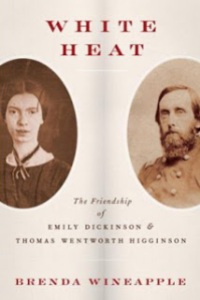
White Heat – The Friendship of Emily Dickinson and Thomas Wentworth Higginson

White HeatHe had seen men enslaved, and seen death in battle on a terrible scale. So when a young, unknown poet named Emily Dickinson wrote to ask whether he thought her verse was “alive”, Thomas Wentworth Higginson – a critic for The Atlantic Monthly and a decorated Union veteran – knew he was seeing poetry that lived and breathed like nothing he had seen before.

Higginson was immediately awed by Emily Dickinson, and went on to become her editor, mentor, and one of the reclusive poet’s closest confidantes. The two met only twice, but exchanged hundreds of deeply personal letters over the next twenty-five years; they commented on each other’s work, mulled over writers they admired, and dazzled each other with nimble turns of phrase. After she died, he shepherded the first collected edition of her poetry into publication, and was a tireless champion of her work in his influential Recent Poems column for The Nation.

Later generations of literary scholars have dismissed Higginson as a dull, ordinary mind, blaming him for the decision to strip some of the distinctive, unusual structure from Dickinson’s poems for publication. However, Brenda Wineapple offers a portrait of Higginson that is far beyond ordinary. He was a widely respected writer, a fervent abolitionist, and a secret accomplice to John Brown’s raid on Harpers Ferry; wounded in the first year of the Civil War, he returned to service as colonel of the first federally-authorized regiment of former slaves. White Heat reveals a rich, remarkable friendship between the citizen soldier and the poet, a correspondence from which Dickinson drew tremendous passion and inspiration – and which she credited, more than once, with saving her life.

Brenda Wineapple is the author and editor of five books, including the award-winning Hawthorne: A Life and Sister Brother: Gertrude and Leo Stein. Her essays, articles, and reviews have appeared in The American Scholar, The New York Times Book Review, Parnassus, Poetry, and The Nation. She teaches in the MFA programs at Columbia University and The New School in New York.

My Writer’s Group

Our writing group! Minus a couple of key members.

One way a writer can improve his odds of traditional publication is having an established writer as a mentor. Writing groups can also encourage and mentor. Let me share an example of the influence a mentor.

In 1919 a young veteran returned from World War I. He moved to Chicago moving into a certain neighborhood for the purpose of being close to the author Sherwood Anderson.

The young beginning writer liked the critical praise for Anderson and his book Winesburg, Ohio. He had heard that Sherwood Anderson was willing to help aspiring writers. He worked to met Anderson. The two men became close friends. They met almost every day to read newspapers, magazines, and novels. They dissected the writings they read.

The aspiring writer brought his own works for critique having Anderson help him improve his craft. Anderson went as far as introducing the want-to-be writer to his network of publishing contacts. The aspiring writer did okay with his first book The Sun Also Rises. The aspiring writer was Ernest Hemingway.

Sherwood Anderson didn’t stop there. He moved to New Orleans where he met another aspiring writer. He took the young man through the same steps and paces of the craft. They shared an apartment. He even invested $300 in getting this writer’s first book Soldier’s Pay published. This young author was William Faulkner. Faulkner’s teacher was the encouragement of learning from how others crafted their work.

Anderson would later move to California and repeat the process with John Steinbeck. Thomas Wolfe and Erskine Caldwell were also mentored by Sherwood Anderson. Ray Bradbury says Winesburg, Ohio was on his mind when he wrote The Martin Chronicles. He basically wrote Winesburg, Ohio placing it on the planet Mars.

Only Mark Twain has had a greater influence in shaping modern American writing than Sherwood Anderson. Anderson didn’t do too badly, did he? William Faulkner, Ernest Hemingway and John Steinbeck each won the Nobel Prize for Literature and there are multiple Pulitzer Prizes between them.

If you are serious about writing find a mentor or join a writing group. My writer’s group and critique group keep me motivated. My writer’s group and group’s member are the best thing that happened to me in 2012.

Devotional: Joy to the World

Joy to the World!

The words and lyrics of the old Christmas carol ‘Joy to the World’ were written in 1719 by Isaac Watts (1674-1748). Joy to the World is a popular Christmas carol which is based on Psalm 98 in the Bible. The father of John Watts was a Non-conformist and so extreme were his views that he was imprisoned twice. His father’s influence over Isaac was demonstrated when he choose to attend Non­conformist Academy at Stoke Newington in preference to a University. Watts was ordained as a Pastor of an Independent congregation. He wrote many hymns and Carols and was awarded a Doctor of Divinity degree by the the University of Edinburgh in 1728. The music to the carol is by George Frederick Handel (1685-1759).

Joy to the World
by Isaac Watts

Joy to the world, the Lord is come!
Let earth receive her King;
Let every heart prepare Him room,
And Heaven and nature sing,
And Heaven, and Heaven, and nature sing.

Joy to the world, the Savior reigns!
Let men their songs employ;
While fields and floods, rocks, hills and plains
Repeat the sounding joy,
Repeat, repeat, the sounding joy.

No more let sins and sorrows grow,
Nor thorns infest the ground;
He comes to make His blessings flow
Far as the curse is found,
Far as, far as, the curse is found.

He rules the world with truth and grace,
And makes the nations prove
The glories of His righteousness,
And wonders of His love,
And wonders, wonders, of His love.

A Visit from St. Nicholas

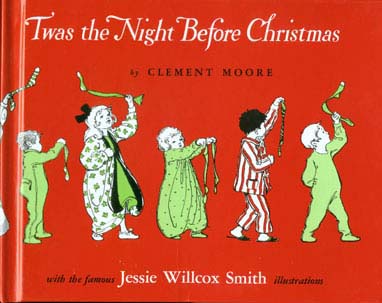
Twas the Night Before Christmas

It’s Sunday, December 23, 2012. On this date in 1823 the Troy Sentinel (a New York state newspaper) published the poem “A Visit from St. Nicholas”.

A Visit from St. Nicholas
by Clement Clark Moore

‘Twas the night before Christmas, when all through the house
Not a creature was stirring, not even a mouse;
The stockings were hung by the chimney with care,
In hopes that St. Nicholas soon would be there;
The children were nestled all snug in their beds,
While visions of sugar-plums danced in their heads;
And mamma in her ’kerchief, and I in my cap,
Had just settled our brains for a long winter’s nap,
When out on the lawn there arose such a clatter,
I sprang from the bed to see what was the matter.
Away to the window I flew like a flash,
Tore open the shutters and threw up the sash.
The moon on the breast of the new-fallen snow
Gave the lustre of mid-day to objects below,
When, what to my wondering eyes should appear,
But a miniature sleigh, and eight tiny reindeer,
With a little old driver, so lively and quick,
I knew in a moment it must be St. Nick.
More rapid than eagles his coursers they came,
And he whistled, and shouted, and called them by name;
“Now, Dasher! now, Dancer! now, Prancer and Vixen!
On, Comet! on, Cupid! on, Donder and Blitzen!
To the top of the porch! to the top of the wall!
Now dash away! dash away! dash away all!”
As dry leaves that before the wild hurricane fly,
When they meet with an obstacle, mount to the sky;
So up to the house-top the coursers they flew,
With the sleigh full of Toys, and St. Nicholas too.
And then, in a twinkling, I heard on the roof
The prancing and pawing of each little hoof.
As I drew in my head, and was turning around,
Down the chimney St. Nicholas came with a bound.
He was dressed all in fur, from his head to his foot,
And his clothes were all tarnished with ashes and soot;
A bundle of Toys he had flung on his back,
And he looked like a pedler just opening his pack.
His eyes—how they twinkled! his dimples how merry!
His cheeks were like roses, his nose like a cherry!
His droll little mouth was drawn up like a bow
And the beard of his chin was as white as the snow;
The stump of a pipe he held tight in his teeth,
And the smoke it encircled his head like a wreath;
He had a broad face and a little round belly,
That shook when he laughed, like a bowlful of jelly.
He was chubby and plump, a right jolly old elf,
And I laughed when I saw him, in spite of myself;
A wink of his eye and a twist of his head,
Soon gave me to know I had nothing to dread;
He spoke not a word, but went straight to his work,
And filled all the stockings; then turned with a jerk,
And laying his finger aside of his nose,
And giving a nod, up the chimney he rose;
He sprang to his sleigh, to his team gave a whistle,
And away they all flew like the down of a thistle,
But I heard him exclaim, ere he drove out of sight,
“Happy Christmas to all, and to all a good-night.”

Poem: I Get Up In The Morning

I Get Up In The Morning

I get up in the morning
A new day begins
I go the mirror
And shave my face again

The years show my age
But my eyes still shine
I think of my lady
I’m so glad she’s still mine

I go to my workplace
And I do my thing
I listen to Pandora
And I start to sing

The day passes quickly
My tasks all complete
I drive to the restaurant
And order tea that’s sweet

The evening meal is fine
As fine as fine can be
And my desert
Is something for all to see

I return to my house
Now the day is done
I sit on the porch
And watch the setting sun

The day is now over
And I go to bed
I say my prayers
And meditate on Scripture in my head

I pray that my dreams
Have me thinking of you
And in my slumber
My dreams come true

I get up in the morning
A new day begins
I go to the mirror
And shave my face again.

Jimmie A. Kepler
© 2008

Originally published in:
WORDS..RHYMES..POETRY & PROSE!

Devotional: A Personal Writing Mission Statement

I am currently attending the East Texas Christian Writer’s Conference at East Texas Baptist University in Marshall, Texas. Yesterday at the conference we received a two-part challenge. First, “as Christian writers” write a “personal writing mission statement”. Second, share it with someone to get their response. Well, I always do my homework on time. I’m sharing what I wrote with you …

My personal writing mission statement:

• sharing Jesus Christ and his teachings with an emphasis on the application of His lessons to everyday life,
• encouraging the development of poets and writers, and
• promoting appreciation of the liberal arts.

Poem: Little Squirrel


Little Squirrel

Little squirrel
In the tree
I see you
Looking at me

Your color is red
In your furry coat
You look at me
Sitting in the boat

You’re eating the acorns
Found in the tree
A smile on your face
Dropping the shells on me!

© 2009 Jimmie A. Kepler

Originally published in:
WORDS..RHYMES..POETRY & PROSE
May 2011

Meet the Poets: Mona Van Duyn – Pulitzer Prize in Poetry 1991 and Poet Laureate of the United States of America 1992

Mona Jane Van Duyn (May 9, 1921 – December 2, 2004) was an American poet. She won every major American award for poetry and was appointed Poet Laureate Consultant in Poetry to the Library of Congress in 1992.

In 1921, Mona Van Duyn was born in Waterloo, Iowa, and raised in the small town of Eldora, Iowa.

She received degrees from Iowa State Teachers College and the University of Iowa. It was there she met Jarvis Thurston, whom she married in 1943, and with whom she founded Perspective, a Quarterly of Literature in 1947, a publication she co-edited until 1975.

Van Duyn’s first collection of poems, Valentines to the Wide World (Cummington Publishing), was published in 1959, followed by A Time of Bees, which appeared as part of the University of North Carolina Press Contemporary Poetry Series in 1964.

She became close friends with the poet James Merrill, and from 1964 through 1981 the two engaged in regular correspondence, which included exchanging poems by mail.

In 1970, Van Duyn published To See, To Take (Atheneum), which received the National Book Award in 1971, followed by Bedtime Stories (Ceres Press, 1972). Her later collections include: Selected Poems (Knopf, 2003); Firefall (1994); If It Be Not I: Collected Poems, 1959-1982 (1994); Near Changes (1990), for which she won the Pulitzer Prize; Letters From a Father, and Other Poems (Atheneum, 1982); and Merciful Disguises (1973), which includes the bulk of her first four books.

About her work, the poet Alfred Corn has said, “Mona Van Duyn has assembled, in a language at once beautiful and exact, one of the most convincing bodies of work in our poetry.” Cynthia Zarin has called her poetry “notable for its formal accomplishment and for its thematic ambition,” adding that the “searching intelligence of the persona we have learned to know in her poems, combined with the humor, technical ease, and the blend of the abstract and the quotidian that the poet has made her own have resulted in that rare good thing: a strong, clear voice, original without eccentricity.”

Van Duyn was awarded the Bollingen Prize, the Hart Crane Memorial Award, the Ruth Lilly Prize, the Loines Prize of the National Institute of Arts and Letters, the Shelley Memorial Prize, and both the Harriet Monroe Memorial Prize and the Eunice Tietjens Award from Poetry magazine, as well as fellowships from The Academy of American Poets, the American Academy of Arts and Sciences, the Guggenheim Foundation, and the National Endowment for the Arts.

Van Duyn has said, “I believe that good poetry can be as ornate as a cathedral or as bare as a pottingshed, as long as it confronts the self with honesty and fullness. Nobody is born with the capacity to perform this act of confrontation, in poetry or anywhere else; one’s writing career is simply a continuing effort to increase one’s skill at it.”

She was elected a Chancellor of the Academy of American Poets in 1985, and served as the first woman Poet Laureate of the United States from 1992 to 1993, the year she was inducted into the St. Louis Walk of Fame.

Mona Van Duyn died of bone cancer on December 1, 2004, in St. Louis, Missouri, where she had lived since 1950.

Selected Bibliography

Valentines to the Wide World (Cummington Publishing, 1959)
A Time of Bees (University of North Carolina Press, 1964)
To See, to Take (Antheneum, 1970)
Bedtime Stories (Ceres Press, 1972)
Merciful Disguises: Poems Published and Unpublished (Atheneum, 1973)
Letters from a Father, and Other Poems (Atheneum, 1982)
Near Changes (Knopf, 1990) – Pulitzer Prize 1991
If It Be Not I: Collected Poems (Knopf, 1992)
Firefall (Knopf, 1992)
Selected Poems (Knopf, 2002)

Sources: http://en.wikipedia.org/wiki/Mona_Van_Duyn and http://www.poets.org/poet.php/prmPID/169


Meet the Poets: Bob Dylan – 2008 Pulitzer Prize: Special Awards and Citations

The Pulitzer Prize jury in 2008 awarded Bob Dylan a special citation for “his profound impact on popular music and American culture, marked by lyrical compositions of extraordinary poetic power.”

PERSONAL INFORMATION
Birth: May 24, 1941 in Duluth, Minnesota, United States.
Occupation: Singer, musician.
Family: son of Abe Zimmerman and Beatrice Rutman; m. Sara Lownds (or Lowndes), Nov. 22, 1965 (div. June 19, 1977); children: Jakob, Jesse, Samuel, Anna, Maria; m. Carolyn Y. Dennis, June 4, 1986 (div. Oct. 1992); 1 child, Desiree Gabrielle.
Education: self-taught; student, U. Minn., 1960; Music Dept., Princeton U., 1970.
Avocations/Research/Interests: Achievements include devising and popularizing folk-rock.
Addresses: Office, Columbia Records, 550 Madison Ave, New York, NY, 10022-3211.

AWARDS
Named to Rock and Roll Hall of Fame, 1988.
recipient Lifetime Achievement Award, Grammy Awards, 1991.
Prince of Asturias Arts award, Prince of Asturias Found, 2007.

WORKS
Musician: (albums) Bob Dylan, 1962; The Freewheelin’ Bob Dylan, 1963; The Times They Are A-Changin’, 1964; Another Side of Bob Dylan, 1964; Bringing It All Back Home, 1965; Highway 61 Revisited, 1965; Blonde on Blonde, 1966; John Wesley Harding, 1967; Bob Dylan’s Greatest Hits, 1967; Nashville Skyline, 1969; Self Portrait, 1970; New Morning, 1970; Bob Dylan’s Greatest Hits, Vol. 2, 1971; Dylan, 1973, Planet Waves, 1974; Blood on Tracks, 1975; Desire, 1976; Hard Rain, 1976; Street Legal, 1978; Masterpieces, 1978; Slow Train Coming, 1979 (Grammy Award for Best Male Rock Vocal Performance for “Gotta Serve Somebody”, 1980); Bob Dylan At Budokan, 1979; Saved, 1980; Shot of Love, 1981; Infidels, 1983; Real Live, 1984; Empire Burlesque, 1985; Biograph, 1985; Knocked Out Loaded, 1986; Down In The Groove, 1988; Oh Mercy, 1989; Under the Red Sky, 1990; The Bootleg Series, Vols. 1-3: (Rare and Unreleased 1961-1991), 1991; Good as I Been to You, 1992; World Gone Wrong, 1993 (Grammy Award for Best Traditional Folk Album, 1994); Bob Dylan’s Greatest Hits, Vol. 3, 1994; MTV Unplugged, 1995; Time Out of Mind, 1997 (Grammy Award for Album of Yr., 1998, Grammy Award for Best Contemporary Folk Album, 1998; Grammy Award for Best Male Rock Vocal Performance for “Cold Irons Bound”, 1998); The Best of Bob Dylan, 1997; The Bootleg Series, Vol. 4: The Royal Albert Hall Concert, 1998; Essential Bob Dylan, 2000; The Best of Bob Dylan, Vol. 2, 2000; The Very Best of Bob Dylan, 2000; Love and Theft, 2001 (Grammy Award for Best Contemporary Folk Album, 2002); The Bootleg Series, Vol. 5, Live 1975; The Rolling Thunder Revue, 2002; The Bootleg Series, Vol. 6: Live 1964, 200;, The Bootleg Series, Vol. 7: No Direction Home: The Soundtrack, 2005, Live at the Gaslight 1962, 2005; Modern Times, 2006 (Grammy Award for Best Contemporary Folk Album, Best Solo Rock Vocal Performance, 2007); musician: (with various artists) The Concert for Bangladesh, 1971 (Grammy Award for Album of Year, 1973); Bob Dylan 30th Anniversary Concert Celebration, 1993; musician: (with The Band) Before the Flood, 1974; The Basement Tapes, 1976; musician: (with Grateful Dead) Dylan and the Dead, 1988; musician: (with Traveling Wilburys) Traveling Wilburys Vol. 1, 1988 (Grammy Award for Best Rock Performance by a Duo or Group with Vocal, 1990); Traveling Wilburys Vol. 3, 1990; musician: (soundtracks) Pat Garrett and Billy the Kid, 1973; The Last Waltz, 1976; Wonder Boys, 2000 (Academy Award for Best Original Song for “Things Have Changed”, 2001); Masked and Anonymous, 2003.

Composer: (songs) Like a Rolling Stone and over 500 more.
Dir., editor: (films) Eat the Document, 1972.
Appeared in: (documentaries) Don’t Look Back, 1967; No Direction Home, 2005
Actor: (films) Pat Garret and Billy the Kid, 1973; Hearts of Fire, 1987; actor, composer, dir., editor, writer (films) Renaldo and Clara, 1978; actor, composer, writer Masked and Anonymous, 2003.
Actor: (TV films) The Madhouse on Castle Street, 1963.
Author: Tarantula, 1971; Writings and Drawings, 1973; Tarantula: Poems, 1994; (book of sketches) Drawn Blank, 1994; (memoirs) Chronicles, Vol. 1, 2004 (Quills award-biography/memoir, 2005).

SOURCE CITATION
“Bob Dylan.” Marquis Who’s Who™, 2008.
http://www.pulitzer.org/biography/2008-Special-Awards-and-Citations