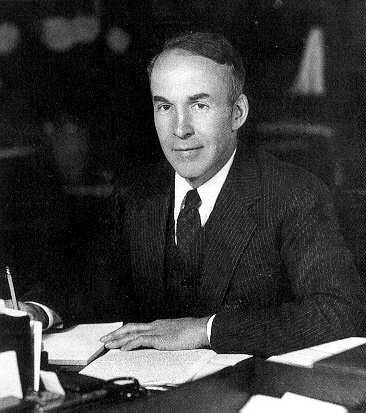
Meet the Poets: Archibald MacLeish – Pulitzer Prize in Poetry 1933, 1953, and 1959.

Archibald MacLeish was born in Glencoe, Illinois, on 7th May 1892. After graduating from Yale University in 1915 and two years later his first book of poems, Tower of Ivory, was published.

MacLeish he joined the United States Army in 1917. He served in France as a field artillery officer during the First World War and during the summer of 1918 took part in the2nd Battle of the Marne. On his return to the United States MacLeish resumed his studies and received a law degree from Harvard Law School in 1919 and became a lawyer in Boston.

In 1923 MacLeish gave up his legal career and decided to tour Europe. During this period he published several books of poetry including The Happy Marriage (1924), The Pot of Earth (1925), Streets in the Moon (1926), The Hamlet of A. MacLeish (1928) and New Found Land(1930). He also wrote two plays, Nobodaddy and Panic which dealt with the Wall Street Crash.

MacLeish worked as editor of Fortune Magazine (1929-1938) but continued to write poetry.Conquistador (1932) won the Pulitzer Prize and His Frescoes for Mr. Rockefeller’s City (1933) was described by one critic as campaign poetry for Franklin D. Roosevelt and the New Deal. MacLeish also joined the League for Independent Political Action. The group, that included Lewis Mumford and John Dewey, promoted alternatives to a capitalist system they considered to be obsolete and cruel.

In August 1936 MacLeish wrote an article for New Masses where he urged the United States government to support the republicans in the Spanish Civil War. Along with John Dos Passos, Lillian Hellman and Ernest Hemingway, MacLeish helped to finance The Spanish Earth, a documentary film about the war.

MacLeish came into conflict with Henry Luce, the owner of Fortune Magazine, and Laird Goldsborough, the foreign affairs editor of Time Magazine, also part of the Luce’s growing media empire. George Teeple Eggleston, who worked for the company at the time, has claimed that it was Goldsborough who persuaded Luce to support General Francisco Franco during the Spanish Civil War. According to Eggleston: “Time’s conservative foreign news editor, Laird Goldsborough, promptly slanted all news stories in his department in favor of General Franco’s rebel insurgents.” Eggleston argued that MacLeish “promptly bombarded Luce memos denouncing Franco’s coalition of landowners, the Church, and the army”. Goldsborough responded by arguing: “On the side of Franco are men of property, men of God, and men of the sword. What positions do you suppose these sorts of men occupy in the minds of 700,000 readers of Time?… They resent communists, anarchists, and political gangsters – those so-called Spanish Republicans.”

MacLeish also joined other left-wing writers in the League of American Writers. Other members included Erskine Caldwell, Upton Sinclair, Malcolm Cowley, Clifford Odets, Langston Hughes, Carl Sandburg, Carl Van Doren, David Ogden Stewart, John Dos Passos, Lillian Hellman and Dashiell Hammett. MacLeish wrote at the time: “The real struggle of our time was not between communism and fascism but the much more fundamental struggle between democratic institutions on the one side and all forms of dictatorship, whatever the dictator’s label, on the other.”

MacLeish took a keen interest in world affairs and The Fall of the City (1937), a radio play about the growth of fascism in Europe, obtained a large audience in the United States. In April 1938 MacLeish published Land of the Free. The book included 338 lines of a poem by MacLeish and 88 photographs by Dorothea Lange, Walker Evans, Arthur Rothstein and Ben Shahn. Most of the photographs came from the Farm Security Administration project and dealt with issues such as rural poverty and child labour.

In 1939 President Franklin D. Roosevelt decided to appoint MacLeish as librarian of Congress. Right-wing politicians objected to this proposal and J. Parnell Thomas a member of the House of Un-American Activities, argued that MacLeish was a communist. MacLeish, who had been a harsh critic of the American Communist Party for many years, replied “no one would be more shocked to learn I am a Communist than the Communists themselves.” When the vote was taken in the Senate, sixty-three voted for MacLeish (eight voted against and twenty-five abstained) and he was appointed.

During the Second World War MacLeish wrote for the New Republic. He was also head of the Office of Facts and Figures. This brought him into conflict with J. Edgar Hoover, who tried to stop him employing left-wing figures such as Malcolm Cowley. Hoover complained that Cowley had been “associated with various Liberal and Communist groups.” In January 1942, MacLeish replied that the FBI agents needed a course of instruction in history. “Don’t you think it would be a good thing if all investigators could be made to understand that Liberalism is not only not a crime but actually the attitude of the President of the United States and the greater part of his Administration?”

MacLeish was unaware that he was also under investigation by Hoover and the FBI. The agency was particularly interested in his involvement with the League of American Writers and other anti-fascist groups in the United States and his pro-Russian stance after the bombing of Pearl Harbor. MacLeish’s FBI file eventually ran to six hundred pages, longer than any other writer in the United States.
In November 1944 Franklin D. Roosevelt appointed MacLeish as his assistant secretary of state for cultural and public affairs. Once again right-wing members of the Senate complained about the appointment of MacLeish. The vote was close with forty-three in favour, twenty-five against, and twenty-eight abstaining.

MacLeish’s main task was to promote the idea of the United Nations to the American people. However, the job only lasted a few months as Harry S. Truman decided not to reappoint him after the death of Roosevelt on 12th April 1945.

In October 1952 Joseph McCarthy claimed that MacLeish had belonged to more Communist front organizations than any man he had investigated. Despite coming under increasing pressure, MacLeish bravely defended his left-wing friends during the McCarthyism era. A play about the irrational fear of communism, The Trojan Horse, appeared in 1952.

MacLeish was appointed professor of rhetoric and oratory at Harvard University in 1949. Other books by MacLeish include Poetry and Journalism (1958), Poetry and Experience (1961), The Collected Poetry of Archibald MacLeish (1963), The Dialogues of Archibald MacLeish and Mark Van Doren (1964), The Wild Old Wicked Man and Other Poems (1968), The Human Season (1972) and Riders on the Earth (1978).

Archibald MacLeish died in Boston on 20th April, 1982.

Source: http://www.spartacus.schoolnet.co.uk/USAmacleish.htm and http://en.wikipedia.org/wiki/Archibald_MacLeish


Meet the Poets: Elizabeth Bishop – Pulitzer Prize in Poetry 1956 and Poet Laureate of the United States of America 1949 -1950

Elizabeth Bishop (February 8, 1911 – October 6, 1979) was an American poet, short-story writer, and recipient of the 1976 Neustadt International Prize for Literature. She was the Poet Laureate of the United States from 1949 to 1950, the Pulitzer Prize winner for Poetry in 1956 and the National Book Award winner in 1970. Elizabeth Bishop House is an artists’ retreat in Great Village, Nova Scotia dedicated to her memory. She is considered one of the most important and distinguished American poets of the 20th century.

Influences

Bishop was greatly influenced by the poet Marianne Moore to whom she was introduced by a librarian at Vassar in 1934. Moore took a keen interest in Bishop’s work, and at one point Moore dissuaded Bishop from attending Cornell Medical School, in which the poet had briefly enrolled herself after moving to New York City following her Vassar graduation. It was four years before Bishop addressed “Dear Miss Moore” as “Dear Marianne,” and only then at the elder poet’s invitation. The friendship between the two women, memorialized by an extensive correspondence (see One Art), endured until Moore’s death in 1972. Bishop’s “At the Fishhouses” (1955) contains allusions on several levels to Moore’s 1924 poem “A Grave.”

She was introduced to Robert Lowell by Randall Jarrell in 1947 and they became great friends, mostly through their written correspondence, until Lowell’s death in 1977. After his death, she wrote, “our friendship, [which was] often kept alive through years of separation only by letters, remained constant and affectionate, and I shall always be deeply grateful for it”. They also both influenced each other’s poetry. Lowell cited Bishop’s influence on his poem “Skunk Hour” which he said, “[was] modeled on Miss Bishop’s ‘The Armadillo.'” Also, his poem “The Scream” is “derived from…Bishop’s story In the Village.” “North Haven,” one of the last poems she published during her lifetime, was written in memory of Lowell in 1978.

Literary Style and Identity

Bishop did not see herself as a “lesbian poet” or as a “female poet.” Although she still considered herself to be “a strong feminist,” she only wanted to be judged based on the quality of her writing and not on her gender or sexual orientation. Also, where some of her notable contemporaries like Robert Lowell and John Berryman made the intimate, often sordid details of their personal lives an important part of their poetry, Bishop avoided this practice altogether. For instance, like Berryman, Bishop struggled with alcoholism and depression throughout her adult life; but Bishop never wrote about this struggle (whereas Berryman made his alcoholism and depression a focal point in his dream song poems).

In contrast to this confessional style involving large amounts of self-exposure, Bishop’s style of writing, though it sometimes involved sparse details from her personal life, was known for its highly detailed and objective, distant point of view and for its reticence on the sordid subject matter that obsessed her contemporaries. In contrast to a poet like Lowell, when Bishop wrote about details and people from her own life (as she did in her story about her childhood and her mentally unstable mother in “In the Village”), she always used discretion.

Although she was generally supportive of the “confessional” style of her friend, Robert Lowell, she drew the line at Lowell’s highly controversial book The Dolphin (1973), in which he used and altered private letters from his ex-wife, Elizabeth Hardwick (whom he’d recently divorced after 23 years of marriage), as material for his poems. In a letter to Lowell, dated March 21, 1972, Bishop strongly urged him against publishing the book, writing, “One can use one’s life as material [for poems]–one does anyway—but these letters—aren’t you violating a trust? IF you were given permission—IF you hadn’t changed them. . .etc. But art just isn’t worth that much.”

Later Career

In addition to winning the Pulitzer Prize, Bishop won the National Book Award and the National Book Critics Circle Award as well as two Guggenheim Fellowships and an Ingram Merrill Foundation grant. In 1976, she became the first woman to receive the Neustadt International Prize for Literature, and remains the only American to be awarded that prize.

Bishop lectured in higher education for a number of years starting in the 1970s when her inheritance began to run out. For a short time she taught at the University of Washington, before teaching at Harvard University for seven years. She often spent her summers in her summer house in the island community of North Haven, Maine. She taught at New York University, before finishing at the Massachusetts Institute of Technology. She commented “I don’t think I believe in writing courses at all… It’s true, children sometimes write wonderful things, paint wonderful pictures, but I think they should be discouraged.”

In 1971 Bishop began a relationship with Alice Methfessel. Never a prolific writer, Bishop noted that she would begin many projects and leave them unfinished. She published her last book in 1976, Geography III. Three years later, she died of a cerebral aneurysm in her apartment at Lewis Wharf, Boston. She is buried in Hope Cemetery in Worcester, Massachusetts. Alice Methfessel was her literary executor.

Awards and Honors

1945: Houghton Mifflin Poetry Prize Fellowship
1947: Guggenheim Fellowship
1949: Appointed Consultant in Poetry at the Library of Congress
1950: American Academy of Arts and Letters Award
1951: Lucy Martin Donelly Fellowship (awarded by Bryn Mawr College)
1953: Shelley Memorial Award
1954: Elected to lifetime membership in the National Institute of Arts and Letters
1956: Pulitzer Prize for Poetry
1960: Chapelbrook Foundation Award
1964: Academy of American Poets Fellowship
1968: Fellow of the American Academy of Arts and Sciences
1968: Ingram-Merrill Foundation Grant
1969: National Book Award
1969: The Order of the Rio Branco (awarded by the Brazilian government)
1974: Harriet Monroe Poetry Award
1976: Books Abroad/Neustadt International Prize
1976: Elected to the American Academy of Arts and Letters
1977: National Book Critics Circle Award
1978: Guggenheim Fellowship

Elizabeth Bishop’s Poetry Collections :

North & South (Houghton Mifflin, 1946)
Poems: North & South/A Cold Spring (Houghton Mifflin, 1955)
A Cold Spring (Houghton Mifflin, 1956)
Questions of Travel (Farrar, Straus, and Giroux, 1965)
The Complete Poems (Farrar, Straus, and Giroux, 1969)
Geography III, (Farrar, Straus, and Giroux, 1976)
The Complete Poems: 1927–1979 (Farrar, Straus, and Giroux, 1983)
Edgar Allan Poe & The Juke-Box: Uncollected Poems, Drafts, and Fragments by Elizabeth Bishop ed. Alice Quinn, (Farrar, Straus, and Giroux, 2006)

Sources: http://www.poemhunter.com/elizabeth-bishop/biography/ and http://en.wikipedia.org/wiki/Elizabeth_Bishop

Poem: Earthlings

Earthlings

Astronauts William Andres,
Jim Lovell, and Frank Borman
Read the creation story
From Genesis in the Bible
As they orbited the moon.
We saw what the moon
And good earth looked like
From outer space …
And the crew
Of Apollo 8 closed with
“good night, good luck,
a Merry Christmas,
and God bless all of you –
all of you on the good Earth.”
At that moment
We were all Earthlings.

Wednesday, December 25, 1968
Jimmie Aaron Kepler

Another of the oldest poems I have written by me. It is from the notebooks and papers my mother gave me about a year ago. I was in high school at DeSoto High School, DeSoto, Texas.  My family was spellbound watching the events and moved to tears when they read from the Bible. The next Sunday at Calvary Baptist Church my pastor, Rev. Henry Odle made a big deal about the Bible reading from space … we all did.

Writer’s Life : My Writing Report Card

My writing report card for July: I was rejected by: Poetry Magazine, The New Yorker, and Asimov’s Science Fiction. I was accepted by: vox poetica. The poem Urban Pigeons will be in their August 26, 2012 issue. I had a book review in this month’s Front Row Lit magazine. I have four submissions currently pending with other publications. Note – you will never get rejected … or accepted if you don’t write and submit.

Meet the Poets: Maxine Kumin – Pulitzer Prize in Poetry 1973 and Poet Laureate of the United States of America 1981 -1982

Maxine Kumin (born June 6, 1925) is an American poet and author. She was appointed Poet Laureate Consultant in Poetry to the Library of Congress in 1981–1982. She received her BA and MA from Radcliffe College.

She has published numerous books of poetry, including Where I Live: New & Selected Poems 1990-2010 (W. W. Norton, 2010); Still to Mow (2009); Jack (2003); The Long Marriage (2003); Bringing Together (2003); Connecting the Dots (1996); Looking for Luck (1992), which received the Poets’ Prize; Nurture (1989); The Long Approach (1986); Our Ground Time Here Will Be Brief (1982); House, Bridge, Fountain, Gate (1975); and Up Country: Poems of New England (1972), for which she received the Pulitzer Prize in 1973.

She is also the author of a memoir, Inside the Halo and Beyond: The Anatomy of a Recovery (W. W. Norton, 2000); four novels; a collection of short stories; more than twenty children’s books; and five books of essays, most recently The Roots of Things: Essays (Northwestern University Press, 2009) and Always Beginning: Essays on a Life in Poetry (Copper Canyon Press, 2000).

She has received the Aiken Taylor Award for Modern Poetry, an American Academy of Arts and Letters award, the Sarah Joseph Hale Award, the Levinson Prize, a National Endowment for the Arts grant, the Eunice Tietjens Memorial Prize from Poetry, and fellowships from The Academy of American Poets, and the National Council on the Arts.

She has served as Consultant in Poetry to the Library of Congress and Poet Laureate of New Hampshire, and is a former Chancellor of the Academy of American Poets. She lives in New Hampshire.

Source: http://www.poets.org/poet.php/prmPID/94

More information: http://en.wikipedia.org/wiki/Maxine_Kumin

Poem: The Year 2000 Is Only 30 Years Away

The Year 2000 Is Only 30 Years Away

It’s Thursday and 1970 starts today as the 60s are now in the past
In the Cotton Bowl we will watch Texas play Notre Dame
After we watch the Cotton Bowl and Tournament of Roses Parades
And the reporter just said the year 2000 is only 30 years away

Soon I will graduate high school and start college
I sure hope I never have to go to Viet-Nam
And I can’t help but still be amazed that just last July
Our American astronauts really walked on the moon

I wonder what the future holds in store for me
In the 2000s that are so, so far away
Will I vacation on the moon or maybe on Mars?
Will I marry? What will be my job? Where will I live?

I love to study history, to read and write
A poet and author is all I want to grow-up and be
But a doctor, dentist, or accountant is what I think my parents want me to be
I might apply to Congressman Teague for an appointment to the US Air Force          Academy

January 1, 1970
Jimmie Aaron Kepler

This is one of the oldest poems I have written by me. It was in notebooks and papers my mother gave me about a year ago. I was in the eleventh grade at DeSoto High School, DeSoto, Texas. I remember writing this one. I had attended an all night New year’s Eve party at my church, Calvary Baptist Church, getting home around sunrise. My father made me get up to watch the parades and be ready for the Cotton Bowl football game. I remember Texas won and were named national champions. I sat writing this poem and thinking about the future. I remember one of the announcers for the parade said something about the year 2000 being only 30 years away and that the kids in school today would be living in the 2000s. His words got me to writing.

Meet the Poets: Gwendolyn Elizabeth Brooks – Pulitzer Prize for Poetry 1950 and Poet Laureate of the United States of America 1985

Gwendolyn Elizabeth Brooks was born on June 17, 1917 in Topeka Kansas. She was the older of two children born to Keziah and David Brooks. The same year of her birth she and her family moved to Chicago where she has resided her entire life.

Brooks’ mother discovered her gift for writing at the early age of seven. She promptly encouraged this talent by exposing Gwendolyn to various forms of literature. Her parents, however were very strict and she was not allowed to play with the kids in the neighborhood.

As a child she lacked the sass and brass of the other girls in her class and became very isolated. As a result, she made few friends while in school. When Brooks was at home in her room she often created a world of her own by reading and writing stories and poetry.

Due to her lack of social skills she became very shy and continued to be shy throughout her adult life. After graduating from high school she went on to Wilson Junior College and graduated in 1936. In 1939 she was married to Henry Blakely and they had two children, Henry junior and Nora Blakely. In 1945 Gwendolyn Brooks’ first book entitled A Street In Bronzeville was published. In 1949 Annie Allen was published and received the Pulitzer Prize for poetry in 1950, becoming the first African American to receive this prestigious award in poetry. In 1953 Brooks’ first novel is published Maud Martha. In 1963 she published Selected Poems and secured her first teaching job at Chicago’s Columbia College.

In 1967 at the Fisk University Writers Conference in Nashville, Brooks met the new black revolution. She came from South Dakota State College, which was all white, where she was received with love. Now she had arrived at an all black college where she was now coldly respected. After this trip Brooks says that she is no longer asleep she is now awake. After 1967 she became aware that other blacks feel that way and are not hesitant about saying it. She appeals to her people for understanding and is more conscious of them in her writing. In 1968 she published her next major collection of poetry, In the Mecca. The effect of her awakening is noticeable in her poetry. Brooks is less concerned with poetic form, and uses mostly free verse.

In 1968 she was named poet laureate for the state of Illinois and was also the first African American to receive an American Academy of Arts and Letters Award in 1976. She was appointed Poet Laureate Consultant in Poetry to the Library of Congress (commonly known as United States Poet Laureate) in 1985. Since then, Gwendolyn Brooks has gone on to receive over fifty honorary doctorates from numerous colleges and universities.

Brooks died of cancer at the age of 83 on December 3, 2000, at her home on Chicago’s South Side. She is buried at Lincoln Cemetery in Blue Island, Illinois.

Source: http://www.uta.edu/english/tim/poetry/gb/Gwendolyn4.html
For more information see: http://en.wikipedia.org/wiki/Gwendolyn_Brooks

Meet the Poets: Phyllis McGinley – 1961 Pulitzer Prize for Poetry

“The Velvet Hand

I call that parent rash and wild
Who’d reason with a six-year child,
Believing little twigs are bent
By calm, considered argument.

In bandying words with progeny,
There’s no percentage I can see,
And people who, imprudent, do so,
Will wonder how their troubles grew so.

Now underneath this tranquil roof
Where sounder theories have their proof,
Our life is sweet, our infants happy.
In quietude dwell Mammy and Pappy.

We’ve sworn a stern, parental vow
That argument we won’t allow.
Brooking no juvenile excess here,
We say a simply No or Yes, here,

And then, when childish wails begin
We don’t debate.
We just give in.”

–Phyllis McGinley

Phyllis McGinley (March 21, 1905 – February 22, 1978) was an American author of children’s books and poetry. She studied at the University of Southern California and the University of Utah in Salt Lake City where she was a Kappa Kappa Gamma, graduating in 1927, then moved to New York City. She wrote copy for an advertising agency, then taught at a junior high school in New Rochelle, New York for one year, until her career as a writer and poet took off.

Her poetry was in the style of light verse, specializing in humor and satiric tone. She embraced domesticity in the wake of second-wave feminism, wrote light verse in the wake of the rise of modern avant-garde and confessional poetry, and filled the gap between the housewife and feminist intellectual who rejected the domestic life. McGinley actually labeled herself a “housewife poet,” and unlike Anne Sexton who used the term to be ironic and self-deprecating, McGinley used it as an honorable and purposefully crafted identity. She wrote mainly for white, middle-class, educated women and her work was published prolifically in periodicals, including the New Yorker and Ladies’ Home Journal. In her poetry, McGinley humorously depicts a life that revolves around the children and routine of domesticity.

Though her work as largely faded into the annuls of history, McGinley was a hugely popular author in her time and she was the recipient of many literary prizes, including a Pulitzer Prize in 1961 for her “Times Three” piece. In 1964 she was honored with the Laetare Medal by the University of Notre Dame (described as ‘An honor to a man or woman who has “enriched the heritage of humanity”‘). She also holds nearly a dozen honorary degrees – “including one from the stronghold of strictly masculine pride, Dartmouth College” (from the dust jacket of Sixpence in Her Shoe (copy 1964)). Time Magazine featured McGinley on the magazine’s cover on June 18, 1965.
She moved to Larchmont, New York in 1937 with her husband, Charles Hayden, and raised two daughters there, singing the praises of domesticity and small town suburbia for nearly 40 years. McGinley died in New York City in 1978.

Source and more information: http://en.wikipedia.org/wiki/Phyllis_McGinley and http://wellversedmom.wordpress.com/2011/04/06/day-6-of-national-poetry-month-the-velvet-hand-by-phyllis-mcginley/

Meet the Poets: Audrey Wurdemann – 1935 Pulitzer Prize for Poetry

“I walk in ambush bright
With terror and delight,
The savage lovely beast
Pacing within my breast,
The proud heart being more
Proud than it was before
For having in its hold
A prize of living gold.” — from Bright Ambush by Audrey Wurdemann

Audrey Wurdemann (January 1, 1911 – May 20, 1960) was an American poet. She was the youngest winner of the Pulitzer Prize for Poetry at the age of 24, for her collection Bright Ambush. She was the great-great-granddaughter of Percy Bysshe Shelley (see note below). She never attended grammar school, and entered high school at the age of 11.

Her first collection of poetry, ‘The House of Silk’ was published when she was 16, sponsored by California poet George Sterling. She was a 1931 honors graduate of the University of Washington. After college she traveled through Asia.

She married poet and novelist Joseph Auslander in 1932 and moved to New York City, where he taught at Columbia. They moved to Washington, DC when Auslander was appointed the first Poet Laureate Consultant in poetry of the Library of Congress; they lived at 3117 35th Street Northwest, Washington, D.C., in the Cathedral Heights neighborhood.

She subsequently collaborated with him on the novels My Uncle Jan and The Islanders. They spent their last years living in Coral Gables, Florida.
Her work appeared in Harper’s, and Poetry magazine. Their papers are held at the University of Miami.

Her husband was Joseph Auslande, the first person to serve as Poet Consultant at the Library of Congress and the longest serving (1937 to 1941). Auslander published six volumes of poems; his best known is The Unconquerables (1943), poems addressed to the German-occupied countries of Europe.

Note: Percy Bysshe Shelley (4 August 1792 – 8 July 1822) was one of the major English Romantic poets and is critically regarded as among the finest lyric poets in the English language. Shelley was famous for his association with John Keats and Lord Byron. The novelist Mary Shelley (née Godwin) was his second wife.

For more information on Audrey Wurdemann see: http://en.wikipedia.org/wiki/Audrey_Wurdemann and http://dcwriters.poetrymutual.org/pages/auslander-wurdemann.html

Meet the Poets: Amy Lawrence Lowell – 1926 Pulitzer Prize for Poetry

“A man must be sacrificed now and again to provide for the next generation of men.” — Amy Lowell

Amy Lawrence Lowell (February 9, 1874 – May 12, 1925) was an American poet of the imagist school from Brookline, Massachusetts who posthumously won the Pulitzer Prize for Poetry in 1926.

Paul Lauter says of Lowell “. . . becomes interesting in our conflicted and tense cultural moment because she was not in any sense ‘free’ either to express her sexuality or to police it. She could not have the confidence—or perhaps bravado—of overseas 1920s lesbian communities, or even of the more modest bohemianism of the Village. On the contrary, at the center of many of her most interesting poems, like ‘Venus Transiens,’ are painfully contradictory impulses toward revelation, display, or even a certain form of ‘flaunting,’ and hiding, a poetics of the closet.”

from “Amy Lowell and Cultural Borders.” In Speaking the Other Self: American Women Writers. Ed. Jeanne Campbell Reesman. Copyright 1997 by The University of Georgia Press.

Source: http://www.english.illinois.edu/maps/poets/g_l/amylowell/about.htm

For more information on Amy Lowell: http://poems.writers-network.com/poet/amy-lowell-29.